Choosing toys for a five-year-old means balancing imagination, learning, and active fun. The selections below cover pretend play, problem solving, physical activity, and creative expression—all popular for this age. Each item is designed to spark curiosity while supporting motor skills, coordination, and social play. Read on to discover five strong options with clear, kid-friendly features that align with how five-year-olds learn and play.
| Product | Brand | Age Range |
|---|---|---|
| Meland Toy Doctor Kit | Meland | 3–6 years |
| Mini Explorer Voice Changer | Mini Explorer | 3–8+ years |
| Let’s Go Fishin’ Game | Pressman | 4+ years |
| Hungry Hungry Hippos Game | Hasbro Gaming | 4+ years |
| KingsDragon RC Robot | KingsDragon | 3–8 years |
Meland Doctor Kit For Imaginative Play

The Meland Doctor Kit is a comprehensive pretend-play set designed to encourage role play as a pediatrician or nurse. The package includes a doctor coat, hat, carrying bag, stethoscope, syringe, thermometer, and more. This selection aims to broaden a child’s healthy knowledge and reduce anxiety about visits by simulating typical checkups. The set also includes a plush toy and nurse attire that can enhance storytelling during playtime, making it a practical option for budding caregivers and future healthcare professionals.
Features emphasize realistic tools and dress-up elements to support immersive scenarios. Children can practice listening to a heartbeat, taking temperatures, and managing basic patient care with safe, age-appropriate props. The kit’s variety helps maintain engagement over multiple play sessions, fostering memory skills and vocabulary as kids describe what they’re doing and why.
Educational value blends with social play, as kids often invite dolls or family members to participate. The kit can support early science and biology concepts in a gentle, approachable way. For caregivers, it offers a structured, low-prep activity that can be used for pretend play themes, storytelling, and even basic health education in a fun setting.
Mini Explorer Voice Changer: Creative Sound Play
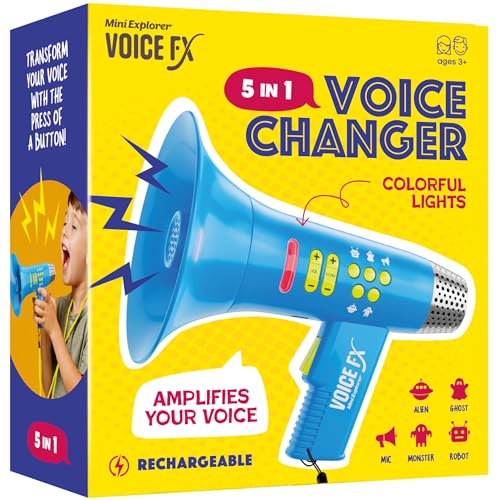
Designed for curious kids who love making sounds, the Mini Explorer Voice Changer offers four distinct voice modes—Alien, Ghost, Monster, and Robot—with an optional standard mic mode. This device encourages vocal experimentation and imaginative role play, making it suitable for storytelling sessions, pretend radio broadcasts, or character play in puppetry and theater games.
The device operates with rechargeable power, reducing the need for frequent battery changes, and includes USB charging for longer playtime. Users can adjust volume and echo to refine their preferred sound, enabling quiet storytelling or high-energy performances. The toy is compact and portable, facilitating play on the go or in small indoor spaces.
From a developmental perspective, the voice changer supports language development, expressive language skills, and listening attention. It also invites collaborative play as children swap roles, create dialogues, and perform for friends or family, strengthening social interaction and cooperative storytelling.
Let’s Go Fishin: Classic Hand-Eye Coordination

The Let’s Go Fishin game from Pressman introduces a fast-paced fishing mechanism that encourages hand-eye coordination and quick thinking. Players use mini fishing poles to catch as many fish as possible before the timer runs out, adding a competitive element while keeping the play accessible for younger children. The game is simple to learn, enabling quick setup and seamless transitions between rounds, which helps sustain engagement for five-year-olds with shorter attention spans.
Educational benefits include counting skills, color recognition, and strategic decision-making as players decide which fish to target and how to maximize their score. The cooperative aspect—taking turns and cheering for others—fosters social skills and good sportsmanship. The compact nature of the set makes it suitable for family game night or classroom activities, reinforcing early math readiness in a playful context.
Hungry Hungry Hippos: Marble-Chomping Fun

Hungry Hungry Hippos is a quick, action-packed game that’s ideal for preschoolers and early elementary learners. The objective is simple: each player selects a hippo and uses a lever to gobble marbles launched into a central pond. The instant marble reloading system keeps the pace high and ensures rapid rounds, which helps maintain excitement for younger players who crave fast feedback and visible results.
As a social activity, the game supports turn-taking and verbal interaction as kids discuss strategies, cheer for teammates, and count marbles at the end of each round. The portable design allows play in various spaces, from living rooms to classrooms, promoting group fun and active movement during game time. The straightforward rules make it accessible to five-year-olds while still offering enough competition to keep them engaged.
KingsDragon RC Robot: Entry-Level Coding And Gesture Play

The KingsDragon RC Robot combines remote control with gesture sensing for an interactive play experience. This programmable robot can respond to hand gestures to turn, move, and patrol, with additional actions that users can program through a simple input. The LED eyes add a playful, tech-forward appeal, reinforcing curiosity about robotics and automation while encouraging motor planning and sequencing skills as kids plan moves and see them executed in real time.
The robot’s design uses non-toxic ABS plastic and multi-joint articulation, supporting durability during active play. Its programmable action modes enable a beginner-friendly introduction to basic coding concepts, allowing children to experiment with commands and sequences. The combination of remote and gesture control provides flexible play that can adapt to different spaces and group activities, promoting cooperation and shared problem solving among peers and family members.
Buying Guide: Key Purchase Considerations
When selecting toys for a five-year-old, consider how the toy supports development across cognitive, social, and physical domains. Here are several angles to weigh:
- Imaginative play potential: Look for sets with accessories, costumes, or realistic props that invite storytelling. Items like doctor kits and role-play costumes help children invent scenarios, boosting language and narrative skills.
- Motor skills and coordination: Active games (fishing, archery with suction arrows, Morse-like remote control moves) promote fine and gross motor development while maintaining safety and age appropriateness.
- Rule complexity and independence: Toys with simple rules support autonomy, while gradually introducing more complex instructions can extend engagement and cognitive growth.
- Durability and safety: For this age, toys should be sturdy with non-toxic materials, rounded edges, and age-appropriate components. Check for choking hazards and ensure parts are sized for younger children.
- Social play value: Choose items that encourage cooperative games, turn-taking, and group participation to strengthen social skills and communication.
- Technology balance: If including tech toys (like gesture-controlled robots or voice changers), ensure screen-free play remains central and that tech features are easy to use and safe for kids.
- Storage and portability: Simple, compact designs with easy cleanup help maintain order and sustain interest for short play windows common at this age.
Accessibility considerations include ease of setup, clear instructions, and the ability to adapt toys for one-on-one or small-group play. For households with multiple children, look for items with cooperative variants or scalable rules so siblings can engage together without frustration. Finally, consider how a toy aligns with any current interests—science, animals, sports, or storytelling—to maximize motivation and long-term engagement.