Discover approachable telescopes designed for newcomers and families. This guide highlights five beginner-friendly options that balance ease of use, portability, and solid optical quality. Each pick supports growing interest in night sky exploration with features like smartphone adapters, Barlow lenses, and user-friendly setup. Read on to compare capabilities and find the best starting telescope for learning the basics of astronomy.
| Product | Brand | Key Benefit | Approx Aperture / Focal Length |
|---|---|---|---|
| Gskyer Telescope, 70mm | Gskyer | Great for kids and beginners; includes wireless remote and phone adapter | 70mm / 400mm |
| ToyerBee Telescope, 70mm | ToyerBee | Portable travel scope with easy magnification range | 70mm / 300mm |
| Dianfan Telescope, 90mm | Dianfan | Big aperture for brighter views; beginner-friendly setup | 90mm / 800mm |
| Celestron StarSense Explorer LT 114AZ | Celestron | Smartphone-assisted sky navigation for quick targets | 114mm / reflect |
| NASA Lunar Telescope | Blue Marble | Moon-focused beginner telescope with tabletop tripod | Unknown (90x magnification listed) |
Below are five carefully chosen options that align with the “best beginner telescope” idea, emphasizing simplicity, value, and the ability to grow with an aspiring stargazer.
Gskyer 70mm Refractor Telescope

Overview: The Gskyer 70mm refractor offers a lightweight, portable design well-suited for beginners and kids. Its 400mm focal length and fully coated optics help produce clearer images of the Moon and bright planets. The kit includes two eyepieces and a 3x Barlow lens, boosting magnification to suit a range of targets. A 5×24 finder scope with cross-hair lines helps locate objects, while a wireless remote and smartphone adapter enable easy capture of celestial views.
Key Features:
– 70mm aperture with 400mm focal length for bright views
– Two eyepieces plus 3x Barlow lens for flexible magnification
– 5×24 finder scope with cross-hair for easier alignment
– Wireless remote and phone adapter for photo capture
Ideal For: Beginners seeking a straightforward setup and kid-friendly operation, with expandability as experience grows.
ToyerBee 70mm Refractor Telescope

Overview: This 70mm refractor targets beginners and families with a compact form factor and beginner-friendly features. It includes two eyepieces (H20mm and H6mm) and a 3x Barlow lens to reach 15x–150x magnification. A phone adapter and wireless remote are included to facilitate capturing views of planets and the Moon. The larger aperture helps deliver clearer images and a wider field of view for first-time observers.
Key Features:
– 70mm aperture, 300mm focal length
– 15x to 150x magnification with included eyepieces and 3x Barlow
– Phone adapter and wireless remote for easy imaging
– Suitable for both kids and adults starting out in astronomy
Ideal For: Families and new stargazers who want a portable, easy-to-use telescope with room to grow in magnification.
Dianfan 90mm Refractor Telescope

Overview: With a 90mm aperture and 800mm focal length, the Dianfan telescope provides brighter, more detailed views suitable for beginners and enthusiasts alike. The kit includes two eyepieces and a 3× Barlow lens for magnifications from 32× to 240×. A 45° zenith mirror ensures upright images for terrestrial viewing, adding versatility for starry nights and daytime observation. Setup is designed to be quick, typically under 15 minutes, with smooth focusing for easy target acquisition.
Key Features:
– 90mm aperture, 800mm focal length for brighter images
– 32×–240× magnification with two eyepieces and a 3× Barlow
– 45° zenith mirror for upright terrestrial viewing
– Beginner-friendly assembly and operation
Ideal For: Beginners who want clearer lunar details and an accessible entry into more advanced deep-sky viewing as confidence grows.
Celestron StarSense Explorer LT 114AZ
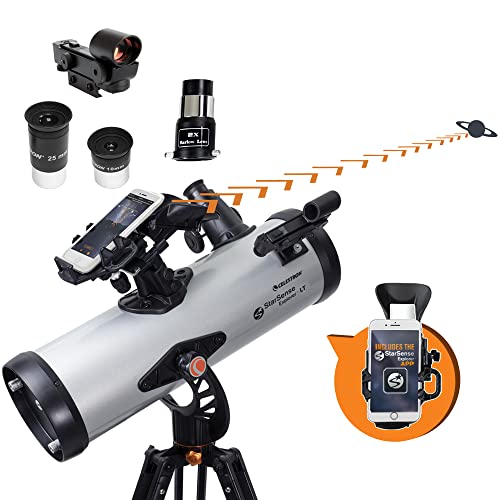
Overview: The StarSense Explorer LT 114AZ uses smartphone-powered sky mapping to simplify star hopping. By docking a phone into the built-in star finder and launching the StarSense app, users receive guided, on-screen arrows to point toward celestial targets. This model integrates patented sky recognition technology that analyzes star patterns to determine the telescope’s position and align the view with planets, nebulae, and star clusters based on time and location.
Key Features:
– 114mm Newtonian reflector for brighter views
– StarSense app with sky recognition technology
– On-screen guided targeting for quick celestial discovery
– Phone dock enables seamless astronomy on iPhone and Android
Ideal For: Beginners who want a modern, app-assisted experience to quickly locate and observe a variety of targets.
NASA Lunar Telescope for Kids
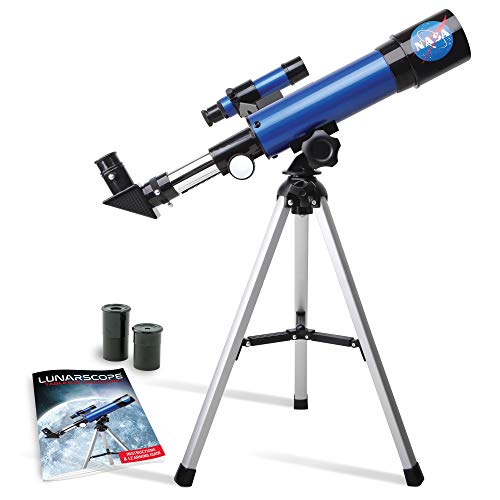
Overview: This NASA-branded Lunar Telescope focuses on lunar observation with a tabletop tripod and finder scope. It’s designed as a kid-friendly entry into space exploration, offering 90x magnification via included eyepieces and a straightforward setup. The kit emphasizes ease of use for young learners while delivering a visually engaging path to exploring the Moon’s surface in greater detail.
Key Features:
– Lunar-focused viewing with two eyepieces
– Tabletop tripod and smooth mount system
– Easy setup ideal for kids and family use
– Educational NASA-branded design
Ideal For: Families seeking a Moon-centric beginner telescope that introduces basic observing habits and scientific curiosity.
Buying Guide: Key Purchase Considerations
Choosing the right beginner telescope involves balancing portability, ease of use, and potential for growth. Consider the following factors:
- Apperture and light gathering: Larger apertures (like 90mm) gather more light for crisper views of the Moon, Jupiter’s bands, and Saturn’s rings, but also increase weight and cost. For beginners, 70–90mm apertures are a solid starting point.
- Focal length and magnification: Longer focal lengths provide higher theoretical magnification, but actual useful magnification is governed by optics quality and seeing conditions. Start with low to moderate magnification and add a Barlow lens if you need more reach.
- Mount type and stability: Equatorial mounts can be more precise but are tougher for beginners; alt-azimuth mounts are intuitive for casual viewing. A stable tripod with smooth movement improves the observing experience.
- Ease of setup: Look for models that assemble quickly, include clear instructions, and offer quick-look targets (like the Moon) to build confidence.
- Accessory ecosystem: Phone adapters, remote shutters, and finder scopes expedite learning and image capture, turning stargazing into an activity that the whole family can enjoy.
- App and software support: Models with smartphone apps for star-hopping or alignment can reduce setup time and enhance the learning curve for new observers.
- Portability and storage: Lightweight, compact designs suit travel and school use; consider whether you need a backpack or carry bag for on-the-go astronomy.
Assessment across the five highlighted options shows a mix of traditional optical tubes with manual aiming and modern, app-assisted experiences. For families and brand-new stargazers, the Gskyer and ToyerBee models deliver straightforward foundational use. The Dianfan setup adds brightness with a larger aperture while remaining approachable. The Celestron StarSense Explorer LT uses advanced smartphone navigation to simplify first targets. The NASA Lunar Telescope provides a Moon-focused entry point that’s especially engaging for kids. Each option supports learning, exploration, and gradual skill-building without overwhelming a beginner.