The night sky offers endless opportunities to explore planets, stars, and distant nebulae. This guide highlights five highly capable telescopes that balance beginner friendliness with strong optical performance, making them ideal for stargazing enthusiasts across ages. Each model features practical accessories such as phone adapters, tripods, and carrying bags to support on-the-go observations.
Summary of selected products
| Product | Brand | Key Feature | Best For |
|---|---|---|---|
| Gskyer 70mm Refractor with AZ Mount | Gskyer | 70mm aperture, 400mm focal length, wireless remote | Beginner stargazers and travel |
| Monocular 80×100 HD with Tripod | KTBDING | 80x magnification, 100mm objective, smartphone adapter | Quick outdoor viewing and portability |
| MEEZAA 90mm Refractor | MEEZAA | 90mm aperture, 800mm focal length, multi-coated optics | Beginner to intermediate astronomy |
| EACONN 80mm Refractor | EACONN | 80mm aperture, rough adjustment gimbal, phone adapter | Clear optics with easy aiming |
| ToyerBee 70mm Refractor | ToyerBee | 70mm aperture, 300mm focal length, wireless remote | Kids and beginners starting out |
Gskyer 70mm Refractor With AZ Mount Overview

The Gskyer telescope uses a 70mm aperture and 400mm focal length, delivering bright views of the Moon and bright planets. The fully coated optics glass lens enhances light transmission for clearer images, while the included wireless remote enables easy capture of celestial scenes. Two eyepieces expand magnification options, and a 3x Barlow lens multiplies magnification for close-up lunar details. A 5×24 finder scope with a crosshair assists object location, making this a solid starter instrument for budget-minded beginners.
KTBDING 80×100 Monocular With Tripod
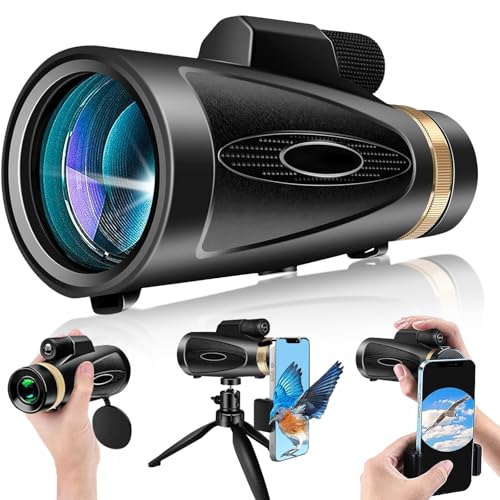
This high-powered monocular offers 80x magnification with a large 100mm objective lens for bright, expansive views. Fully multi-coated lenses and a BAK-4 prism optimize light transmission and reduce refraction loss. The quick-position smartphone adapter and included tripod allow stable photography on the go, making it ideal for travelers who want long-distance observation without a heavy setup.
MEEZAA 90mm Refractor For Astronomy

The MEEZAA telescope features a 90mm aperture and 800mm focal length, providing superior light gathering for brighter astronomical images. It includes two eyepieces (10 mm and 25 mm) plus a 3x Barlow lens, enabling a wide magnification range (up to 240x). Fully multi-coated optics improve brightness and clarity, while the AZ mount and included tripod simplify setup for beginners and enthusiasts exploring deep-sky targets and lunar details.
EACONN 80mm Refractor For Kids And Adults

With an 80mm aperture, this telescope captures more light for brighter, clearer images. It features rough adjustment and a positioning gimbal with scale to help users aim more comfortably. The kit includes two eyepieces (K20mm and K9mm), a 5×24 finder scope, and a dedicated smartphone adapter. The design emphasizes ease of use, assembly, and stable imaging, appealing to beginners who want straightforward operation and dependable optics.
ToyerBee 70mm Refractor For Beginners

The ToyerBee telescope offers a 70mm aperture and 300mm focal length, balancing light collection with portability. It includes a wireless remote and a phone adapter to capture images on the go, making it a practical option for families and beginners who want an affordable yet capable stargazing tool. With 15X-150X magnification through two eyepieces and a 3x Barlow lens, observers can explore planets, the Moon, and brighter deep-sky objects while learning telescope basics.
GALAEYES 80mm Refractor For Astronomy

The GALAEYES 80mm aperture telescope offers sharp, true-to-life color with high- transmission coatings. The 600mm focal length supports clear planetary and lunar views, while the erect-image prism enables both celestial and terrestrial observing. A smartphone adapter allows quick photo captures, and the included portable bag enhances transport. The instrument is designed for beginners who desire reliable optics and straightforward alignment for astronomy and sightseeing alike.
HEXEUM 80mm Portable Refractor
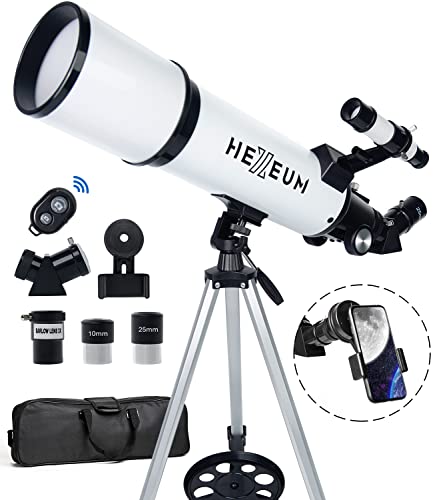
The HEXEUM telescope features an 80mm aperture and 600mm focal length with fully multi-coated optics for bright, crisp views. The package includes two eyepieces (25mm and 10mm) for versatile magnification (24X and 60X) plus a 3x Barlow lens. A lightweight aluminum tripod and wireless remote support mobile photography, and the carry bag makes this option convenient for travel and outdoor sessions, especially for beginners seeking portability without sacrificing image quality.
Buying Guide
- Apature and focal length balance: Larger apertures (around 80mm) gather more light for brighter images, but compact kits around 70mm are lighter and more portable for beginners.
- Optics and coatings: Fully multi-coated optics and low-dispersion glass reduce glare and improve brightness and contrast, especially in ambient light.
- Mount type: Alt-azimuth (AZ) mounts are simple and intuitive for beginners, while more advanced users may prefer equatorial mounts for tracking celestial objects with less drift.
- Eyepieces and magnification: A pair of eyepieces plus a Barlow lens expands the magnification range. Be mindful that extremely high magnification offers diminishing returns without steady viewing conditions and a stable mount.
- Portability and setup: For travel or family use, consider telescopes with built-in carrying bags, smartphone adapters, and lightweight tripods to encourage ongoing use.
- Accessories: Finderscopes, smartphone adapters, and wireless remotes enhance usability and allow easier capture of images and videos of the night sky.
- Target user: Beginners benefit from simpler, more forgiving optics and straightforward assembly, while those progressing to planetary detail or lunar features may prioritize higher aperture and multispectral coatings.
- Budget and durability: Plastic-bodied beginners’ models are affordable and light, whereas metal tripods and stronger mounts improve stability for extended sessions.