Robot toys continue to captivate kids with interactive play that blends motion, lights, and sound with basic STEM concepts. This guide highlights five top-rated options that balance friendlier controls, programmable features, and engaging demonstrations. Whether your child enjoys gesture control, voice responses, or dancing robots, these picks offer safe, durable designs and age-appropriate challenges to spark creativity.
| Product | Brand | Key Feature |
|---|---|---|
| KingsDragon RC Robot Toys for Kids | KingsDragon | Gesture sensing, 50 programmable actions |
| Hamourd Robot Toys for Boys & Girls | Hamourd | 2.4GHz remote, tank tracks, auto-demo |
| EduCuties Robot Toys for Kids | EduCuties | Gesture control, 50 actions, interactive |
| Ruko 1088 Smart Robots for Kids | Ruko | Voice control, app control, 10 songs |
| SGILE RC Robot Toys for Kids | SGILE | Gesture sensing, one-button programming |
The following picks emphasize hands-on experimentation, safety, and clear learning outcomes. Each product section provides a concise overview, notable features, and practical insights to help families choose the best fit for their child’s interests and development stage.
KingsDragon Gesture Sensing RC Robot

The KingsDragon robot blends remote control with hand-gesture commands for intuitive play. It supports turning, sliding forward and backward, and has a multi-function mode that includes auto display and obstacle avoidance. Eye LEDs light up blue during movement, enhancing the visual experience. Its programmable mode can store up to 50 actions, enabling kids to sequence moves like turns, walks, patrols, and dances. Made from non-toxic ABS plastic, the robot features articulated joints and sturdy wheels for varied routines. This option suits young builders who enjoy creative choreography and learning basic programming concepts without complex interfaces.
Hamourd RC Emo Robot with Auto-Demonstration
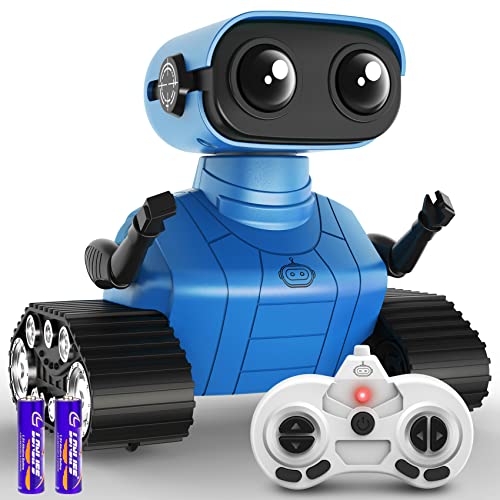
The Hamourd robot combines a friendly design with versatile motion controls through a 2.4GHz remote. It offers track-based movement and auto-demo sequences that spin, dance, and perform together with lighted LED eyes. Voice responses and built-in songs enhance interactive play, while flexible head and arms add expressive potential. The controller enables straightforward operation for beginners, making it a strong option for early RC enthusiasts who want immediate feedback and engaging performances.
EduCuties Programmable Robot with Gesture Sensing

EduCuties emphasizes programming and gesture control in a kid-friendly package. The robot can be steered via infrared or hand gestures, with up to 50 programmable actions. Its LED eyes and durable ABS construction help sustain repeated play. The pre-programmed motion sequences let children experiment with cause-and-effect storytelling, encouraging sequencing and planning skills while maintaining a simple learning curve for newer players.
Ruko 1088 Smart Robot

Ruko 1088 stands out with voice control and app-based interaction, expanding the traditional remote-control experience. It supports multiple forms of play, including gymnastics, storytelling, dancing, and music. At 15.8 inches tall, it presents as a substantial, engaging presence that can grow with a child’s curiosity. The device offers expressive features—ten songs, nine joints, and various interactive modes—that foster creativity, problem-solving, and an early interest in robotics and programming.
SGILE Gesture Sensing Programmable Robot

SGILE offers a compact gesture-sensing robot with one-button programming that can store up to 50 commands. The chest-mounted sensor responds to hand gestures to guide forward, backward, left, and right movements. A built-in patrol mode enables autonomous movement with obstacle avoidance. This model is well-suited for younger kids who prefer straightforward control with a simple learning path toward basic programming concepts and interactive routines.
BAZOLOTA RC Robot with Gesture Sensing
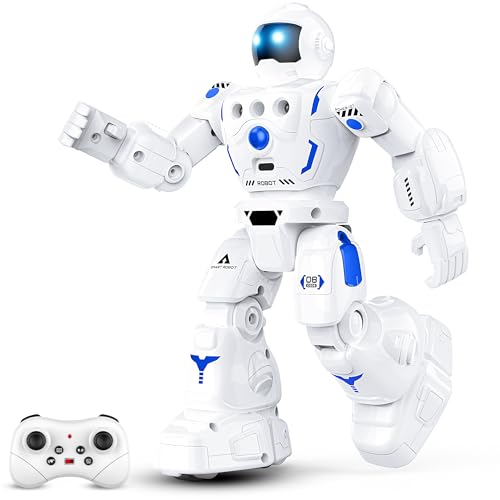
BAZOLOTA emphasizes gesture control with a long 164-foot range for remote commands. The robot can walk, slide, sing, and dance, providing a broad range of performative options. Built-in rechargeable power and USB charging support convenience, while adjustable volume protects hearing in different environments. It suits kids who enjoy performance-based play and longer, interactive sessions with a robot companion.
GILOBABY Robot Toys with LED Eyes

GILOBABY combines a two-part design with LED eyes and flexible limbs for varied poses. The lower chassis uses tank-like tracks for 360-degree rotation and smooth lateral movement. A 2.4 GHz remote enables easy control, while the one-click demonstration feature provides quick routines for younger kids to observe, imitate, and improvise. This model supports early motor skill development and imaginative play.
Buying Guide: Key Purchase Considerations And Comparisons
When selecting a robot toy for kids, consider how the device supports learning, safety, and long-term engagement. Here are practical criteria and comparisons to guide decisions:
- Age appropriateness and safety: Look for durable, non-toxic materials and features designed for the child’s age and motor skills. Parental controls and volume settings help tailor experiences to individual needs.
- Interactivity level: Remote control, gesture sensing, voice commands, and app integration each offer different learning curves. Gesture-based models promote spatial reasoning and fine motor control, while programming modes foster sequential thinking and problem-solving.
- Programming complexity: Models with up to 50 programmable actions provide advancement opportunities. Simpler one-button programming suits younger children, whereas more advanced sequences support older kids in planning and testing ideas.
- Motion and play patterns: Assess whether the toy supports dancing, patrols, obstacle avoidance, or storytelling. A mix of predefined demos and user-generated sequences enhances creativity and attention to detail.
- Durability and maintenance: Consider battery life, charging options, and ease of cleaning. Strong wheels or tracks and impact-resistant casings reduce wear during active play.
- Learning outcomes: Identify toys that promote STEM concepts like sequencing, cause-and-effect reasoning, and basic programming logic without overwhelming the child with complex interfaces.
- Future-proofing: Some models offer app or software updates that expand features over time. This can extend the toy’s relevance as a child’s skills grow.
- Budget and value: Compare not just price, but the range of functions, build quality, and the potential for extended play through multiple modes and activities.
Summary: For beginners, gesture-sensing and one-button programming models provide approachable entry points, while mid-range options with multiple modes (dance, storytelling, songs) offer richer play. Higher-end designs with app control or extensive programmable actions encourage deeper exploration of robotics concepts. Always align the choice with your child’s interests—whether it’s dancing, obstacle courses, or storytelling—and ensure the toy includes safe, age-appropriate controls.