Choosing a programmable robot for a 12-year-old blends entertainment with education. The right kit helps spark interest in coding, robotics, and problem-solving while delivering hands-on fun. Below are five well-rounded options that balance build quality, programming pathways, and diverse play modes to support beginner explorers and advancing tinkerers alike.
Summary Of Chosen Products
| Product | Brand | Key Focus | Programming |
|---|---|---|---|
| Henoda Robot Toys | Henoda | Remote/app control, 468+ pieces, motion & transforming robot | Phone app Bluetooth, 2.4GHz remote |
| Makeblock mBot | Makeblock | Entry-level coding robot, Scratch/Arduino | Scratch, mBlock software |
| Ruko 1088 Smart Robot | Ruko | Large programmable robot, voice/app control | App, voice control, multi-mode |
| ELEGOO UNO R3 Smart Robot Car Kit V4 | ELEGOO | Arduino-based robot car kit, modular parts | Arduino/Android & iOS control via app |
| Makeblock mBot2 | Makeblock | AI learning support, Scratch & Python programming | Block coding, Python, Scratch |
Henoda Robot Toys For 8-16 Year Olds
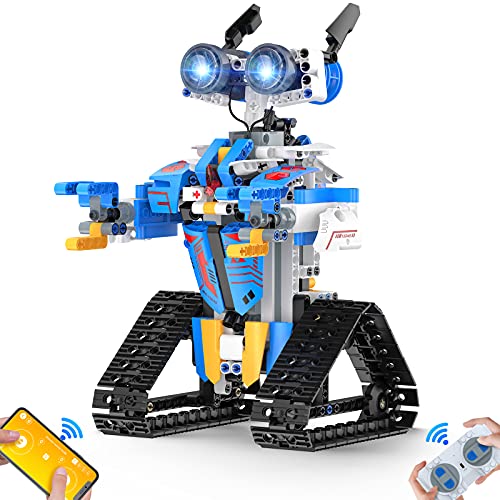
Henoda’s programmable robot set combines STEM-building blocks with versatile control options. The 468+ piece kit supports hands-on construction that enhances hand-eye coordination and practical abilities, aligning with project-based learning. The robot moves in multiple directions, features glowing eyes, and includes flexible joints for transforming motions. A Bluetooth-connected smartphone app enables programming and remote control, while a 2.4GHz remote expands the play modes beyond app interactions. Path mode, voice control, gravity-sensor mode, and stem programming mode provide a broad spectrum of entry points into robotics and coding, with a remote control range over 20 meters for flexible play. The kit is suitable for ages 8 and up, making it a strong choice for pre-teens developing early STEM literacy.
Makeblock mBot Robot Kit

The mBot is an approachable entry point for kids to learn coding and robotics. It blends Scratch-based programming with Arduino foundations, helping children progress from block-based coding to text-based languages. The kit is straightforward to assemble in about 15 minutes, enabling quick wins that sustain interest. Its features include line-following, obstacle avoidance, and remote-control capabilities. Inclusive tutorials and free software (mBlock) accompany the kit, with additional apps available for extended practice. Note that some components require batteries not included, so plan for a small accessory setup to maximize playtime.
Ruko 1088 Smart Robots for Kids

Ruko 1088 offers a larger, more interactive programmable robot experience. Standing at up to 15.8 inches tall, it provides dynamic play with 10 expressions, 9 joints, and 10 songs. The robot supports multiple control modes including voice, app, and preset interaction patterns. Its diverse capabilities—gymnastics, storytelling, dance, music, and recording—encourage imaginative play while introducing basic programming concepts. The emphasis on expressive, lifelike movement provides a tangible bridge to computational thinking and robotics basics suitable for kids in the 8–12 range and beyond.
ELEGOO UNO R3 Smart Robot Car Kit V4

ELEGOO’s UNO R3-based kit is a robust Arduino-centric platform designed for beginners and intermediate builders. It’s a full educational package that includes 24 kinds of module parts such as obstacle avoidance and line-tracing modules, with the option to control via smartphone or tablets running Android or iOS. The assembly is streamlined with standardized interfaces (XH2.54), reducing setup errors and promoting straightforward learning. This kit is ideal for youngsters ready to venture into electronics, robotics, and programming with a strong emphasis on experiential learning and experimentation.
Makeblock mBot2 Coding Robot

mBot2 is a step up from the original mBot, blending Scratch and Python to support more advanced coding concepts while remaining approachable for middle school learners. It features multiple play modes including Drive, Draw and Run, Musician, and Voice Control, with wireless options via Bluetooth, USB, or Wi-Fi. The kit includes structured projects and coding paths—along with ongoing software support—helping kids progress from visual programming to text-based coding. The design encourages experimentation, robotics literacy, and AI-related learning through hands-on activities and project-based challenges.
Buying Guide: Key Purchase Considerations
- Age and skill trajectory: For strong foundational learning, look for kits with Scratch/Block coding and clear progression to Python or Arduino-based projects.
- Programming path: Consider whether you want apps, desktop software, or a hybrid approach. A mix of block-based and text-based languages can support growth.
- Hardware flexibility: Kits with modular components and multiple control modes (app, remote, voice) offer richer play and extended relevance as skills improve.
- Expansion potential: Some kits encourage future purchases or integration with other modules, expanding long-term value and learning continuity.
- Safety and materials: Ensure parts are non-toxic, edges are smooth, and the kit adheres to age-appropriate safety standards.
- Educational resources: Access to tutorials, project cards, and community support can accelerate learning and sustain motivation.
- Power and durability: Check battery life or power options, especially for mobile play, and ensure components are robust for repeated building sessions.
- Price vs. value: Compare included components, software, and support against alternatives to determine the best long-term value for a learner.
- Future-proofing: If a child shows growing interest, consider kits that offer AI, Python, or advanced robotics programming to extend the learning path.
These five selections provide a spectrum of experiences—from entry-level building blocks to AI-enabled robotics—designed to engage a 12-year-old in hands-on programming while supporting steady skill development in STEM subjects.