Discover a curated collection of piano pieces specially arranged for young players. This guide highlights approachable classics and collections designed to build technique, musicality, and confidence. Each choice features straightforward notation and engaging repertoire, making practice both educational and enjoyable for early learners.
The table below summarizes five selected titles and their key attributes to help you compare options quickly.
| Product | Format | Pages | Notes |
|---|---|---|---|
| Piano Pieces for Children (Everybody’s Favorite Series, No. 3) | Piano Solo | Unknown | Contains works from masters to folk tunes; standard notation |
| Piano Pieces for Children 2 (EFS No. 250) | Piano Solo | 192 | Extends repertoire; keyboard format |
| Piano Pieces for Young Children (EFS No.252) | Piano Solo | 144 | Early-learner friendly selections; keyboard |
| Easy Piano Pieces for Children – Beginner Piano Songbook | Piano Solo | 160 | Classical miniatures with fingering guidance |
| Piano Pieces for the Adult Beginner, No. 251 | Piano Solo | 192 | Adapted for beginners; piano/keyboard |
Piano Pieces for Children (Everybody’s Favorite Series, No. 3)
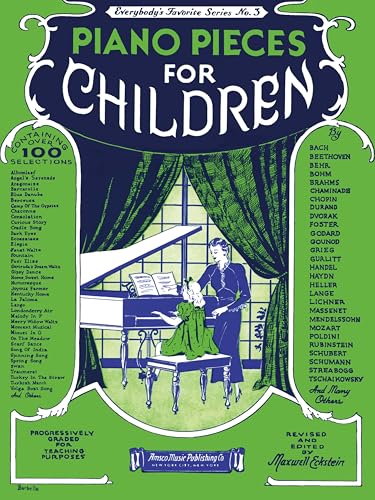
This collection gathers 100 compositions spanning classical masterworks, folk tunes, and dances, all arranged for piano with standard notation. Suitable for children building repertoire, it emphasizes accessible melodies and straightforward rhythms to support early-stage reading and coordination. The inclusive mix fosters musical variety while reinforcing fundamental technique, note reading, and expression.
Piano Pieces for Children 2 (EFS No. 250)

This volume continues the beginner-friendly series with a broad range of pieces formatted for piano solo. With 192 pages designed for developing players, it supports gradual progression in technique, tone production, and musical phrasing. The book’s structure enables teachers and parents to tailor practice sessions to the child’s growing capabilities.
Piano Pieces for Young Children (EFS No.252)

Designed specifically for early learners, this 144-page collection features piano solos tailored to develop confidence and fluency in reading simple notation. The selections emphasize approachable rhythm patterns and clear melodic lines, making it suitable for classroom use or home practice under parental guidance.
Easy Piano Pieces for Children – Beginner Piano Songbook

This beginner-friendly collection features over 100 simple piano pieces with fingerings, aiding novices in building confidence and technique. The selections include classical pieces adapted for easy play, supporting gradual repertoire expansion while promoting correct hand position and musical phrasing.
Piano Pieces for the Adult Beginner, No. 251

Although aimed at adult beginners, this collection offers approachable pieces that can also benefit younger players transitioning to more advanced material. The format emphasizes pedagogical value with practical practice material, allowing learners to explore more substantial repertoire while reinforcing fundamentals.
Library of Piano Classics (Intermediate to Advanced)

This library assembles famous classical piano pieces in an edition suitable for intermediate to advanced players. While more challenging, it provides a broader horizon of repertoire for motivated young players ready to tackle standard classical genres and refinement of technique. It complements early learning collections by bridging to more complex works.
Buying Guide
- Skill level alignment: Choose volumes labeled for early learners or beginners to ensure appropriate difficulty and pacing. Transition pieces should gradually increase complexity without overwhelming the student.
- Notation and fingering: Look for standard notation with clear fingerings and annotations, which support reading development and proper technique.
- Repertoire variety: A mix of classical, folk, and contemporary-inspired pieces cultivates musical curiosity and exposure to different styles.
- Edition and print quality: Durable bindings and legible print reduce practice friction, especially for younger readers who may handle the books frequently.
- Practice structure: Consider the layout of pages and the presence of paired pieces or themed selections to facilitate structured practice sessions with teacher or parent guidance.
- Editorial guidance: Some volumes include performance notes or pedagogical tips to help with tempo, dynamics, and expression; this can be valuable for self-guided practice.
- Progression pathway: A sequence from simple pieces to more challenging works helps track improvement and maintain motivation over time.
- Bundle considerations: If buying multiple volumes, ensure consistent fingering systems or editorial approaches to minimize confusion as skills grow.
- Resource availability: Check for accompanying audio tracks or online resources that can aid aural skills and provide listening references for students.
- Teacher collaboration: Coordinate with a piano teacher to select titles that align with current lessons and long-term goals.