Educational robots blend play with core skills like coding, critical thinking, and problem solving. Below are five standout options that align with the keyword learning robot for kids, spanning gesture controls, programmable features, and hands-on STEM activities. Each entry includes key capabilities to help you compare at a glance.
| Product | Brand | Key Feature | Age Range | Amazon Link |
|---|---|---|---|---|
| KingsDragon RC Robot Toys | KingsDragon | Gesture sensing, 50 actions, obstacle avoidance | 3–8 | https://www.amazon.com/dp/B07RWLZSQP?tag=toyreiew-20 |
| Ruko 1088 Smart Robots | Ruko | Voice control, APP control, multiple expressions | 4–9 | https://www.amazon.com/dp/B085WPHTHW?tag=toyreiew-20 |
| Miko 3 (Blue) | Miko My Companion | STEAM content, personalized interactions | 5–12 | https://www.amazon.com/dp/B09RWTYYGB?tag=toyreiew-20 |
| BAZOLOTA Robot Toys | BAZOLOTA | Gesture control, singing and dancing, long-distance remote | 3–12 | https://www.amazon.com/dp/B0FFTLFJG5?tag=toyreiew-20 |
| Makeblock mBot Kit | Makeblock | Scratch to Arduino coding, robotics education | 8–12 | https://www.amazon.com/dp/B00SK5RUQY?tag=toyreiew-20 |
The following sections spotlight each product with a concise overview, its learning value, and practical use cases for growing minds. All selections offer hands-on interaction and scalable challenges suitable for home learning environments.
KingsDragon RC Robot: Gesture Remote Play

The KingsDragon remote control robot combines infrared control with gesture sensing, enabling kids to guide the robot by hand gestures or with a traditional controller. It offers a comprehensive set of functions, including auto display modes and obstacle avoidance, to encourage exploratory play and spatial awareness. The robot’s eyes light up with blue LEDs when in motion, providing a visual cue for kids learning cause and effect. Its durable ABS construction and multi-joint design support basic robotics concepts like articulation and motion planning. With a built-in 50-action programming option, children can sequence moves to see how small steps create a larger routine, reinforcing memory, sequencing, and predictive thinking.
Ideal uses: daily imaginative play, early programming practice, and interactive storytelling sessions. Potential growth paths include experimenting with basic motion planning, testing different sequences, and comparing gesture-based control with remote control for preferred play styles.
Ruko 1088: Large Programmable Robot

Ruko 1088 stands out as a large, kid-friendly robot that blends voice commands, app-based control, and expressive features. Standing taller than typical toys at up to 15.8 inches, it offers a strong physical presence that motivates kids to explore storytelling and movement. Its 10 expressions and 10 songs, combined with nine flexible joints, provide a dynamic platform for exploring sequencing, rhythm, and emotional intelligence in a playful context. The robot’s diverse functions—gymnastics, storytelling, dance, music, and recording—invite children to express ideas through multiple media, strengthening coordination and imaginative thinking while introducing basic programming concepts through interactive play.
Learning outcomes include building early coding literacy, understanding feedback loops between actions and outcomes, and fostering comfort with technology as a collaborative partner rather than a toy. It’s particularly suitable for group play, where kids can choreograph simple routines and compare different approaches to achieve the same result.
Miko 3: AI-Powered Educational Robot (Blue)
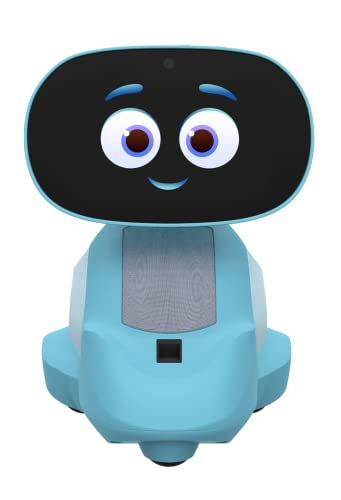
Miko 3 is an AI-powered educational companion designed to blend STEAM learning with emotional development. Its touchscreen interface delivers interactive content that adapts to a child’s interests, and the AI system personalizes activities to maintain engagement. The product emphasizes hands-on exploration across science subjects, arts, and problem-solving, with a claim of a notable rise in engagement through tailored interactions. This robot supports independent learning while offering guided prompts to help kids articulate questions, test hypotheses, and reflect on outcomes. It also serves as a social catalyst, encouraging curiosity and sustained exploration through games and stories linked to learning goals.
With Miko 3, learners can practice critical thinking, collaboration, and digital literacy in a friendly, responsive setting. It is well-suited for quiet study sessions, storytelling, and guided practice in math or science apps, making it a versatile addition to a home learning setup.
BAZOLOTA: Gesture-Controlled Robot for Kids
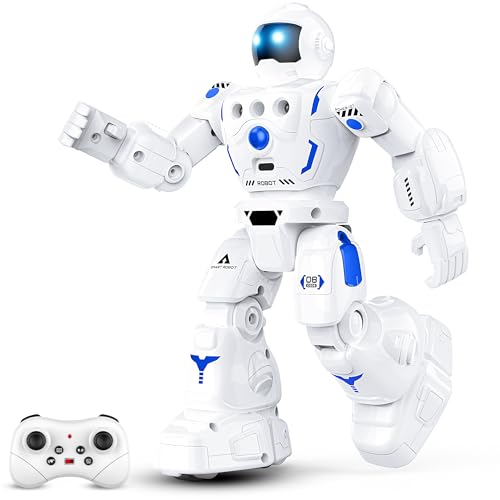
BAZOLOTA offers gesture-sensing control that allows kids to navigate the robot by simple hand movements, including forward, backward, left, and right motions. The robot also features singing and dancing capabilities, enriching kinetic learning with auditory and musical cues. With a generous 164-foot control range via remote, the toy fosters extended exploration and spatial awareness. The ability to adjust volume supports safe listening levels for younger children. Rechargeable via USB, the robot supports a longer play session between charges, which helps children build sustained attention and routine-building skills. The combination of gesture control, movement, and performance modes makes learning vibrant and memorable.
Use cases include movement-based storytelling, rhythm-based activities, and simple sequencing tasks that encourage trial-and-error experimentation and hypothesis testing about motion and timing.
Makeblock mBot Kit: Coding for Kids

The Makeblock mBot kit is a foundational robotics and coding platform, designed to bridge Scratch and Arduino for school-age learners. It provides clear building instructions and easy assembly, enabling children to explore electronics, mechanics, and coding through hands-on projects. Core features include multi-function remote control (line-following and obstacle avoidance) and a robust ecosystem of tutorials and apps, including mBlock software. The kit supports progressive learning, letting kids start with simple tasks and advance to more complex projects as confidence grows. This makes it a strong choice for families seeking a scalable, classroom-like experience at home.
Educational value centers on computational thinking, systems thinking, and practical tinkering—pacing the curriculum from visual programming to text-based coding. The kit’s modular design invites experimentation with sensors, motors, and user interfaces, fostering curiosity and persistence through project-based challenges.
Buying Guide: Key Purchase Considerations And Comparisons
When choosing a learning robot for kids, consider these factors to match a child’s interests, learning pace, and safety needs:
- Programming and learning style: Gesture-based, voice-controlled, or Scratch/Arduino-style coding; match to your child’s comfort with screens and abstraction levels.
- Age suitability and complexity: Ensure the robot offers scalable tasks, from simple actions to multi-step sequences, aligned with the child’s developmental stage.
- Interactivity and engagement: Look for responsive feedback, engaging content, and learning activities beyond play to sustain curiosity.
- Durability and safety: Non-toxic materials, sturdy construction, and rounded edges; check battery type, charging time, and safety certifications.
- Expansion potential and ecosystem: Availability of expansion kits, tutorials, and community content helps extend learning over time.
- Social and collaborative features: Group play options or storytelling capabilities can support teamwork and communication skills.
- Cost and value: Consider long-term educational value, not just upfront features; some kits include software tools and lesson plans that reduce extra purchases.
In summary, for younger children, gesture-controlled or story-driven robots (like KingsDragon and BAZOLOTA) offer approachable entry points into motion and sequencing. For ages 6–9, larger, expressive robots (Ruko 1088) and AI-enhanced companions (Miko 3) provide deeper learning via storytelling, music, and personalized content. For older beginners, the Makeblock mBot Kit delivers a structured path from visual to text-based coding, supported by extensive tutorials.
Each option can serve as a catalyst for curiosity, collaboration, and problem solving. Selecting the right robot depends on a child’s interests—whether they are drawn to movement and play or to building and programming—and the family’s goals for hands-on STEM exploration.