Finding objects in the night sky becomes faster and more accurate with the right finder scope. This guide highlights five top finder scopes that help you locate stars, galaxies, and planetary targets with minimal fuss. Each option balances ease of use, field of view, and compatibility with common telescopes. Read on to compare features and choose the finder that best fits your observing style and setup.
| Product | Brand | Key Feature |
|---|---|---|
| Telrad Finder Sight | TELRAD | Easiest aiming with sky-centered window, non-magnified view |
| Celestron 51630 Star Telescope Finderscope | Celestron | Right-side-up views with adjustable red dot brightness |
| SVBONY SV208 Finder Scope | SVBONY | 8×50, illuminated reticle, erect image for easy targeting |
| Astromania Finder Scope, 9×50 | Astromania | High magnification, 90-degree viewing for zenith targets |
| SVBONY SV182 Finderscope | SVBONY | 6×30, crosshair reticle, comfortable right-angle design |
Note: The table above offers a quick snapshot of each option. Details below cover how these finders perform in real observing scenarios, so you can decide which one best matches your telescope, observing goals, and preferred viewing angle.
Telrad Finder Sight

The Telrad finder uses a non-magnified window that matches the sky around the telescope view, helping users point quickly without introducing magnification. Its aiming method is intuitive for both beginners and experienced observers, and the footprint is lightweight for easy mounting on a wide range of telescopes. The Telrad is especially popular for rapid star-hopping and is considered a reliable primary finder in many setups.
Celestron 51630 Star Telescope Finderscope

The StarPointer red dot finderscope adds precise pointing capability to any telescope. It provides right-side-up views that align with what you see with your naked eye, making it easy to locate targets. The adjustable red dot brightness allows users to preserve night vision while searching at dusk or dawn, or to highlight terrestrial targets during daytime observations.
SVBONY SV208 Finder Scope

The SV208 features an 8×50 optical design with a large 50mm objective, delivering a bright image and a generous field of view. It includes an illuminated reticle, aiding alignment in very low-light conditions. The 90-degree right-angle eyepiece angle reduces neck strain during extended sessions, making it a practical choice for observers who frequently observe high- or near-zenith targets.
Astromania Finder Scope, 9×50
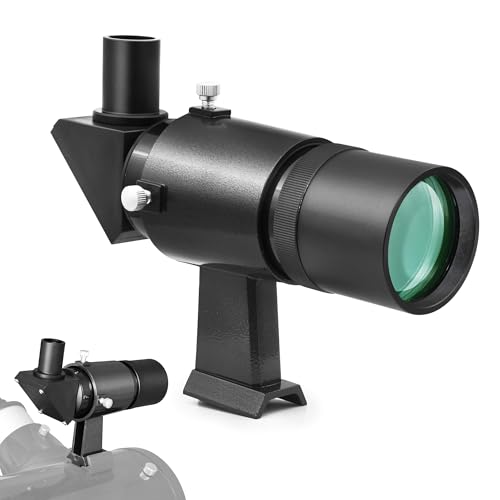
With a 9×50 optical configuration, the Astromania finder offers bright views of deep-sky objects and a crosshair to assist alignment. Its 90-degree upright image makes searching more comfortable, especially for targets near the zenith. The combination of higher magnification and a longer focal length provides precise initial targeting before switching to a main telescope.
SVBONY Finder Scope 5×24

The 5×24 finder is a compact, lightweight option that serves as a secondary aiming aid. It includes a crosshair reticle and a mounting bracket suitable for many telescope tubes. While lower magnification limits faint object detection, the device excels at coarse pointing and initial alignment, especially when paired with a larger main telescope.
SVBONY SV165 Mini Guide Scope
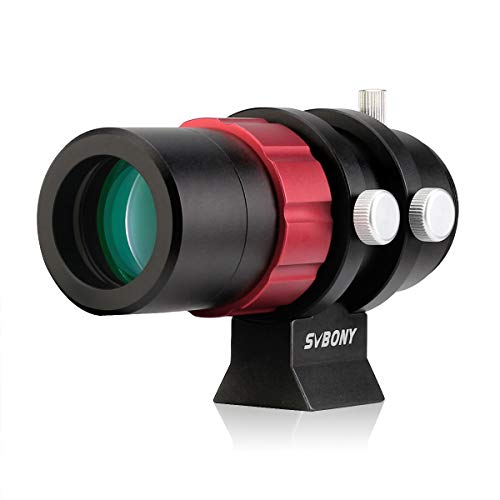
The SV165 Mini Guide Scope is designed to work with auto guiding cameras and includes interfaces suitable for 1.25-inch and M42 mounts. It offers a bright, sharp image with a wide field of view, facilitating quick target acquisition during guiding sessions. The 45mm back focus distance supports easy focusing and alignment with compatible cameras and mount setups.
Talcope Brightness Red Dot Finderscope

The Talcope red dot finder projects a bright LED dot onto a non-magnifying window for quick aiming. Brightness is adjustable to suit day or night observing conditions, making it a versatile option for many telescope models. It includes a bracket compatible with dovetail bases and a battery, enabling straightforward installation and use right away.
Buying Guide: Key Purchase Considerations
- Mounting compatibility: Check your telescope’s tube diameter and the finder’s bracket to ensure a secure fit. Some finders come with universal brackets that fit many tubes, while others require adapters.
- Optical design and magnification: Higher magnification finders (like 9×50) reveal fainter stars but may be harder to use for quick alignment. Lower magnification (5×24, 6×30) offers speed but fewer faint targets.
- Right-side-up vs inverted images: Upright finders align with how you see the sky with the naked eye, reducing cognitive load during star hopping. Upright images are often preferred for beginners.
- Illumination and reticles: Red-dot/illuminated reticles simplify night observations, especially in light-polluted skies. A built-in crosshair helps with precise alignment during setup.
- Angle and ergonomics: 90-degree finders reduce neck strain when observing objects near the zenith. Straight-through designs can be quicker but may require more bending.
- Durability and build quality: Metal housings tend to hold alignment better over time and withstand outdoor conditions better than plastic counterparts.
- Maintenance and accessories: Consider included dust caps, brackets, and mounting screws. Some packages include helpful accessories for quick setup and transport.
- Budget and value: Compare features across brands. A slightly higher price can be justified by brighter optics, better illumination, or more versatile mounting options.