Jumpstart your piano journey with beginner-friendly digital pianos that blend authenticity, features, and value. This guide highlights five entry-level options that deliver a genuine keyboard feel, useful learning tools, and essential accessories to help newcomers practice confidently. Explore bundles with stands, pedals, headphones, and more to support steady progress.
| Product | Brand | Key Features |
|---|---|---|
| A1 | Qerewf | 88-key semi-weighted keys; sustain pedal; stand; carrying case; headphones; 128 voices; 80 demo songs |
| DEK-610S | Donner | 61 keys; 249 voices; 249 rhythms; included stand, bench, mic; LCD display |
| KU-3506 | KUMENG | 88-key semi-weighted; 800 tones; 128 polyphony; MIDI; USB; Bluetooth; sheet stand |
| UISCOM | UISCOM | 88 keys semi-weighted; USB-MIDI; Bluetooth; stand; pedal; headphones |
| Alesis | Alesis | 88 keys; 480 sounds; 160 rhythms; built-in lessons; portable with stand |
Disclaimer: This guide presents objective overviews based on listed features to help consumers compare options for beginners. Each model includes essential accessories and learning-friendly functions that support skill development and musical exploration.
A1: Qerewf 88-Key Beginner Bundle

The A1 bundle centers on an 88-key digital piano with semi-weighted keys, aiming to emulate a traditional piano feel. The package includes a sustain pedal, power supply, stand, carrying case, and headphones, offering a comprehensive start for beginners. With a diverse sound palette including 128 instrument voices and 80 demo songs, learners can explore styles while focusing on technique and rhythm. The standard keyboard touch provides a familiar response that supports early finger independence and expressive playing.
DEK-610S: Donner All-In-One Keyboard Kit

The DEK-610S kit provides an all-inclusive setup with a 61-key keyboard, stand, bench, sheet music stand, microphone, and power adapter. Its 32-note polyphony, 249 voices, and 249 rhythms enable wide creative exploration and accompaniment. An LCD display helps beginners follow active functions and settings during practice, making it a practical bundle for those wanting a ready-to-play package from day one.
KU-3506: KUMENG 88-Key Semi-Weighted Piano

This 88-key semi-weighted keyboard mirrors the feel of an acoustic piano, supporting developing players with a touch-sensitive response. It offers 800 tones and 128 polyphony to cover a range of musical styles, along with a multifunction panel for tone selection, recording control, and a split function. Bluetooth connectivity and MIDI/USB compatibility enable expanded learning options with apps or computer software, making it a versatile choice for beginners aiming to grow into more complex pieces.
UISCOM: Full-Size 88-Key Semi-Weighted Set
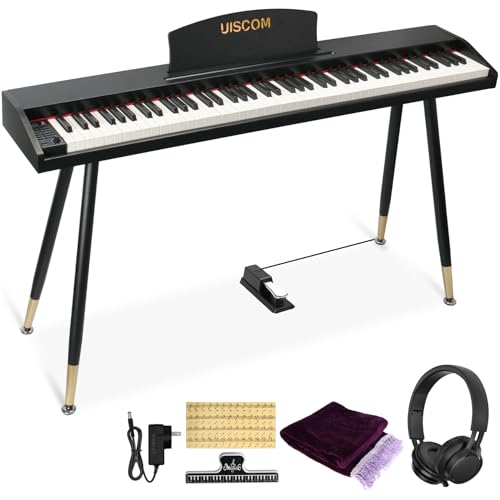
The UISCOM digital piano emphasizes a full-size 88-key semi-weighted keyboard with built-in speakers, a stand, pedal, and USB-MIDI compatibility. The 88-key action is designed to resemble an acoustic instrument, helping beginners develop proper finger strength and technique. Bluetooth and device connectivity expand practice opportunities, while the included accessories support immediate setup and ongoing learning without needing additional purchases.
Alesis 88-Key Starter Keyboard

The Alesis starter keyboard emphasizes portability with 88 full-size, touch-sensitive keys and built-in speakers for immediate play. A rich sound library includes 480 tones and 160 rhythms, offering broad room for experimentation. Alesis also highlights lesson-oriented features and built-in demos to support consistent practice and progression for beginners who want structured guidance alongside creative exploration.
Buying Guide: Key Purchase Considerations
When choosing a digital piano for beginners, consider these factors to balance cost, usability, and learning progress:
- Key action and touch: Semi-weighted versus fully weighted keys affect how closely the keyboard mimics a real piano. Beginners may prefer lighter semi-weighted action for comfort and quick adaptation, gradually advancing to heavier feels as accuracy improves.
- Number of keys: Most entry-level models offer 88 keys, which is standard for practicing repertoire. Some compact kits use 61 keys, which can be a trade-off between portability and full-range playing.
- Sound library and polyphony: A broad library (tones, rhythms) fuels creativity, while higher polyphony (the number of simultaneous notes) prevents voice cutting during complex passages or layering.
- Learning features: Demo songs, built-in lessons, metronome, and recording capabilities support structured practice and progress tracking without external apps.
- Connectivity: MIDI/USB, Bluetooth, and app compatibility expand practice options with digital resources, lessons, and accompaniment tracks.
- Included accessories: Stands, pedals, benches, and carrying cases vary by bundle. A complete starter kit reduces setup friction and ensures a stable practice environment.
- Portability and space: For small living spaces or traveling practice, consider compact models with carry-friendly packaging and lightweight stands.
- Durability and warranty: Look for reputable brands and warranty terms that protect the investment as beginners explore and learn.
In choosing among these options, weigh your preferred approach to practice, the importance of authentic feel, and the desire for an all-in-one kit versus a more modular setup. Each model listed offers a different balance of realism, features, and bundled accessories to suit various beginner needs.