Counting cubes are versatile learning tools that support foundational math skills, early engineering concepts, and hands-on problem solving. This article highlights five top counting cube sets designed to engage children and strengthen number sense, patterning, and fine motor coordination. Each product below includes key features and practical uses for homeschooling, classroom activities, and enrichment play.
Summary Table of Chosen Products
| Product | Brand | Key Use |
|---|---|---|
| MathLink Cubes | Learning Resources | One-to-one counting, sum and number sense, basic operations |
| MathLink Cubes Big Builders | Learning Resources | Creative projects, early engineering, extended counting |
| Math Linking Cubes (SpriteGru) | SpriteGru | Colorful counting, sorting, basic place value, imagination |
| Math Manipulatives Counting Cubes | KUTOI | Colorful blocks for quick counting, addition, subtraction, patterns |
| STEM Explorers MathLink Builders | Learning Resources | Critical thinking, fine motor skills, building and connecting |
Learning Resources MathLink Cubes — Set of 100
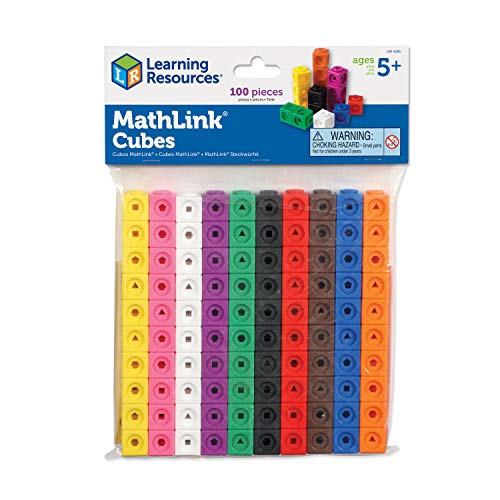
These MathLink Cubes provide a classic, versatile set for kindergarten and early elementary learners. The kit supports counting to 100, one-to-one correspondence, skip counting, and basic arithmetic like addition and subtraction. Beyond raw math, the cubes foster color and shape identification, patterning, matching, and fine motor skills. The geometric cutouts inside each cube enable more complex patterning activities, expanding learning opportunities from simple counting to exploratory math play. This makes the set suitable for homeschoolers and classroom use alike, with plenty of opportunities for small-group or independent tasks.
MathLink Cubes Big Builders — Set of 200

Big Builders doubles the cube count, inviting imaginative construction and extended math exploration. The 200-piece set supports early engineering concepts by letting children design structures such as helicopters, robots, and animals. It also encourages critical thinking as students plan, execute, and iteratively improve their builds. Teachers and parents can integrate these cubes into STEAM-inspired activities that combine math, design thinking, and storytelling through model-building. This set is well-suited for larger groups or extended project work.
SpriteGru Math Linking Cubes — 100 Pieces

SpriteGru’s set offers 100 connecting cubes in 10 vibrant colors, providing a visually engaging way to explore counting, color identification, and basic arithmetic. The cubes link easily to demonstrate place value, quantities, and height comparisons. The kit also supports open-ended play—children can build names, simple machines, or imaginative creatures—while practicing word problems and early math reasoning. It’s a practical option for classrooms, tutoring sessions, and home learning alike.
KUTOI Math Manipulatives Counting Cubes — 100

KUTOI’s 100-count set is designed for ages 3 and up, spanning preschool through early elementary. The cubes are bright, stackable, and color-coded to enhance number sense, counting, and basic operations. The product emphasizes a straightforward, hands-on approach to addition, subtraction, multiplication, and division through visual representations. Clear, vibrant blocks help kids translate abstract math concepts into tangible constructions, boosting engagement during independent practice or guided instruction.
Learning Resources STEM Explorers MathLink Builders — 100

STEM Explorers Builders focuses on critical thinking alongside math manipulation. The 100-piece set invites children to assemble animals, objects, and imaginative designs, which reinforces sequencing, measurement, and spatial awareness. The fine motor aspect of snapping cubes together helps with dexterity while the open-ended exploration supports problem-solving and creative thinking. This set integrates well with curriculum activities, science connections, and maker-inspired projects in both homeschool and school settings.
Buying Guide: Key Considerations And Comparisons
- Age suitability: Check recommended ages to ensure the cubes match your child’s developmental stage, from preschool counting to early arithmetic.
- Quantity and variety: Higher piece counts support larger group activities and extended projects, but smaller sets offer portability and focused practice.
- Colors and patterns: Multicolor sets help with number recognition, patterning, and place value; consider sets with a wide color range for richer activities.
- Durability and finish: Look for sturdy plastic cubes with smooth edges to withstand frequent snapping and rebuilding, especially for classroom use.
- Educational scope: Some sets emphasize math operations, others focus on STEM building and critical thinking—align with your learning goals.
- Storage and organization: Kits with organizers or included storage boxes make tidying up easier and encourage consistent use.
- Compatibility: If you already own cubes from a brand, verify compatibility for stacking and linking to maximize reuse.
- Instructional resources: Activity cards, guides, or teacher prompts add value by providing structured lessons and problem sets.
Across these five selections, counting cubes support a range of educational goals—from basic counting to early engineering and design thinking. They accommodate different learning styles, including visual, tactile, and kinesthetic approaches. When selecting a set, consider how the cubes will be used: individual practice, partner activities, or whole-class projects. The best choice balances quantity, durability, and creative potential to sustain engaging math exploration over time.