Explore top wood building kits that suit aspiring builders around age 13. These hands-on projects combine creativity with STEM concepts, promoting problem solving, motor skills, and perseverance. Each selection below features durable wooden pieces, clear instructions, and engaging builds that appeal to curious teens. From multi-model STEM sets to detailed wooden models, these kits offer rewarding challenges for independent work or family project time.
| Product | Brand | Age Range | Why It Stands Out |
|---|---|---|---|
| 6-in-1 STEM Kits for Kids Age 8-12 | FliipFlaap | 8-12 | Multiple models, physics concepts, great for family bonding |
| NATIONAL GEOGRAPHIC Da Vinci Model Kit | Blue Marble | 8-12 | Three functional machines, compact and educational |
| Kraftic Woodworking Building Kit for Kids and Adults | Kraftic | All ages | Real wood pieces, step-by-step manual, paint-friendly |
| Lakeshore Build-It-Yourself Woodworking Kit | Lakeshore | 8-teen | Real tools, hands-on creativity, durable materials |
| Wood Trick Hot Rod Wooden Model Car Kit | Wood Trick | Teens to Adults | Detailed, glue-free assembly, mechanical motion |
Note: Each kit provides a distinct learning angle—from engineering fundamentals to woodworking crafts. While ages listed are guidelines, these projects can be adapted to suit 13-year-old learners with supervision and extra challenges as needed.
6-in-1 STEM Kits for 8-12 Year Olds
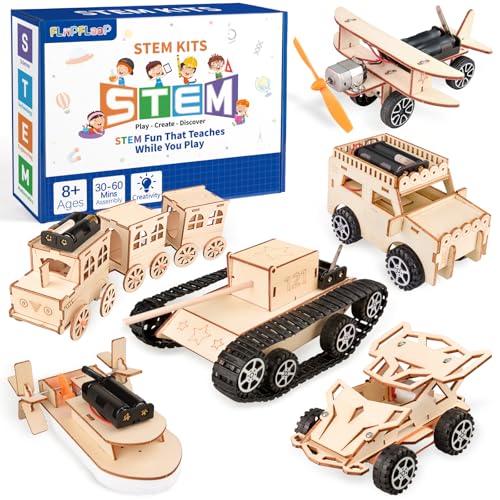
The 6-in-1 STEM kit provides six distinct models that teach foundational engineering and physics ideas. Kids assemble each model to observe motion, energy transfer, and electricity in action. Batteries are required (not included), ensuring ongoing exploration beyond the initial builds. This kit supports hands-on experimentation and collaboration, making it suitable for 13-year-olds who enjoy multi-model challenges and room-to-grow.
NATIONAL GEOGRAPHIC Da Vinci Catapult Kit

This National Geographic kit challenges teens with a three-model build—ballista, bombards, and a catapult. Fully functional designs come with projectiles and targets, promoting hands-on understanding of mechanical principles, gearing, and simple physics. The kit is designed for a focused build session of 1-3 hours per model, making it a compact yet impactful project for 13-year-olds who crave precision and engineering history.
Kraftic Woodworking Building Kit

The Kraftic woodworking kit provides a more realistic wood-building experience for both kids and adults. It includes 35 real wood pieces, screws, a screwdriver, and an instructional manual. Clear packaging and separate bags help keep pieces organized, while the option to paint after completion adds a creative finish. This kit supports independent work or guided sessions, appealing to older teens seeking a substantial woodworking project.
Lakeshore Build-It-Yourself Woodworking Kit

Lakeshore’s kit introduces real woodworking with accessible tools and over 80 pieces. It nurtures creativity, problem-solving, and motor skills, offering a foundational woodcraft experience that can be scaled with more complex projects as a teen’s skills grow. The kit’s structure supports progressive learning and sustained engagement for curious 13-year-olds.
Wood Trick Hot Rod Wooden Model Car Kit

This detailed wooden model car kit offers a mechanical build with a visible engine and moving parts. Composed entirely of wood, it minimizes the need for glue or specialized tools, relying on an illustrated assembly guide. The finished Hot Rod is both a display piece and a hands-on study of gears and motion—an attractive option for teens who enjoy intricate, collectible builds.
Buying Guide: Wood Building Kits For Teens
- Project difficulty and age suitability: Look for kits labeled for older children or teens, with clear instructions and manageable piece counts. Some sets are modular, allowing escalating challenges as skills improve.
- Materials and tools: Wooden kits range from pre-sanded pieces to those requiring basic hand tools. Consider whether tools are included, the need for paint or finishing supplies, and whether glue is necessary.
- Learning goals: Pick kits aligned with interests—engineering concepts, woodworking basics, or decorative models. Multi-model kits can reinforce transferable skills like problem solving and spatial reasoning.
- Time commitment: Some kits build quickly while others span multiple sessions. Match the expected time with the teen’s schedule to sustain motivation.
- Safety and supervision: For younger teens or beginners, supervision and guidance help ensure safe use of tools and proper handling of small parts.
- Reuse and upcycling potential: Some projects offer opportunities to repaint or customize, extending their educational and creative value beyond construction.
- Upgrading challenge: Consider kits that can be expanded with additional models or compatible projects to keep the learning trajectory continuous as skills advance.
Across these options, parents and guardians can select a kit that fits the teen’s interests, whether it’s a compact mechanical build, a durable woodworking project, or a detailed model car. Each kit emphasizes hands-on learning, sustained focus, and practical understanding of how things are engineered—valuable skills for future study and hobbies.