The right walker can help a 9-month-old explore mobility with confidence. This guide highlights five top-rated options that blend safety, engaging activities, and durable design to support early walking, balance, and coordination. Each pick is evaluated for height suitability, stability, and learning potential, offering parents a clear view of what to expect from a first-walker purchase.
| Product | Brand | Key Benefit |
|---|---|---|
| Bautia Wooden Baby Walker | Bautia | Natural wood, multiple activity centers, quiet wheels |
| SYNCFUN Baby Learning Walker | SYNCFUN | Two-speed settings, removable play panel, light-up features |
| WOODMAM Wooden Baby Walker | WOODMAM | 10-in-1 activities, detachable busy board, ergonomic height |
| YBIKE Pewi Walking Ride On Toy | YBIKE | Ride-on and push features, indoor/outdoor use, durable |
| Playskool Step Start Walk N Ride | Playskool | 2-in-1 ride-on and walker, kid-friendly design |
Bautia Wooden Baby Walker

The Bautia wooden walker combines a sturdy frame with a natural wood finish and rounded edges to enhance safety for first steps. It features a lively activity panel that includes a rolling letter wheel, xylophone, flip board, and a tracking game. These toys help develop hand-eye coordination and cognitive skills while encouraging babies to practice standing and walking. Rubber wheels provide floor-friendly, quiet movement to protect surfaces as little ones explore.
SYNCFUN Baby Learning Walker

SYNCFUN’s 2-in-1 design supports growth from sitting to standing and walking. It offers adjustable speed settings, enabling a low speed for younger babies and a standard speed as mobility improves. A detachable play panel adds versatility, allowing play on the floor, crib, or on the walker itself. The light-up buttons, interactive piano panel, and rolling wheels engage infants with visual and auditory feedback, fostering motor and cognitive development during early walking.
WOODMAM Wooden Baby Walker

WOODMAM offers a 10-in-1 Montessori-style push walker that blends learning and mobility. Its gears, peek-a-boo window, counting beads, pretend phone, mirror, xylophone, spinning blocks, shape sorter, and sliding puzzle provide a broad spectrum of activities to support fine motor skills, cause-and-effect understanding, and early problem-solving. A detachable busy board increases portability for travel and independent play. Designed with an adjustable height and ergonomic balance to assist early walkers in achieving stable, natural movement.
YBIKE Pewi Walking Ride On Toy
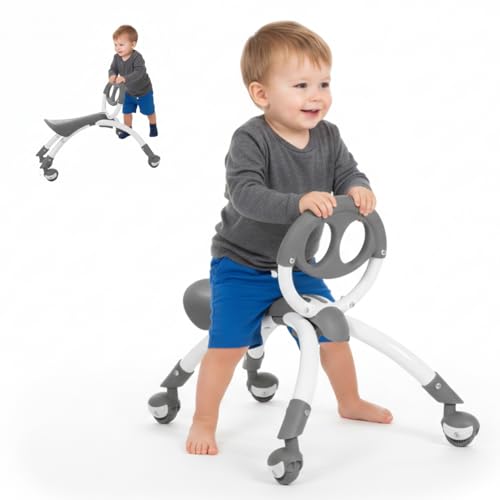
The YBIKE Pewi is designed to grow with a child from crawling to walking and riding. It serves as a ride-on toy and a push toy, promoting balance, coordination, and confidence. Built with a lightweight aluminum frame and a sturdy molded seat, it provides stability for early walkers. Its 360-degree caster wheels offer smooth, floor-friendly movement on multiple surfaces, making it suitable for indoor and outdoor use without scratching floors.
Playskool Step Start Walk N Ride

Playskool’s Step Start Walk N Ride combines walk-along and ride-on features in a kid-friendly design. This 2-in-1 toy supports early mobility while offering engaging play experiences that help develop gross motor skills and spatial awareness. With a simple, sturdy structure and age-appropriate features, it provides a reliable option for caregivers seeking a convertible walker for young children approaching their first steps.
Buying Guide: Key Purchase Considerations
- Age and height suitability: Ensure the walker supports a safe stance for a 9-month-old or soon-to-be walker, with an adjustable height or a compact footprint for early learners.
- Stability and safety: Look for wide bases, non-slip feet, low centers of gravity, and durable materials to prevent tipping during first steps.
- Material and finish: Wood walkers offer a classic, sturdy feel and quieter operation, while plastic or metal frames may provide lighter weight and easier cleaning.
- Activity and learning features: Panels, buttons, shape sorters, and music/sound elements can stimulate motor skills and cognitive development, but avoid overly busy designs that may distract or overwhelm.
- Portability and storage: Detachable panels or foldable components can aid travel and storage, especially for families on the move.
- Indoor vs. outdoor use: Some walkers are better suited for indoor use with floor-friendly wheels, while others are robust enough for paved or grassy areas.
- Cleaning and maintenance: Consider ease of cleaning, especially for toys with moving parts or fabric components.
- Price vs. value: Compare durability, feature set, and warranty considerations to balance upfront cost with long-term usefulness.