Finding development-focused toys for toddlers with delays involves choosing items that encourage fine motor skills, cause-and-effect understanding, color and shape recognition, and social interaction. The following selections are designed to be engaging, safe for little hands, and adaptable for varied developmental needs. Each option highlights clear, tangible play outcomes to support early learning milestones.
| Product | Brand | Key Benefit | Amazon Link |
|---|---|---|---|
| Kidoozie Ball Drop | Kidoozie | Cause-and-effect and fine motor development; colorful levels and rattling balls | View |
| Battat – Cause-and-Effect Toy | Battat | Color sorting, animal recognition, and basic problem solving | View |
| Montessori Toys For Toddlers — Color Sorting | Tonberless | Shape and color differentiation; fine motor practice | View |
| Montessori Toys For Toddlers — Color Sorting (Small Fish) | SMALL FISH | Color sorting, hand-eye coordination, sensory play | View |
| Aullsaty Talking Flash Cards | Aullsaty | Speech and language exposure; interactive, social play | View |
Product Highlights At A Glance
- Kidoozie Ball Drop: Multi-level drops with rattling balls, building cause-and-effect and fine motor skills.
- Battat – Cause-and-Effect Toy: Buttons and colors to teach cause-and-effect while exploring animals.
- Tonberless Montessori Color Sorting: Wooden puzzle set for shapes, colors, and sorting skills.
- SMALL FISH Color Sorting Toy: Beechwood blocks for sorting and problem-solving with vibrant colors.
- Aullsaty Flash Cards: 248 sight words with a cat reader for language and social learning.
These selections emphasize hands-on engagement, sensory feedback, and simple, repeatable play patterns ideal for toddlers with developmental delays. They support foundational skills without overwhelming complexity and can be used in small-group or one-on-one play sessions with caregivers or therapists.
Kidoozie Ball Drop

The Kidoozie Ball Drop offers six levels of ball travel, with each layer dropping the ball at a different point. Its bright colors and varying paths encourage visual tracking and trial-and-error problem solving, while the rattling sounds capture attention and invite repeated play. The tower design supports hand-eye coordination and fine motor precision as toddlers grip and release the balls along curved ramps.
Key benefits include early cause-and-effect learning as kids observe how actions at the top lead to outcomes at the bottom, plus sensory stimulation from fragmented ball sounds. The toy’s durable construction aims to withstand active toddler use and provides a visually engaging experience for sustained attention during therapy sessions or casual play.
Battat – Cause-and-Effect Toy
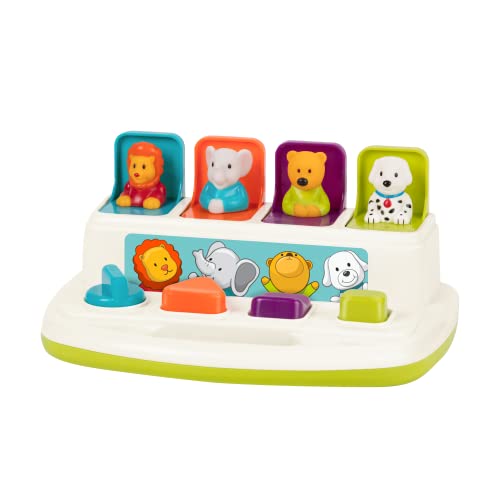
This developmental toy features a set of buttons that users press, turn, flip, or slide to reveal a hidden animal. The design reinforces cause-and-effect reasoning and introduces basic physics concepts through tactile interaction. Children learn through exploration, discovering which actions trigger which outcomes, while enjoying colorful animal characters that aid memory and recognition.
Educational benefits focus on cause-and-effect understanding, color and animal recognition, and fine motor engagement. The compact form supports portability for therapy visits or at-home sessions, and the variety of button interactions keeps attention while building hand strength and dexterity.
Tonberless Montessori Color Sorting

This wooden sorting and stacking puzzle includes 20 pieces in five colors and five shapes. The moderate piece count supports toddler-level problem solving and sequencing, while the wooden construction provides a sensory-rich experience with safe, smooth edges. Children practice color recognition, shape sorting, and hand-eye coordination as they fit shapes into matching slots.
Designed for early learners, the toy doubles as a travel-friendly option that encourages independent exploration and imaginative play. The tactile feel of real wood reinforces a calm, focused play session, making it suitable for children who benefit from predictable, structured activities.
SMALL FISH Color Sorting Toy

Designed for 18 months and up, this wooden sorting toy emphasizes color differentiation, shape recognition, and fine motor control. The bright rainbow sticks are sized for little hands and promote pincer grasp development as children place sticks into matching holes. It supports sustained focus through repetitive sorting tasks and builds confidence in spatial reasoning.
Great for sensory-rich play, the beechwood material provides a sturdy, safe play surface with smooth edges. The toy’s simple rules and durable design allow caregivers to adapt activities for children with varying attention spans and motor abilities.
Aullsaty Talking Flash Cards

These talking flash cards feature 248 sight words across 14 subjects, presented by a friendly cat reader with standard American pronunciation. The interactive setup supports language acquisition, attention to auditory cues, and memory recall. It is particularly helpful for speech therapy contexts where consistent repetition and visual-auditory pairing aid learning.
Parents and therapists can use the device to reinforce vocabulary, sentence structure, and early literacy. The device offers adjustable volume and a repeat option to accommodate diverse listening needs and attention spans, making it a versatile language-learning tool for toddlers with developmental delays.
Buying Guide: Key Purchase Considerations And Comparisons
- Developmental aims: Match toys to specific goals such as fine motor skills, hand-eye coordination, color/shape recognition, or language development. Choose items that offer clear cause-and-effect feedback and adjustable difficulty.
- Safety and durability: Look for sturdy materials, rounded edges, and non-toxic finishes. Wooden toys often provide tactile feedback and long-lasting use, while plastic options should be BPA-free and well-constructed for rough handling.
- Engagement level: Favor toys with multiple interaction modes (press, twist, drop, sort) to sustain attention and reduce frustration. Consider a mix of solitary and cooperative play options to encourage social interaction.
- Adaptability for therapy: Select items that can be used in one-on-one sessions with therapists or caregivers, with simple instructions and repeatable play patterns. Visual cues and sound feedback can enhance engagement for children with auditory or speech delays.
- Portability and setup: For frequent sessions, choose compact, easy-to-store toys that require minimal setup. Travel-friendly options support continuity between home and clinic environments.
- Age and skill range: Ensure the toy is appropriate for the child’s current developmental stage while offering room to progress. Avoid overly complex games that may lead to frustration.
- Cost and value: Consider durability and educational value. A higher-quality item that lasts months or years may provide better long-term value than cheaper, fragile options.
- Caregiver involvement: Toys that invite caregiver interaction promote language modeling, guided play, and social engagement, which are essential for children with delays.
When selecting toys, balance sensory input with cognitive challenges. A well-rounded set often includes one item focused on motor skills, one on language or cognition, and one that encourages social play or turn-taking. Regular, short play sessions with guided prompts can yield meaningful progress without overwhelming the child.