Parents seek toys that engage toddlers in independent play while building early math, fine motor skills, and problem-solving. The following selections from trusted brands offer self-guided activities that kids can explore alone or with minimal supervision. Each option supports color sorting, counting, shape recognition, and imaginative play—essentials for fostering confident, curious young learners.
Summary of selected products:
- RAEQKS Counting Sorting Dinosaur Toys Montessori Sensory Matching Toy
- Creativity for Kids Sensory Bin: Construction Zone Playset
- 13 Pieces Montessori Kitchen Toys for Toddlers
- Oomloid Counting Animals Montessori Toys
- JUNBESTN Easter Matching Eggs Parlour Games
All five options emphasize hands-on exploration, durable materials, and age-appropriate challenges that suit toddlers and preschoolers working on independent discovery. They cover a range of themes—from dinosaurs and animals to construction and kitchen pretend play—giving children the chance to learn through self-directed activity in various settings, including home, daycare, and classrooms.
Dinosaur Counting Sorting Montessori Toy
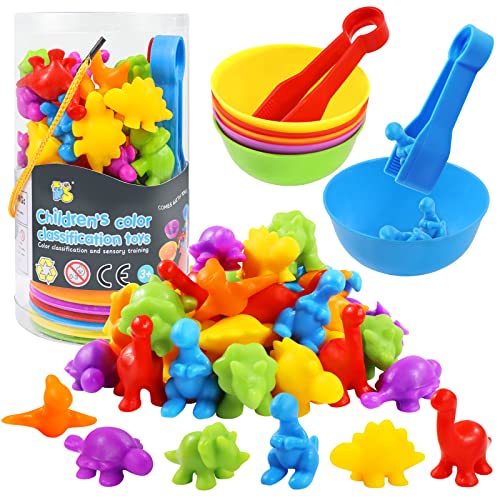
RAEQKS presents a counting and sorting activity designed for independent play. The set includes 48 dinosaurs in multiple colors, six rainbow sorting bowls, two tweezers, and a storage bucket. Children can sort by color, practice counting, and work on fine motor skills by using tweezers. The activity supports early math concepts such as counting, grouping, and simple comparisons, while also encouraging hand-eye coordination and three-dimensional spatial reasoning. Suitable for kids aged 3 and up, this Montessori-inspired toy fosters self-guided exploration and quiet, constructive play.
Construction Zone Sensory Bin

This all-in-one sensory playset from Creativity for Kids enables kids to create a mini construction site with sensory sand, vehicles, signs, and cones. The kit includes a reusable storage bin, sand, a mini dump truck, cement mixer, roller, shovel tools, and more. It’s designed to develop fine motor skills, sensory awareness, and imaginative storytelling without screens. The self-contained setup helps children engage in independent, goal-oriented play as they build, scoop, and transport materials, mimicking real-world construction activities in a kid-friendly, mess-contained environment.
Montessori Kitchen Pretend Play Set

These 13 pieces provide a safe, realistic kitchen play experience tailored for early independence. The set includes wooden and plastic tools such as knives, cutting boards, and various vegetable or fruit-inspired accessories. Designed to resemble real kitchen activities, the pieces encourage independent exploration, role-play, and fine motor skill development. Materials are described as non-toxic and child-safe, with a focus on a simple, intuitive design that supports self-directed pretend cooking and early math tasks like portioning and counting.
Counting Animals Montessori Toys

Oomloid’s Counting Animals set includes 36 multicolored animal figures with six color-sorted bowls and tweezers. Aimed at children aged 3 to 5, this activity centers on counting, color matching, and sorting. The self-guided play supports early math skills, such as one-to-one correspondence, grouping, and pattern recognition. The kit is designed for quiet, focused learning intervals—great for home, classroom centers, and daycare settings—while promoting hand-eye coordination and fine motor development through independent handling of pieces.
Easter Matching Eggs for Independent Play

JUNBESTN offers a set of 12 color- and shape-coded eggs that click together and pull apart, encouraging independent play. Toddlers can practice counting, sorting, and matching while manipulating the eggs, which are sized for small hands and designed to be easy to grasp. The eggs provide a playful, reusable activity that can double as an Easter gift or classroom enrichment tool. The straightforward packaging supports solo exploration, yet can also be shared with peers for collaborative play and early cooperative skills.
Buying Guide
Key purchase considerations help ensure the chosen toys match a child’s development stage and the family’s play environment:
- Age and safety: Select age-appropriate materials with non-toxic finishes, rounded edges, and choking-hazard awareness for younger toddlers.
- Independence level: Look for activities that require minimal setup and can run as self-contained stations or prompts without continuous instruction.
- Learning goals: Choose toys that cultivate counting, color recognition, sorting, fine motor skills, and early math concepts to align with curricula or at-home learning goals.
- Materials and durability: Prefer sturdy, washable, and easy-to-clean components that withstand frequent handling and toddler wear-and-tear.
- Portability and storage: Consider compact kits with built-in containers or bins for easy transport and organized storage between play sessions.
- Variety and engagement: Mix tactile, visual, and pretend-play opportunities—dinosaurs, animals, construction, and kitchen themes—to maintain interest and support broad cognitive development.
- Montessori alignment: Many items follow Montessori principles like self-correcting tasks, color matching, and practical life skills, which can naturally integrate into classroom or home routines.
- Caregiver guidance: While independent, some toys offer subtle prompts or challenge levels that can be scaled as a child grows, ensuring continued relevance.
When organizing play spaces, group similar activities by skill (sorting, counting, and fine motor) and rotate items every few weeks to sustain curiosity. Providing a dedicated, accessible shelf or bin encourages kids to initiate play themselves, promoting confidence and autonomy.