Finding the right toy clock can make learning time intuitive and engaging for kids. The following selections emphasize hands-on demonstrations, friendly designs, and reliable mechanisms to help children grasp hours, minutes, and time concepts. Each item below is chosen for classroom or homeschooling use, with features that support independent practice and guided instruction.
| Product | Brand | Key Benefit |
|---|---|---|
| Learning Resources Big Time Mini Clock | Learning Resources | Hidden gears for smooth time progression; color-coded hands |
| BEST LEARNING Learning Clock | BEST LEARNING | Interactive talking clock with quizzes and Sleep Mode |
| Melissa & Doug Turn & Tell Wooden Clock | Melissa & Doug | Reversible time cards for hands-on matching |
| Learning Resources Time Activity Set | Learning Resources | Multi-sensory teaching system with manipulatives |
| Coogam Wooden Clock | Coogam | Analog and digital time learning with a board game |
Learning Resources Big Time Mini Clock

The Learning Resources Big Time Mini Clock is designed for classroom and at-home use, offering a kid-friendly mechanism that simplifies time-telling concepts. The clock features hidden gears that maintain correct time as the hands are spun, which helps reduce confusion during guided practice. Color-coded hour and minute markings align with the hands, supporting visual learners as they connect the relative positions of the two hands to set and read time. Teachers and parents can leverage its tangible feel to demonstrate elapsed time, early math skills, and daily routines in a structured, repeatable way.
Key strengths include a robust, durable build for frequent handling and a straightforward interface that keeps student focus on time-telling rather than on tool operation. The clock’s design encourages independent exploration while still allowing adult facilitation when introducing half-hour and quarter-hour concepts. For classrooms with multiple students, this model serves as a reliable anchor tool for timed activities, time-matching tasks, and quick checks of understanding during warm-ups or review sessions.
BEST LEARNING Learning Clock

The BEST LEARNING Learning Clock combines an engaging talking function with practical time-telling practice. It helps children learn by hearing the time spoken aloud, which supports auditory learners and reinforces correct pronunciation of time concepts. The clock offers a quiz mode that challenges students to determine the time and respond, increasing interaction and retention. Sleep Mode features provide a gentle night-time function, helping children wind down while familiarizing them with a clock’s nighttime association. Getting hands-on with hour and minute adjustments becomes a meaningful activity when the clock verbalizes the result, bridging demonstration and independent practice.
From an instructional perspective, the clock’s color-coded hour and minute hands align with the numerals, guiding learners through hour alignment first, then minute alignment. This staged approach supports gradual mastery—especially beneficial for younger students or mixed-ability groups. The device’s durability and multiple modes make it suitable for centers, small-group instruction, or take-home learning kits, where consistency across lessons matters for time-telling progression.
Melissa & Doug Turn & Tell Wooden Clock

The Melissa & Doug Turn & Tell Wooden Clock focuses on active, embodied learning. Its sturdy wooden construction supports frequent handling in classroom and home settings. The clock includes 12 reusable, reversible time cards that prompt students to match hands to printed times, fostering recall and procedural fluency. A highlighted feature is the hidden digital clock that automatically adjusts to reflect the analog time shown, which helps learners connect digital and analog representations. The set encourages collaborative activities, such as small-group time-telling challenges or classroom centers, while maintaining a low-tech, durable design ideal for younger learners.
Educators will value the physical manipulation of clock hands and the straightforward, tactile approach to time-telling. The reversibility of time cards adds a level of replayability and allows for varied activities—time-border games, time-range comparisons, and morning routines practice. While designed for early learners, the set scales well in mixed-age groups, supporting stretch goals like reading time to the nearest five minutes and discussing elapsed time through guided tasks.
Learning Resources Time Activity Set
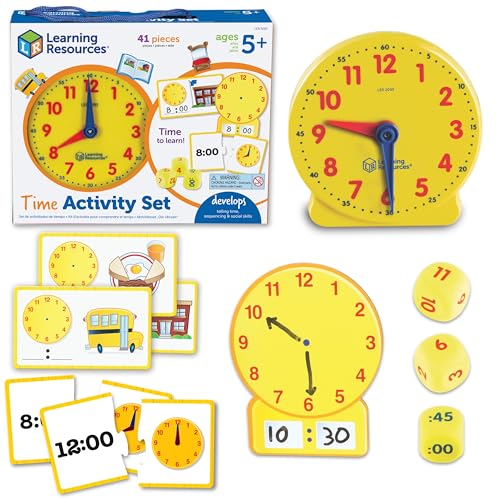
The Learning Resources Time Activity Set provides a comprehensive, multi-sensory approach to telling time. It includes a realistic teaching clock with synchronized hour and minute hands, moving together to reinforce how time progresses. Color-coded hands and numeric cues support visual learning, while puzzles, dice games, and activity cards introduce varied modalities to maintain engagement. The set includes durable teaching materials such as a double-sided card set, a dry-erase board, and additional foam dice, allowing teachers to design multiple pathways to mastery—from basic hour-minute alignment to more complex time measures like half-hours and quarters.
With its broad assortment of manipulatives, the Time Activity Set facilitates differentiated instruction. Students can work independently on timed tasks, while teachers can guide small groups through increasing difficulty. The kit’s emphasis on concrete manipulation helps bridge concrete learning with abstract concepts, laying a solid foundation for future math skills, including elapsed time and calendar-related activities. It also serves well in Montessori-inspired environments that value hands-on exploration.
Coogam Wooden Clock Teaching Time Toy

The Coogam wooden clock combines analog and digital time learning with a board game element that supports collaborative play. The hands on the wooden clock rotate smoothly to demonstrate time-telling, while the included flashcards offer quick practice for hours, half-hours, and quarter-hours. A fly-telling time board game component introduces a playful route for learners to apply what they’ve learned in a competitive or cooperative setting. The durable wooden construction makes it suitable for classroom use, travel, or homeschool environments where long-term resilience matters as students practice telling time across formats.
From a classroom planning perspective, the Coogam clock supports both direct instruction and independent or small-group activities. Its dual-mode approach—hands-on clock work plus game-based practice—can help reach diverse learners, including those who benefit from kinesthetic or social learning styles. The product also supports routine-building activities, such as daily time checks or time-management games that reinforce behavioral expectations alongside math skills.
Buying Guide: Time-Telling Tools For Every Learning Style
- Hands-on versus audio-visual: Choose clocks with physical clock hands for kinesthetic learners and/or talking features for auditory learners. Some learners benefit from a combination to maximize retention.
- Durability: For classroom use, select wooden or high-quality plastic clocks with sturdy moving parts and secure housing to withstand frequent handling.
- Time formats: Ensure both analog and digital representations are available, and consider tools that demonstrate transitions between hours, half-hours, and quarter-hours.
- Multi-sensory options: Sets that include cards, boards, or dice provide varied paths to mastery, supporting diverse learning preferences and enabling differentiated instruction.
- Center and group use: If implementing in a classroom, look for tools that scale from individual practice to small-group activities, with easy setup and clear instructional prompts.
- Age range alignment: Match the tool to the learner’s current skills—beginning readers may benefit from color-coded hands and audible cues, while older or advanced students can tackle elapsed time and calendar-related tasks.
- Engagement and motivation: Features like interactive quizzes, night-light Sleep Modes, or game-based components can sustain interest without sacrificing instructional value.
- Learning progression: A balanced mix of immediate feedback (instant readings, audible confirmations) and independent practice helps build confidence and fluency over time.