Choosing a telescope for deep space viewing depends on aperture, optical quality, stability, and ease of use. The following selections focus on capable azimuth and equatorial mounts, good light-gathering power, and beginner-friendly features that help uncover planets, lunar details, and distant galaxies. Each option below offers distinct strengths for exploring the night sky, from portable refractors to computerized reflectors.
| Product | Brand | Aperture | Focal Length | Mount Type |
|---|---|---|---|---|
| MEEZAA Telescope, 90mm Aperture | MEEZAA | 90mm | 800mm | AZ Mount |
| MEEZAA 150EQ Newtonian Reflector | MEEZAA | 150mm | 650mm | Equatorial Mount |
| Gskyer 70mm AZ Refractor | Gskyer | 70mm | 400mm | AZ Mount |
| Dianfan 90mm Refractor | Dianfan | 90mm | 800mm | AZ Mount |
| Celestron NexStar 8SE | Celestron | 203mm | 2032mm | GoTo Equatorial |
MEEZAA Telescope, 90mm Refractor for Beginners

The MEEZAA 90mm refractor provides a solid entry point for adult astronomy and beginners. Its 90mm aperture captures more light than smaller travel scopes, improving brightness and detail on the Moon and planets. The fully multi-coated optical glass lenses increase light transmission for brighter, clearer views. A versatile focal length of 800mm (f/8.88) pairs with two eyepieces (10 mm and 25 mm) and a 3X Barlow lens to offer magnifications from 32X to 240X. The included AZ mount, tripod, and phone adapter create a convenient, all-in-one setup for quick sky observations and occasional terrestrial use. Portable and beginner-friendly, this option supports expanding curiosity into deeper space exploration.
MEEZAA Telescope, 150EQ Newtonian Reflector for Deep Space
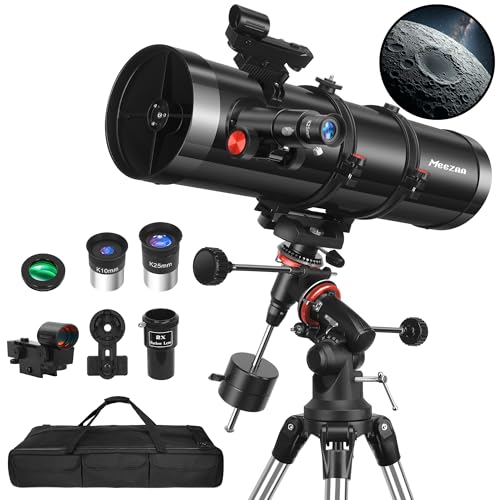
The 150EQ Newtonian from MEEZAA emphasizes light-gathering power with a 150mm aperture and 650mm focal length, ideal for brighte r images of deep-space objects, planets, and the Moon. The kit includes a red dot finder for quick targeting, a 2X Barlow lens, and two eyepieces (25mm and 10mm) to deliver magnifications from approximately 26X to 130X. The upgraded German Equatorial Mount with smooth slow-motion controls enables accurate manual tracking, making it a strong choice for beginners learning the sky and for enthusiasts pursuing more detailed planetary and deep-sky work.
Gskyer Telescope, 70mm AZ Travel Refractor

This Gskyer model balances portability with optical quality, featuring a 70mm aperture and a 400mm focal length for sharp, bright images of the Moon, planets, and brighter deep-space targets. The kit includes two eyepieces, a 3X Barlow lens, a 5×24 finder scope, a smartphone adapter, and a wireless remote for easy capturing. The 3X Barlow multiplies magnification, while the wireless remote enables hands-free photography. The compact design makes it a practical choice for travel, family star-gazing sessions, and quick sky checks between activities.
Dianfan Telescope, 90mm Refractor for Beginners

The Dianfan 90mm refractor emphasizes clarity and ease of use for learners. Its 90mm aperture and 800 mm focal length deliver bright, crisp views, enhanced by full multi-coated coatings for improved contrast and color fidelity. With two eyepieces and a 3× Barlow lens, users can achieve 32× to 240× magnification. The included 45° zenith mirror keeps images upright for terrestrial viewing, while the quick-assembly design helps beginners get observing faster. It suits families and first-time sky watchers aiming to explore lunar detail and brighter deep-space targets.
Celestron NexStar 8SE Computerized Telescope

The NexStar 8SE combines a large 8-inch Schmidt-Cassegrain optical tube with a fully computerized GoTo mount and SkyAlign alignment. The 8-inch aperture provides excellent light-gathering to reveal faint deep-sky objects, planetary detail, and galaxies. The NexStar+ hand controller accesses a database of 40,000+ objects and automatically slews and tracks targets, removing the need for manual star-hopping. This setup is well-suited for both ambitious beginners and advanced users who want easy, reliable access to a broad catalog of celestial targets and a streamlined observing experience.
Celestron StarSense Explorer DX 130AZ
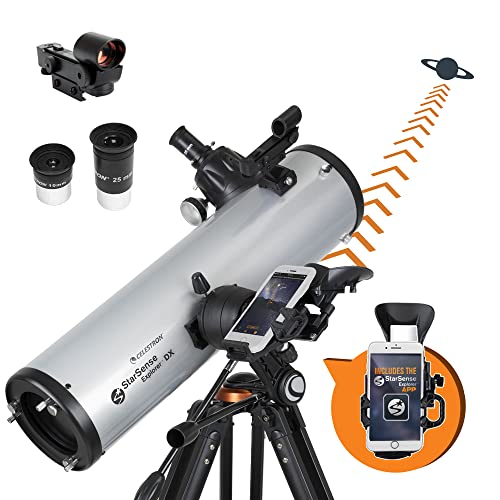
The StarSense Explorer DX 130AZ uses smartphone-powered sky mapping to simplify night sky navigation. Dock your phone, run the StarSense app, and the system analyzes star patterns to determine the telescope’s position, guiding users to top targets based on local time and location. The app-curated list highlights planets, bright nebulae, galaxies, and clusters, helping beginners and casual sky-watchers quickly find compelling objects. This option blends modern software with a traditional Newtonian design for accessible deep-space exploration from urban and dark-sky sites alike.
Celestron StarSense Explorer LT 114AZ
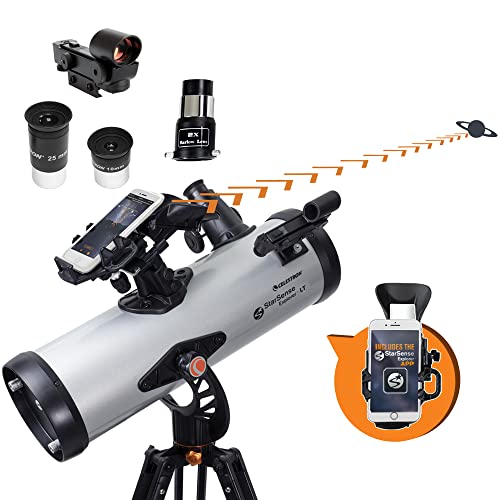
The StarSense Explorer LT 114AZ offers smartphone-enabled sky mapping with a compact Newtonian design, making it a compelling entry point for beginners who want automated guidance without heavy equipment. The StarSense technology analyzes star patterns to help locate objects, while the accompanying app delivers a tailored list of viewing targets for the chosen location and time. It’s ideal for casual stargazing, family sessions, and those who want a smart, approachable way to learn the night sky.
Buying Guide: Key Purchase Considerations and Comparisons
- Aperture and light-gathering power: Larger apertures reveal fainter objects and finer details, especially in deep space. If you plan to view distant galaxies or nebulae, prioritize 150 mm or larger where possible, while recognizing larger scopes require sturdier mounts and more setup effort.
- Mount type and stability: AZ (alt-azimuth) mounts are quick to set up and simple to use, suitable for beginners and casual observing. Equatorial mounts, including German Equatorial and GoTo systems, offer smoother tracking and easier celestial navigation for longer sessions.
- GoTo and smartphone integration: Computerized and app-assisted models reduce the learning curve and improve object finding. They are especially helpful in light-polluted areas where manual star-hopping becomes challenging.
- Optical quality and coatings: Fully coated optics improve brightness and contrast. Multi-coated lenses help deliver sharper images, particularly in the visible light range used for planets and brighter deep-sky objects.
- Portability and ease of setup: For beginners and families, a balance between performance and weight matters. Travel-friendly kits with carrying cases and quick-assembly features enable more frequent observing sessions.
- Accessories: A good starter kit includes additional eyepieces, a Barlow lens for magnification range, a finder or red dot sight for aiming, and a sturdy tripod or mount. A phone adapter and remote can simplify photography and sharing finds.
- Upgrade trajectory: If you anticipate growing into more advanced observing, consider models with larger apertures and more robust mounts (GoTo or computerized systems) to support longer sessions and a broader target catalog.