For young explorers, a beginner telescope can open the universe. This guide highlights practical, beginner-friendly options suited for an 11-year-old, focusing on clear optics, easy setup, and durable design. Each pick supports learning—from moon craters to distant planets—while staying budget-conscious and kid-friendly. Below you’ll find a concise product summary, followed by in-depth looks at five recommended telescopes and a buying guide to help you compare features like aperture, focal length, and accessories.
| Product | Brand | Key Benefit |
|---|---|---|
| Telescope for Adults Astronomy, 70mm Aperture 400mm Focal Length (Black) | FREE SOLDIER | Bright images, flexible magnification |
| HSL70400 Telescope for Kids 8-12, 70mm Aperture 400mm Focal Length | HSL | Fully coated optics; kid-friendly gift box |
| Telescope for Adults Astronomy, 70mm Aperture 300mm Focal Length | FREE SOLDIER | Compact option with wireless remote |
| Telescope for Adults Astronomy, 70mm Aperture 300mm Focal Length (Space) | FREE SOLDIER | Portable and easy to transport |
| Pirate Spyglass Telescope Pocket Compass Set | SSZS | Compact, nostalgic design for outdoor learning |
Telescope For Beginners: 70mm Aperture 400mm (Black)

The FREE SOLDIER telescope offers a 70mm aperture with a 400mm focal length, designed for beginners and older kids. It ships with a 3X Barlow lens and two eyepieces (H20mm and H6mm) to cover a wide magnification range from 15X to 150X. A 5X24 finder scope helps budding astronomers locate objects accurately. The setup is supported by a lightweight, portable carry bag and a tripod, with a smartphone adapter included for capturing moments. The optical system emphasizes bright, high-contrast images and relatively forgiving alignment, which is ideal for early stargazing sessions.
Why it suits an 11-year-old: The toolset balances performance with simplicity. The larger aperture admits more light, letting Moon features and brighter planets show up clearly even during twilight sessions. Its beginner-friendly accessories encourage hands-on exploration and ongoing curiosity about how the sky changes through the seasons.
HSL70400 Kids Telescope: 70mm Aperture, 400mm Focal
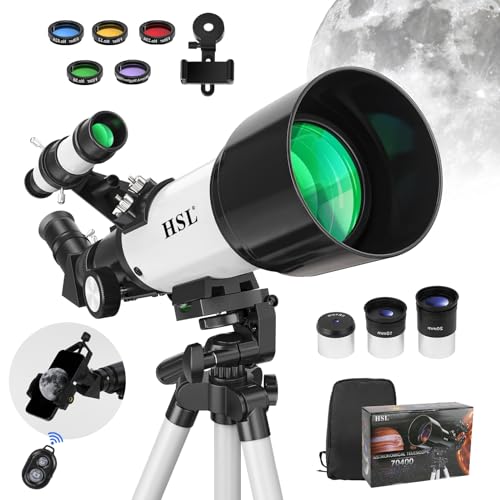
Designed for younger audiences, this telescope uses fully coated optical glass lenses to deliver crisp lunar and planetary views. A 400mm focal length paired with a 70mm aperture allows bright, clear images with enough light gathering for detail on the Moon and brighter planets. It includes three eyepieces (20mm, 10mm, and 4mm) to accommodate different targets and viewing conditions, while its colorful gift-ready packaging makes it a thoughtful present for birthdays or holidays.
Why it suits an 11-year-old: The multi-eyepiece setup provides a gentle transition from wide-field viewing to higher magnification, enabling kids to experiment with magnification without complex adjustments. The gift-box presentation makes it a compelling, motivating choice for young beginners.
70mm Aperture 300mm Focal Length: Portable Beginner’s Telescope
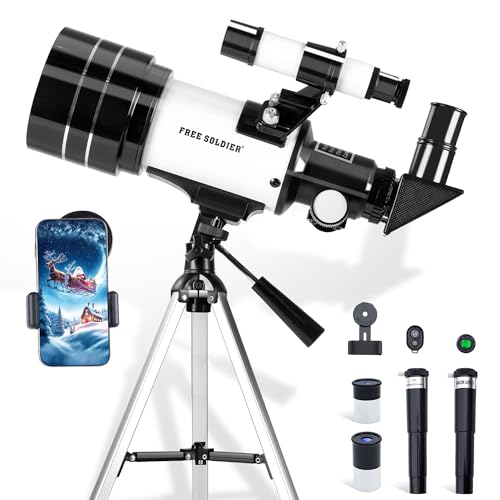
This FREE SOLDIER model emphasizes portability with a 300mm focal length and a 70mm aperture. It provides a similar magnification range (15X to 150X) as the 400mm version, thanks to a 3X Barlow lens and two eyepieces. A wireless remote and carry bag are included to support outdoor observing and quick demonstrations for classroom or family star-gazing nights. The optical performance remains solid with a fully coated lens system to maximize light transmission and sharpness.
Why it suits an 11-year-old: The lighter weight and remote-enabled features make it easy to show off discoveries to friends or family during an outdoor star party, while maintaining quality optics appropriate for introductory astronomy.
70mm Aperture 300mm Focal Length: Space Edition

The Space Edition variant mirrors the 300mm focal length with the same 70mm aperture, optimized for portability and everyday use. It carries the same high-resolution, multi-coated lens technology that helps maximize light transmission and image clarity. A smartphone adapter and a wireless remote provide modern capture capabilities, which can be appealing for an 11-year-old who enjoys sharing discoveries with peers or posting to family groups.
Why it suits an 11-year-old: The combination of portability, user-friendly features, and the ability to document observations offers a balanced learning experience—encouraging exploration without overwhelming setup complexity.
Pirate Spyglass Telescope Pocket Compass Set

Although styled as a novelty, this pocket spyglass introduces basic far-field viewing with a 25×30 magnification and a compact, collapsible design. The included compass adds a navigational element that can fuse astronomy with outdoor exploration, such as field trips or backyard observing sessions. While not a traditional telescope, it serves as an accessible stepping stone toward more advanced optics for curious 11-year-olds.
Why it suits an 11-year-old: It offers a low-barrier entry to observing objects at a distance, encouraging curiosity about angles, distance, and direction. It can complement more capable telescopes for a well-rounded beginner’s toolkit.
Buying Guide: Key Purchase Considerations
- Aperture and light gathering: A 70mm aperture (about 2.7 inches) strikes a good balance for beginners, delivering brighter lunar features and the earliest planets without excessive weight or complexity. Larger apertures improve brightness but may add cost and bulk.
- Focal length and magnification: Longer focal lengths provide a higher maximum magnification, but effective magnification also depends on lens quality and atmospheric conditions. Look for sets that include a few eyepieces and a Barlow or other magnification accessories to explore different targets.
- Ease of use: For an 11-year-old, simple setup, clear instructions, and reliable tracking are essential. A sturdy tripod, easy-to-use finder scope, and lightweight carry bag increase usability and outdoor readiness.
- Accessories: A smartphone adapter helps kids capture celestial images. A remote shutter or wireless control can make night observations more engaging for young learners.
- Durability and safety: Choose models with durable materials, protective lens coatings, and simple maintenance. Non-slip grips and safe, compact designs reduce the risk of accidents during setup and use.
- Portability: If you plan to travel to dark-sky sites or family trips, lighter frames and integrated carrying solutions can simplify outings and encourage more frequent use.
- Learning alignment: Look for kid-friendly guides or online resources that explain constellations, moon phases, and basic sky navigation to maximize learning outcomes.
Overall, beginner telescopes with 70mm apertures and 300–400mm focal lengths provide a practical balance for an 11-year-old. Favor models with multiple eyepieces and a finder scope, plus a simple carry setup to encourage regular use. Pair the telescope with a sky-watching plan—target the Moon during its crescent or gibbous phases and gradually introduce brighter planets as visibility improves.