Exploring a talking robot toy can spark creativity, language skills, and problem-solving in children. This guide highlights five top options that blend storytelling, motion, and interactive features. Each pick supports learning through play, using touch, voice, gestures, and programmable actions. Read on to compare design, control methods, and developmental benefits to help you choose the best robot companion for your child.
| Product | Brand | Key Features |
|---|---|---|
| GILOBABY Interactive Talking Robot – Blue | GILOBABY | Touch & voice control, record & repeat, dancing, singing |
| KingsDragon Robot Toy – Gesture Sensing | KingsDragon | Hand gesture control, remote control, LED eyes, programming up to 50 moves |
| KingsDragon RC Robot Toys – 3–8+ Years | KingsDragon | Remote and gesture control, 50 action programming, LED eyes, obstacle avoidance |
| LENGTOUQ Robots Toy – Remote & Gesture | LENGTOUQ | Remote control, gesture sensing, 50 programmable actions, singing/dancing |
| Ruko 1088 Smart Robots – App & Voice | Ruko | Large size, STEM play, 10 songs, 9 joints, multiple play modes |
GILOBABY Interactive Talking Robot – Blue
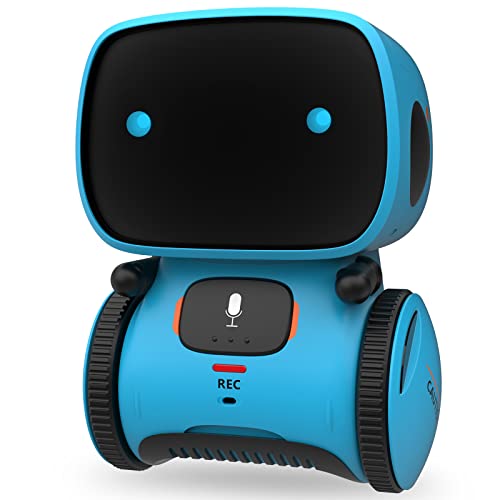
Designed for ages 3–7, the GILOBABY blue robot functions as an interactive companion that can hold conversations and respond to prompts. Its touch sensors and voice commands allow simple instructions, such as moving forward, reversing, or spinning 360 degrees. This encourages short-form conversations, turn-taking, and motor coordination as kids command the robot through play. In addition to movement, the robot sings and dances, and offers a record-and-repeat feature that lets children hear their own voices echoed back, fostering pronunciation practice and rhythmic experimentation.
KingsDragon Gesture-Sensing Robot – RC & Play

This interactive robot supports both gesture-based and remote control operation, offering forward/backward movement and left/right turns in response to hand signals or RC commands. Obstacle-detection sensors help prevent collisions, making it suitable for dynamic play indoors. It features LED eyes that light up as it moves, adding a visual cue to its actions. The unit can be programmed via the remote to store up to 50 moves, allowing kids to perform a sequence like a tiny choreographed routine. It’s a strong pick for children who enjoy cause-and-effect play and storytelling through movement, singing, and dancing.
KingsDragon RC Robot Toys – Gesture & Programming

This gesture-sensing robot blends infrared remote control with hand commands for intuitive play. It includes auto-display and obstacle-avoidance features and bright blue LED eyes that illuminate during movement. The toy supports a 50-action programming capability, enabling kids to build extended sequences such as turns, walking, patrolling, and dancing. Built with non-toxic ABS plastic and multi-joint design, it offers durability for active play and repeated programming sessions, providing opportunities to explore sequencing, cause-and-effect, and pretend play narratives.
LENGTOUQ Remote & Gesture Robot – Programmable

The LENGTOUQ robot combines wireless remote control with gesture sensing, offering forward/backward motion and turning actions triggered by user gestures. It includes obstacle avoidance and an automatic display mode to entertain and teach sequencing through action recording. The robot’s LED eyes provide a visual cue during operation, while the remote control also adjusts volume for music or speaking. With 50 programmable actions, children can craft short routines and watch them repeat, reinforcing planning and memory skills as they experiment with different motion patterns.
Ruko 1088 Smart Robot – Large Interactive Toy

Ruko’s 1088 model stands out with a large, kid-friendly build—up to about 15.8 inches tall—providing a substantial physical presence for storytelling and role-play. Its STEM-oriented design emphasizes basic programming concepts through expressive features: ten expressions, nine joints for dynamic movement, and ten songs for interactive performances. It supports multiple play modes, including gymnastic routines, storytelling, dance, and recorded narration, offering a well-rounded experience that encourages imagination, sequencing, and narrative construction in a larger-scale toy robot form.
Buying Guide
- Control method: Consider whether your child prefers touch, voice, gesture, or remote control. Devices offering multiple methods provide flexible play scenarios and adaptability as skills grow.
- Programming depth: Look for robots with 20–50 programmable actions. More options support longer-term engagement and introduce basic sequencing and memory concepts.
- Learning goals: For language development, prioritize record-and-repeat or storytelling features. For spatial awareness and sequencing, gesture and obstacle-avoidance features are beneficial.
- Durability and materials: Non-toxic plastics and sturdy joints are important for younger children who may handle toys roughly during imaginative play.
- Size and presence: Larger models offer a tangible presence for group play and can better support storytelling and role-playing activities.
- Safety and age range: Match the toy’s recommended age to the child’s development stage. Supervision is advised for younger kids during new features such as recording or app-connected modes.
- Maintenance: Check battery life, charging options, and the availability of replacement parts or customer support in case of wear or malfunction.