Finding engaging stem kits for a 7-year-old means balancing hands-on building with age-appropriate challenges. The following selections emphasize creativity, critical thinking, and basic engineering concepts that fit a child’s growing curiosity. Each kit below is designed to inspire exploration in science, technology, engineering, and math while providing safe, age-appropriate activities that can be enjoyed solo or with family.
Summary at a glance: the table below highlights five standout kits that align with early elementary STEM interests, including robotic builds, chemistry-inspired tricks, hydraulic hand mechanisms, and expansive electronics exploration. These options encourage problem-solving, fine motor skills, and collaborative learning, making them suitable for classrooms, homeschool, or weekend projects.
| Product | Brand | Audience Fit | What It Teaches |
|---|---|---|---|
| STEM Kits for Kids Crafts 6-8 8-12 | BeAndge | 8-12; great for 7-year-olds with guidance | Robotics basics, motorized mechanisms |
| Blue Marble National Geographic Magic Chemistry Set | Blue Marble | 8-12; beginner-friendly magic-based experiments | Chemistry basics and scientific demonstrations |
| National Geographic Earth Science Kit | Blue Marble | 8-10; family-friendly exploration | Earth sciences and experiments |
| KLUTZ Lego Race Cars STEM Activity Kit | Klutz | 8-12; creative building | Spatial reasoning, design, and STEM skills |
| Thames & Kosmos Mega Cyborg Hand STEM Kit | Thames & Kosmos | 8-12; hands-on hydraulics | Hydraulic systems and mechanical hand action |
STEM Kits for Kids Crafts 6-8 8-12

BeAndge’s STEM kit includes five sets: a solar-powered car, a wind-powered car, an obstacle-avoidance robot, a transmission tank, and a glider. It offers hands-on robotics building that introduces energy conversion, motion, and basic circuitry. Batteries are required separately, and it is suitable for family STEM activities or classroom projects.
Key features to note: a bundled robotics kit with multiple vehicles, encourages collaborative learning, and presents a visually engaging path from simple machines to robot behavior. It’s particularly strong for kids who enjoy constructing moving models and observing cause-and-effect in real time.
Blue Marble National Geographic Magic Chemistry Set
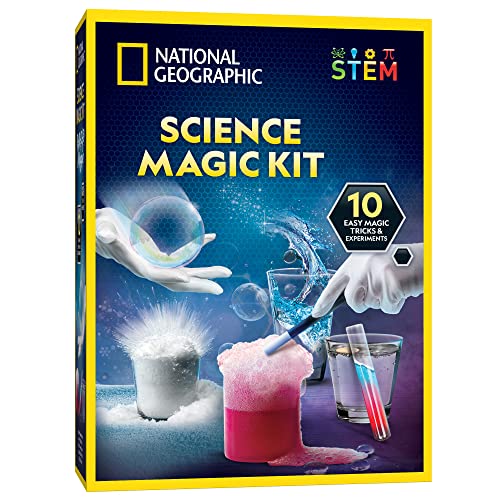
Blue Marble’s magic-themed chemistry kit presents 10 experiments designed as tricks, making chemistry approachable and entertaining. Included magic props help children present demonstrations to family and friends, while the illustrated guide explains the science behind each effect and fosters curiosity about chemical reactions and color changes.
Educational value centers on scientific inquiry, observation, and vocabulary development. It’s well-suited for kids who respond to visual demonstrations and storytelling as a pathway to learning science concepts.
National Geographic Earth Science Kit

This expansive kit offers more than 15 experiments spanning dueling water tornadoes, erupting volcanoes, crystal growth, and geologic digs. It’s designed for family sharing, allowing multiple children to explore Earth science topics simultaneously. The included learning guide provides accessible explanations about scientific concepts behind each activity.
Strengths include breadth and the opportunity to foster teamwork and project-based learning. It’s a robust option for families seeking a wide range of investigations that stay engaging across weeks of activities.
KLUTZ Lego Race Cars STEM Activity Kit

Klutz pairs a book with hands-on materials to build 10 LEGO race cars and a racetrack. The kit emphasizes spatial reasoning, logical sequencing, and creativity, guiding kids through step-by-step instructions to produce unique, functional models. It’s particularly appealing for children who enjoy both construction play and structured challenges.
The combination of reading and building supports literacy alongside engineering thinking, making it suitable for mixed-age group projects and reading-practice sessions tied to STEM.
Thames & Kosmos Mega Cyborg Hand

This kit lets kids build a wearable hydraulic hand that opens and closes using air pressure and manual control. It requires no motors or batteries, emphasizing pneumatics and mechanical design. The adjustable finger joints provide precision movement, enabling learners to experiment with grip strength and articulation.
The Mega Cyborg Hand is ideal for curious minds who enjoy tangible, scale-model engineering and experimenting with cause-and-effect in a physical system that resembles real-world hydraulics.
Science STEM Kits for Kids, Electronics Exploration Kit

VLGOEM’s 66-piece electronics kit promises over 1,200 possible projects, giving young builders a wide canvas for innovation. The parts are color-coded and snap together easily without tools, making it accessible for beginners while offering depth for advanced projects. It’s a strong option for kids learning circuitry concepts, sensors, and basic programming logic.
With a broad project scope and an organized guide, this kit supports practical, hands-on exploration of electrical engineering principles and introduces the idea of iterative design and testing.
Smartivity DIY Robotic Mechanical Hand

Smartivity’s mechanical hand kit is a project-based, screen-free activity designed to develop problem-solving and engineering thinking. It emphasizes step-by-step assembly, mechanical design, and a long-lasting learning experience with replacement parts. Accessible to a wide age range, it’s suitable for group projects or independent exploration.
The kit fosters hands-on construction, attention to detail, and patience as kids build and test the functioning hand, aligning with fundamental STEM skills in a tangible way.
choopheme 10 in 1 Stem Toys

Choopheme’s 10-in-1 set offers a variety of building models, including excavators and cranes, designed to trigger interest in engineering. The kit emphasizes multiple model designs, hands-on assembly, and storage for easy cleanup. It is suitable for kids who enjoy constructing different machines and seeing immediate results from their designs.
Safety considerations focus on non-toxic materials and straightforward assembly, with clear, kid-friendly instructions that encourage independent exploration while also supporting parental guidance when needed.
Buying Guide
Key purchase considerations for stem kits tailored to 7-year-olds include age-appropriateness, complexity level, and learning outcomes. Look for hands-on activities that balance guided instruction with room for independent exploration. Safety features, such as non-toxic materials and child-friendly components, are essential. Consider the child’s interests—robots, chemistry, or mechanics—and choose kits that offer scalable challenges to grow with them.
- Complexity and guidance: Some kits provide step-by-step directions suitable for beginners, while others offer open-ended projects to encourage problem-solving.
- Hands-on engagement: Kits should offer tangible assembly, triggers for exploration, and clear feedback when a project works or needs adjustment.
- STEM breadth vs. depth: Decide whether you want a broad set of activities across STEM fields or a deep focus on one area such as hydraulics or electronics.
- Safety and setup: Check for easy-to-follow assembly, minimal tools, and any required but non-included items (like batteries).
- Educational value: Look for learning guides that explain the science behind the activities, not just how to build.
From a family learning perspective, kits that encourage collaboration and discussion around discoveries tend to yield the most benefit. For classrooms or structured learning, consider kits with multiple experiments that can be distributed among students to promote teamwork and shared problem-solving. If portability matters, favor compact kits with organized storage and clear labeling to simplify setup between sessions.