Exploring the solar system can be as thrilling as a day at the planetarium. This guide highlights five engaging, kid-friendly solar system toys ideal for 8-year-olds. Each product blends hands-on learning with captivating visuals to foster curiosity about space, astronomy, and science concepts. Read on to compare features and find the best match for budding scientists.
| Product | Brand | Main Benefit | Ideal For |
|---|---|---|---|
| Science Can Solar System for Kids, Talking Astronomy Solar System Model Kit | Science Can | Interactive, bilingual learning with a built-in projector and educational facts | Hands-on explorers who enjoy classroom-style learning at home |
| National Geographic Glow-in-The-Dark Solar System Model Kit | Blue Marble | Glow-in-the-dark 3D model with movable arms and paint set | Creative builders who like painting and displaying a glowing model |
| National Geographic Mega Space Activity Kit | Blue Marble | Over 100 pieces for a broad range of space-themed crafts and activities | Project-based learners who enjoy multiple activities in one kit |
| 4M Solar System Planetarium | 4M | DIY planetarium with glow-in-the-dark features and educational wall chart | Young inventors who like assembly and classroom-style demonstrations |
| Solar System Building Sets with Light – Rotatable Space Exploration | CUBIMANA | Rotating 8-planet solar system with built-in lights and educational play | Engineering-minded kids who enjoy constructing and rotating planetary models |
Science Can Solar System for Kids, Talking Solar System Model

The Science Can Talking Solar System Model provides an engaging way to explore space. It projects the eight planets onto a surface, turning any room into a planetarium. The model offers bilingual learning with English and Spanish options and includes 24 space exploration slides via three disks. Kids press planet patterns to receive educational facts, reinforcing basic astronomy concepts while enjoying hands-on projection activity.
Science Can Interactive Talking Solar System Projector

This interactive projector features 53 quiz questions and 24 projected images across three disks, transforming a room into a space observatory. It offers English and French language options and an immersive learning experience with a quiz mode to reinforce astronomy concepts while keeping kids engaged during study or play sessions.
National Geographic Glow-in-The-Dark Solar System Model Kit

Kids build and display a glowing solar system with movable arms for all eight planets, including a sun. The kit includes six paint colors, glow-in-the-dark accents, decals, a poster with solar system facts, and kid-friendly instructions. Built for visual learners, it emphasizes art integration and hands-on assembly to solidify understanding of planetary order and scale.
National Geographic Mega Space Activity Kit

This all-in-one kit includes 100+ pieces for a broad range of space-themed crafts, experiments, and activities. It features a foam rocket launch, glowing constellations, and solar system painting projects. The kit supports exploratory learning, combining science with art to help kids understand space phenomena through hands-on construction and display.
4M Solar System Planetarium
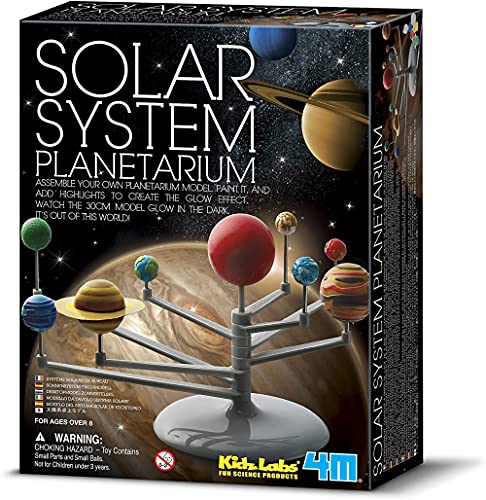
With simple assembly, this DIY planetarium uses stencils, glow paint, and a wall chart to teach the solar system. The set includes basic building materials and quiz questions to reinforce learning. It suits curious builders who enjoy step-by-step creation and visual demonstrations of planetary concepts.
Solar System Building Sets with Light – Rotatable

This rotatable space exploration set includes 9 planets and a rocket, with built-in lighting to simulate sunlight. The rotating mechanism helps kids visualize orbital movement while practicing engineering skills. It’s designed to boost hand-eye coordination, spatial reasoning, and creativity through building and display.
Buying Guide: Key Purchase Considerations
When selecting a solar system toy for an 8-year-old, consider learning goals, engagement level, and space for display. Hands-on kits like build-and-paint sets support art integration and fine motor skills, while projector and model kits emphasize spatial reasoning and astronomy concepts. Some options offer bilingual learning or interactive questions, which can deepen comprehension and language development.
- Educational scope: Determine whether the kit covers planets, orbits, and solar system concepts, or focuses on creative play with glow effects and displays.
- Engagement and pace: For independent play, choose interactive or puzzle-based kits. For guided learning, select kits with step-by-step instructions and fact sheets.
- Construction and mess: Consider the mess level and assembly time. Some kits require extensive painting or gluing; others are ready-to-display after a few steps.
- Display suitability: Glow-in-the-dark and 3D models fit well as bedroom decor or classroom demonstrations, while compact projects suit small spaces.
- Language features: Bilingual options or quiz modes can enhance language development and subject retention beyond basic visuals.
Comparative Highlights
- Best for interactive learning: Science Can Talking Solar System Model and Interactive Projector.
- Best for display: National Geographic Glow-in-The-Dark Solar System Model Kit.
- Best for broad exploration: National Geographic Mega Space Activity Kit.
- Best for hands-on construction: 4M Solar System Planetarium and Solar System Building Sets with Light.