Curious minds and budding scientists will find solar system toys to be engaging, educational, and fun. This guide highlights five standout options that blend hands-on learning with imaginative play, helping children understand planets, orbits, and space phenomena from the comfort of home or the classroom. Each selection is evaluated for age suitability, durability, and interactive features to support STEM curiosity.
| Product | Brand | Type | Key Benefit |
|---|---|---|---|
| Science Can Solar System | Science Can | Talking Solar System Model | Projectable planetarium with bilingual guide |
| National Geographic Glow-in-The-Dark Solar System | Blue Marble | 3D Model Kit | Glows in the dark, movable arms |
| Great Explorations 3D Glow in the Dark Planets | University Games | Glow-in-the-Dark Planets | Bright, ready-to-hang display |
| BLAZPATH Solar System Wooden Puzzle | BLAZPATH | Wooden Puzzle Toy | Portable, toddler-friendly parts |
| Dan&Darci Inflatable Solar System Planets | Dan&Darci | Inflatable Planet Set | Big, immersive ceiling display |
These selections emphasize visual and tactile learning, with options ranging from projectors and movable arms to wooden puzzles and inflatables. They’re designed to engage different play styles, from quiet solo exploration to collaborative classroom activities, while reinforcing basic astronomy concepts through interactive play.
Science Can Solar System: Talking Model

Features include a projector that casts all eight planets onto a surface, creating a ceiling planetarium. The model offers bilingual educational content in English and Spanish, allowing kids to press a planet pattern on the base to hear interesting astronomy facts. It comes with three disks containing 24 full-color slides showing planets, spaceships, astronauts, and more. The projector is adjustable for a clear display and supports hands-on exploration of the solar system.
National Geographic Glow-in-The-Dark Model Kit

This all-inclusive kit lets kids build an 8-planet solar system with a glowing finish. It includes six paint colors, glow-in-the-dark accents, brushes, decals, and a poster with solar system facts. Movable arms allow easy positioning of planets, enabling learners to recreate orbital arrangements. Easy-to-follow, kid-friendly instructions support independent assembly or guided projects in a classroom setting.
Great Explorations: Glow Planets In A Tube

The kit features eight colorful 3-D planets plus Pluto in a luminous display. It emphasizes bright glow-in-the-dark visuals to create a captivating room decoration while serving as a learning tool. The included materials support easy hanging or arrangement, enabling kids to design their own solar system display and explore the scale and arrangement of celestial bodies.
BLAZPATH Wooden Solar System Puzzle

This wooden puzzle features ten real-planet photographs, forming a complete solar system display in a compact, portable format. Weighing around 180g and 0.4″ thick, it’s designed for travel and easy handling by toddlers and young children. The circular puzzle pieces support fine motor skill development and recognition of planetary order, with a toddler-friendly design and durable construction.
Dan&Darci Inflatable Solar System Planets
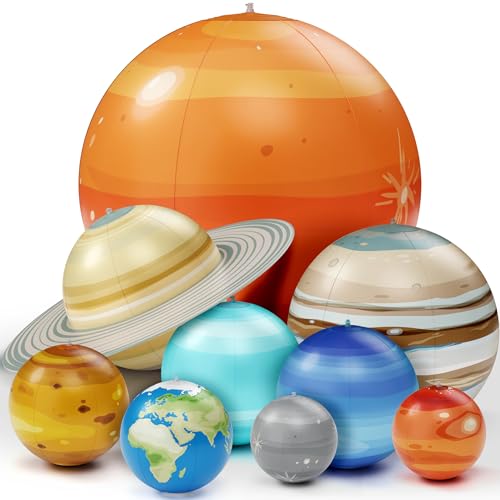
These jumbo inflatables present all eight planets and the sun in a ceiling-friendly display. The set includes galaxy learning cards with facts to extend understanding, suitable for ceiling decor and interactive learning. Planets can be hung with included strings, enabling kids to visualize orbital relationships while engaging in hands-on exploration of space concepts.
Buying Guide
When choosing a solar system toy, consider how the product supports different learning styles and ages. Look for durable materials, safe construction for hands-on exploration, and clear opportunities for hands-on manipulation or display. Key purchase considerations include:
- Age and safety: Match the product to the child’s age, handling capabilities, and safety needs, especially for smaller parts or inflatables.
- Educational value: Determine whether the toy reinforces astronomy basics, such as planet order, orbits, or surface features, and if it offers expandable learning resources.
- Interactivity: Decide between projector-based experiences, movable parts, or tactile puzzles to suit different preferences and learning environments.
- Durability and care: Consider materials (wood, plastic, inflatable) and cleaning requirements, especially for classroom or travel use.
- Display and space: Assess whether the toy doubles as room décor (glow features, wall-mounted or ceiling-hanging options) or is primarily a hands-on activity.
- Portability and setup: Portable puzzles and compact kits are beneficial for travel or classroom rotations; easy setup reduces maintenance time.
- Value and variety: A kit with multiple planets, discs, or accessories offers broader exploration opportunities over time.
Overall, selecting a solar system toy involves balancing educational impact with play value, ensuring a product that remains engaging as a child’s understanding of space grows. The options listed here provide a range of formats to fit different learning environments, from individual discovery to collaborative classroom projects.