Choosing the right science kit can spark curiosity and build confidence in budding scientists. The following selection highlights kits that mix experiments, chemistry, and STEM projects into engaging activities for kids. Each set emphasizes hands-on learning, clear instructions, and safe materials for at-home exploration. Whether your child loves volcanos, crystals, or color-changing reactions, these options offer meaningful ways to explore science with real-world connections.
| Product | Brand | Focus |
|---|---|---|
| NATIONAL GEOGRAPHIC Science Magic Kit | Blue Marble | Science magic tricks and 100+ experiments |
| National Geographic Junior Chemistry Set | Blue Marble | Early chemistry lab with 50 experiments |
| National Geographic Amazing Chemistry Set | Blue Marble | 100+ chemistry experiments, crystal growing |
| National Geographic Mega Science Lab | Blue Marble | Earth science, chemistry, and magic projects |
| Discovery™ Super Reactions Science Kit | Discovery Kids | 66 experiments with chemistry concepts |
The following sections profile each selected kit with a concise overview, key features, and practical considerations for parents and educators. Each product focuses on safe, beginner-friendly experiments designed to nurture curiosity and everyday scientific thinking.
NATIONAL GEOGRAPHIC Science Magic Kit

The National Geographic Science Magic Kit blends science experiments with magic tricks to create engaging demonstrations. It offers 100+ experiments that push kids to explore physics and chemistry in surprising ways, such as bending metal with water, vanishing test tubes, and coins floating on a surface. The kit includes a magic wand and gloves, making it easy to present tricks to friends and family while explaining the science behind each effect. This combination of demonstration and hands-on activity can help children connect theoretical concepts with practical results.
National Geographic Junior Chemistry Set

This kit is designed for young scientists aged 4 and up, providing a complete early learning lab experience. It focuses on chemistry using common household items like baking soda and vinegar, helping kids understand basic reactions. With 50 hands-on experiments and illustrated, easy-to-follow instructions, children can discover trial-and-error learning in a structured way. Its beginner-friendly approach makes it suitable for guided homeschool sessions or classroom demonstrations where foundational chemistry concepts are introduced and reinforced through safe, engaging activities.
National Geographic Amazing Chemistry Set

This chemistry-focused kit features 100+ experiments, including crystal growing and color-change reactions. Kids learn by doing, with a comprehensive set of materials for 15 standout experiments and a bonus guide with 85 additional ideas. The kit emphasizes safe handling, clear instructions, and curiosity-driven exploration, making it a strong option for ongoing science projects, school plans, or rainy-day science challenges that keep learning iterative and fun.
National Geographic Mega Science Lab
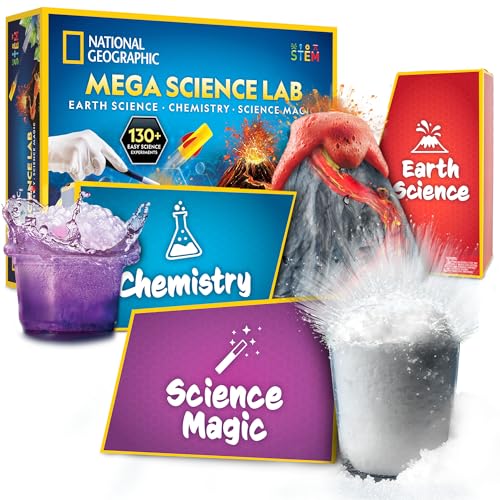
The Mega Science Lab combines three thematic kits into one bundle, featuring earth science, chemistry, and magic-based experiments. Kids can build and erupt a volcano, grow glow-in-the-dark crystals, create water tornadoes, and collect rock and mineral specimens. The set includes a bonus guide with additional experiments, offering a broad learning spectrum that covers geology, chemistry, and hands-on problem solving. It is well-suited for longer-term science projects or as a central STEM kit in a classroom rotation.
Discovery™ Super Reactions Science Kit

The Discovery Super Reactions kit provides 66 action-packed experiments that explore chemistry concepts like acid-base reactions, pH indicators, and gas expansion. With a mix of guided activities and bonus DIY ideas, this kit emphasizes real science with kid-friendly explanations of the reactions at work. The included tools and materials are designed to feel like a true laboratory experience, helping children reason through experiments and predict outcomes while maintaining a safe home setting.
Buying Guide: Key Purchase Considerations
- Age appropriateness: Check recommended age ranges to ensure the kit matches your child’s developmental level and reading ability.
- Hands-on balance: Look for kits that offer a mix of guided experiments and independent exploration to foster curiosity and confidence.
- Lesson clarity: Favor sets with illustrated, step-by-step instructions to reduce frustration and enhance learning outcomes.
- Safety and materials: Prioritize kits that include quality, safe-to-handle materials and come with goggles or protective gear when relevant.
- Expandability: Some kits offer additional experiments or bonus guides, extending learning beyond the initial set.
- Curriculum alignment: If used in a classroom or homeschool, consider how the kit aligns with science standards or core topics like chemistry, physics, or earth science.
- Cost and value: Compare the number of experiments and included tools to assess long-term value beyond the initial purchase.
- Storage and organization: Kits with durable containers or organizers help keep materials sorted for easy reuse.
- Community and support: Access to online tutorials, troubleshooting tips, or teacher resources can enhance the learning experience.