Choosing the right robot kit for teens means balancing complexity, creativity, and real-world application. The following selections are tailored for 14-year-olds who want more advanced challenges, longer-lasting projects, and opportunities to explore coding, sensing, and robotics concepts. Each kit emphasizes hands-on building, programmable control, and expandable learning potential. Use this guide to compare components, programming options, and how each kit supports STEM growth beyond the classroom.
| Product | Brand | Focus | Age Range |
|---|---|---|---|
| ELEGOO UNO R3 Smart Robot Car Kit V4 | ELEGOO | Arduino-powered car with sensors and app control | 8-16 |
| Henoda Robot Toys (APP/Remote) | Henoda | Remote and app-controlled programmable robot | 8-16 |
| Thames & Kosmos Mega Cyborg Hand | Thames & Kosmos | Hydraulic, pneumatic hand with adjustable joints | 8+ |
| ELEGOO Conqueror Robot Tank Kit | ELEGOO | Arduino-based tank with rich functions | 8-16 |
| Robot Building Toys Stem Projects (Henoda) | Henoda | Remote & App-controlled programmable robot | 8-16 |
ELEGOO UNO R3 Smart Robot Car Kit V4

The ELEGOO Smart Robot Car Kit V4 introduces teens to foundational robotics concepts through an Arduino-based platform. This kit supports hands-on programming, electronics assembly, and robotics theory, making it suitable for extended STEM learning. It includes 24 module parts, such as obstacle avoidance and line-tracing modules, plus Android and iOS app compatibility for remote operation. The interface has been simplified with XH2.54 ports to reduce setup errors and speed up assembly. This setup encourages experimentation with sensors, control logic, and basic autonomous behavior.
Henoda Robot Toys With APP Or Remote
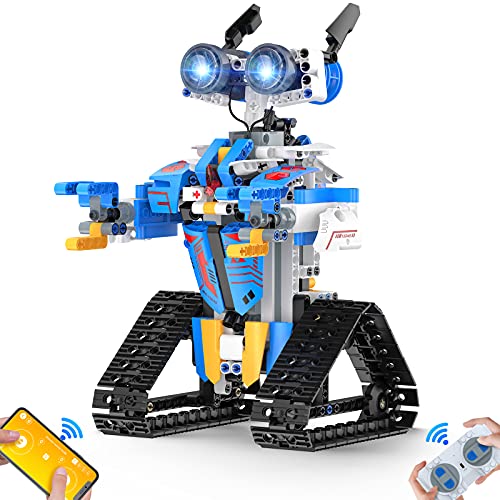
This Henoda set combines 468+ building blocks with remote and app-controlled capabilities, promoting hands-on building and imaginative play. The kit emphasizes STEM skills, including hand-eye coordination, motor control, and problem solving as kids assemble and customize their robot. It offers multiple control modes—remote, path mode, voice control, gravity sensor, and stem programming—plus a 2.4 GHz remote for longer-range play. The design supports open-ended exploration, encouraging kids 8 and up to test movement, sensing, and basic programming concepts.
Thames & Kosmos Mega Cyborg Hand

The Mega Cyborg Hand kit focuses on hydraulics and pneumatics to create a wearable, manually controlled robotic hand. There are no motors or batteries required; it demonstrates pneumatic actuation and manual finger movement to grip objects with realistic motion. Each finger joint is adjustable, allowing precise positioning and experimentation with leverage and control. This kit emphasizes the physics of pressure, fluid dynamics, and mechanical design, offering a tactile exploration of engineering principles for teens studying STEM topics.
ELEGOO Conqueror Robot Tank Kit
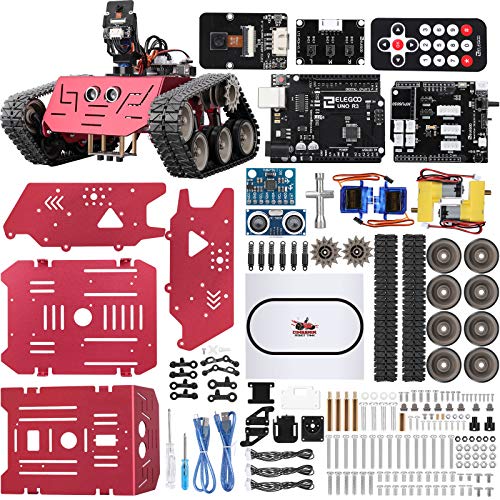
The Conqueror Tank Kit expands on Arduino-based robotics with a robust tank design and varied functionalities. It emphasizes DIY assembly, hands-on construction, and a suite of graphically programmed building blocks. The kit is designed to spark creativity and imagination while extending students’ knowledge of sensors, actuators, and control systems. It’s suitable for more complex projects that challenge problem solving, iterative testing, and circuit integration in a classroom or home setting.
Robot Building Toys Stem Projects (Henoda)
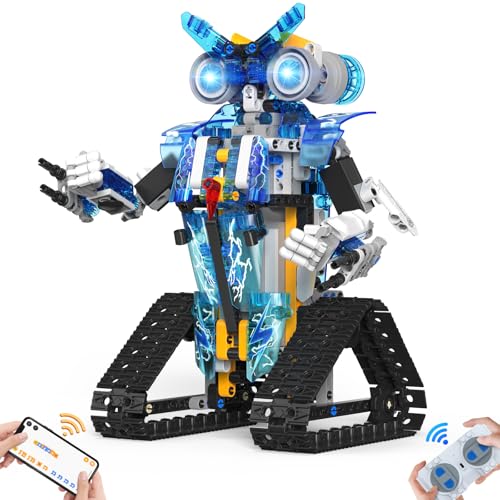
This Henoda kit focuses on remote and app-controlled programmable robot building blocks, delivering substantial hands-on activity and STEM learning. With 443+ pieces, it supports constructing diverse robot configurations, encouraging creativity, patience, and engineering thinking. Features include a remote control system and Bluetooth app support for programming and testing movements, making it a flexible option for teens exploring robotics and coding concepts in an interactive format.
Buying Guide
- Programming environment: Consider whether the kit uses Arduino, Bluetooth app control, or graphical programming. Teens may prefer more open-ended languages (C/C++) or block-based interfaces for easier iteration.
- Hardware complexity: Start with kits offering clear instructions and scalable projects. Seek sets that allow add-ons or expansion to extend learning beyond initial builds.
- Sensing and actuation: Look for kits with a mix of sensors (line-following, obstacle detection, gyroscopes) and varied actuators (servos, motors, pneumatics) to explore control systems and feedback loops.
- Community and resources: A platform with tutorials, project ideas, and active forums helps sustained engagement and troubleshooting.
- Safety and materials: Non-toxic components, sturdy construction, and age-appropriate parts are important for extended use and safe experimentation.
- Hands-on vs. remote control: Balance kits that emphasize manual assembly with those offering remote or app-driven programming based on the teen’s interest in coding or mechanical design.
- Project scope and goals: Consider whether the goal is to learn fundamentals, build a programmable robot, or create physical computing projects that align with school coursework.