Finding a robot that blends entertainment with learning is ideal for curious 9-year-olds. The following five options offer hands-on coding, programmable play, and interactive features that help kids develop problem-solving, logic, and creativity. Each product below is chosen for age suitability, safety, and engaging activities that align with STEM learning goals.
| Product | Age Range | Key Benefit |
|---|---|---|
| Ruko 1088 Smart Robots for Kids | 4-9 | Voice and APP control, expressive movements |
| Henoda Robot Toys | 8-16 | 468+ pieces, multi-mode control, long-range remote |
| KingsDragon RC Robot | 6-9 | Gesture sensing, singing and dancing, obstacle sensing |
| ELEGOO UNO R3 Smart Robot Car Kit | 8-12 | Arduino-based coding, modular building, broad learning suite |
| Makeblock mBot | 8-12 | Scratch to Arduino coding, easy assembly, rich tutorials |
Ruko 1088 Smart Robots for Kids

The Ruko 1088 stands out with its large size and multi-modal play. Standing tall at up to 15.8 inches, this robot offers voice control, APP control, and 10 expressions across 9 joints, enabling dynamic, lifelike movement. With 10 songs and varied activities—gymnastics, storytelling, dancing, music, and recording—it provides a broad platform for imaginative play and basic programming exploration. Its emphasis on creativity and coordination makes it a strong option for curious 9-year-olds seeking a responsive, social robot companion.
Henoda Robot Toys for Kids
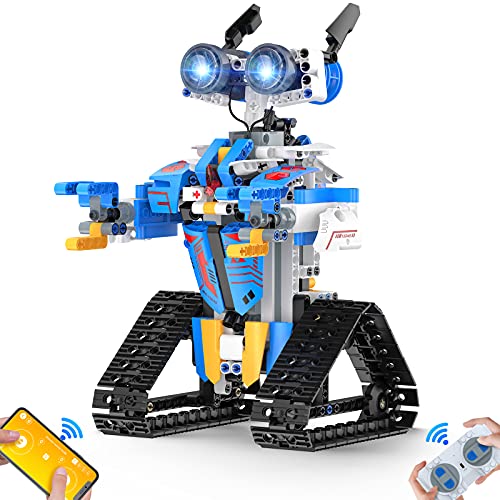
The Henoda kit emphasizes STEM-building with 468+ pieces and a robust remote control. It supports phone APP Bluetooth control, plus a 2.4 GHz remote for extended range. The toy offers path-based, voice, gravity sensor, and programmable modes, encouraging hands-on construction, problem solving, and collaborative play. Its modular design and transforming robot features can captivate 9-year-olds, helping bridge tactile building with digital control.
KingsDragon RC Gesture Sensing Robot

KingsDragon offers hand-gesture sensing alongside remote control, enabling intuitive command of forward, backward, and turning movements. Its collision detection sensors help teach spatial awareness while avoiding crashes. The robot supports recording up to 50 programmable moves, making it a valuable tool for children to plan sequences and see cause-and-effect outcomes. It also features singing and dancing routines, contributing to interactive, entertaining learning sessions for 9-year-olds.
ELEGOO UNO R3 Smart Robot Car Kit

The ELEGOO UNO R3 kit is a foundational STEM option, combining Arduino-based learning with a modular, car-style robot. It includes 24 module parts such as obstacle avoidance and line-tracing modules, with control via smartphone or tablet. Easy assembly and a strong ecosystem of tutorials support progressive learning—from basic circuits to more advanced programming—making it a preferred pick for 9-year-olds ready to dive into hands-on robotics.
Makeblock mBot

The Makeblock mBot prioritizes approachable coding education, transitioning from Scratch to Arduino. It comes with clear building instructions and can be used as a remote-controlled car with line-following and obstacle-avoidance features. The kit includes tutorials and apps for programming, enabling gradual skill development across electronics, robotics components, and software. This makes it suitable for 9-year-olds starting to engage with real-world code and hardware integration.
Buying Guide: Key Purchase Considerations
- Age-appropriate complexity: Choose a kit that matches the child’s current skills with room to grow. For beginners, simpler remote-control and basic coding options are ideal; for more advanced learners, kits with Scratch-to-Arduino or block-based to text-based progression are preferable.
- Hands-on learning vs. guided play: Some robots emphasize storytelling and dancing, while others focus on building and programming. Consider the child’s interests—creative play or technical construction.
- Programming environment: Look for tools with kid-friendly software (Scratch, block-based coding) and supportive tutorials. Apps should be compatible with common devices and offer offline options when possible.
- Expansion potential: Kits that allow adding sensors, motors, or external modules provide long-term engagement as skills progress.
- Safety and durability: Check for sturdy plastics, non-toxic materials, and safe handling when kids manipulate moving parts and wires.
- Price vs. value: Weigh the included components, length of active support, and the breadth of learning opportunities against cost. More modular systems may pay off in extended learning.
- Community and resources: A strong online community with tutorials, project ideas, and troubleshooting can significantly enhance the learning experience.
In selecting a robot for a 9-year-old, prioritize models that balance engaging activities with clear educational benefits. The options above provide a spectrum—from large, expressive companions to hands-on building kits—allowing caregivers to tailor choices to a child’s curiosity and learning pace.