Choosing the right robot for an 11-year-old blends hands-on building, programmable learning, and safe, engaging play. The following selection focuses on wind‑up, remote/app‑controlled, and solar robots that nurture problem‑solving, engineering reasoning, and creativity. Each option below meets age‑appropriate challenges with clear building steps, interactive modes, and evolving skill demand to keep a curious learner engaged.
Summary table of chosen products:
| Product | Brand | Key Strength | Typical Play Style |
|---|---|---|---|
| Henoda STEM Building Block Robot Kit (468+ pieces) | Henoda | Building, remote and app control, STEM projects | |
| Henoda Remote & APP Controlled Robot Kit (443+ pcs) | Henoda | Remote control, app programming, STEM thinking | |
| COBFDHA Solar Robot Space Kits (120Pcs) | COBFDHA | Outdoor experimentation, solar energy concepts | |
| KingsDragon Gesture Robot | KingsDragon | Hand commands, autonomous features, experiments | |
| Lucky Doug 12-in-1 Solar Robot Kit | Lucky Doug | Outdoor solar play, project variety |
Henoda 468+ Pieces STEM Building Robot Kit
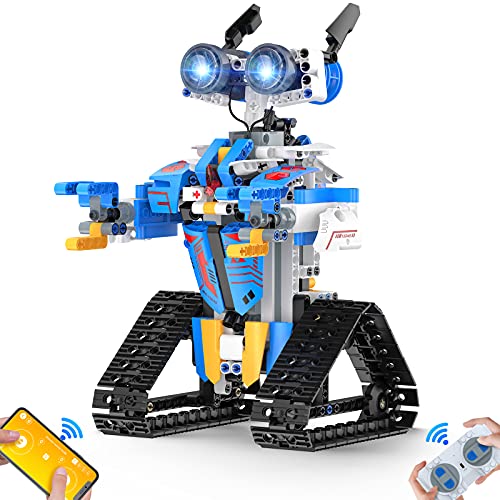
The Henoda kit centers on a large 468+ piece STEM building system with glow eyes, rotating limbs, and transforming robot forms. This setup emphasizes hand-eye coordination, practical building skills, and the basics of mechanical motion. It supports multiple play modes—remote, app Bluetooth, gravity sensing, and stem programming—making it suitable for a learner who enjoys both construction and simple programming tasks. The remote distance exceeds 20 meters, offering ample space for experimentation and demonstrations.
Educational value meets playability: kids assemble parts, test movement in four directions, and explore practical robotics concepts. The kit is pitched as a birthday or festival gift, designed to engage kids 8 and up in constructive, screen-conscious play. This product is a strong option for families seeking a comprehensive build-and-play experience with a focus on STEM fundamentals.
Henoda Remote & APP Controlled Robot Kit (443+ Pcs)
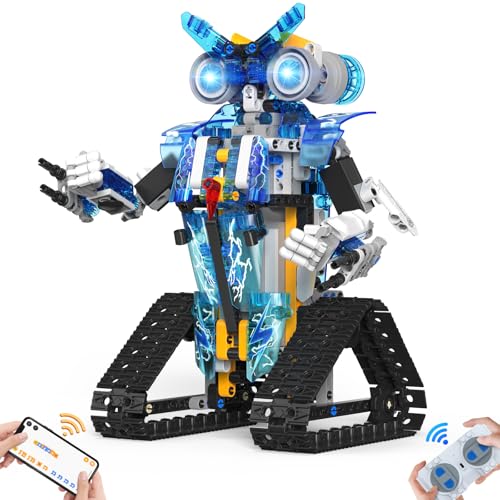
This Henoda set features 443+ pieces and a transparent aesthetic with lightning-pattern stickers, designed to sharpen patience and engineering thinking. The robot supports remote control (2.4 GHz) and an app with five modes: remote, voice, gravity sensor, STEM programming, and path mode, plus a 20-meter control range. It is well-suited for older kids who enjoy detailed assembly, programmable routines, and testing cause-and-effect within a guided software environment.
COBFDHA Solar Robot Space Kits
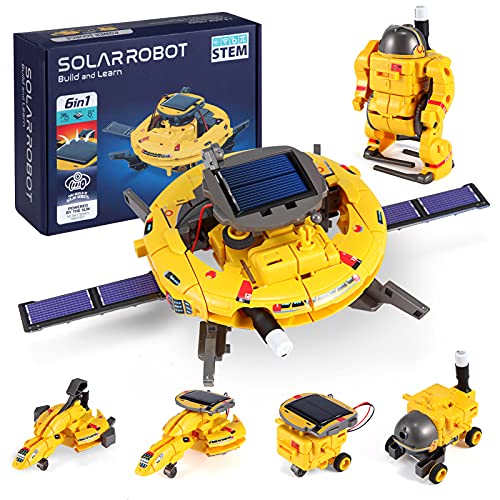
COBFDHA offers a solar-powered robotics project with six different land-moving robots in a single kit. The solar approach fosters environmental awareness and renewable energy concepts while maintaining hands-on building challenges. The kit emphasizes creativity, imagination, and problem-solving as kids explore how solar energy drives motion. Suitable for outdoor use and weather permitting, it balances indoor and outdoor play with a clear STEM focus for ages roughly 8–12.
KingsDragon Gesture Remote Control Robot

KingsDragon’s robot combines infrared remote control with gesture sensing, enabling users to influence movement through hand motions. It includes an auto display, obstacle avoidance, and a large action library (up to 50 programmed moves). The design emphasizes hands-free interaction, quick feedback, and beginner-friendly programming that can grow into more complex sequences as a child’s skills mature.
Lucky Doug 12-in-1 Solar Robot Kit

Lucky Doug presents a versatile solar robot kit with 12 build options, all powered by solar energy. The solar approach teaches renewable energy concepts while offering substantial variety for extended play. It’s an excellent choice for outdoor exploration and for children who enjoy experimenting with different configurations and motions across multiple builds. The included parts are designed to be disassembled and rebuilt, supporting iterative learning.
STEM 13-in-1 Solar Robot: Bottleboom

Bottleboom’s 13-in-1 solar robot kit elevates the solar-powered project category with a broader range of robots. The kit emphasizes renewable energy learning, hands-on construction, and mechanical reasoning. It provides an indoor/outdoor-friendly experience suitable for ages around 8–14, enabling kids to explore mechanics, gears, and motion under solar propulsion while developing problem-solving and self-confidence.
Buying Guide: Key Purchase Considerations For 11-Year-Olds
Age range and learning curve: Look for kits specifically labeled for ages 8–12 or 8–14. Thicker instruction sheets and modular parts help young builders progress to more advanced programming or complex builds as confidence grows.
Power source: Robotic kits can use remote control, Bluetooth apps, gravity sensing, or solar energy. Consider your child’s environment and interest: indoor, outdoor, or mixed play. Solar-powered kits teach renewable energy concepts and promote outdoor experimentation.
Programming and control modes: Apps and onboard programming tracks add depth, but ensure the learning curve remains manageable. Some kits offer a simple remote, while others provide multi-mode programming that can grow with the child’s skills.
Number of pieces and build complexity: More pieces usually indicate extended play and longer learning timelines, but ensure the included instructions and support materials are age-appropriate. Large, multi-part builds can boost patience and planning skills.
Hands-on STEM impact: Favor kits that explicitly target hands-on construction, mechanical reasoning, problem-solving, and critical thinking. A mix of assembly work, experimentation, and guided challenges yields the best cognitive growth.
Safety and materials: Look for non-toxic plastics, smooth edges, and ergonomic designs. Avoid overly small parts for younger siblings or less careful users, especially with multi-piece kits.
Future expansion: Some brands offer additional modules or expansion kits, enabling progressive learning paths from basic mechanics to programming and automated sequences. Consider whether a kit can grow with the child’s interests.
Value and support: Check for clear instructions, online tutorials, and robust customer support. A well-documented product helps families maximize learning outcomes and reduce frustration during builds.
Overall, for an 11-year-old, a mix of buildable STEM kits with programmable or solar-powered features tends to deliver the best balance of hands-on learning and engaging play. The options listed above provide varied levels of challenge, from gesture-controlled play to multi-mode app programming and renewable energy exploration. Each kit supports core competencies in science, technology, engineering, and math while offering enjoyable, screen-light experiences that encourage curiosity and independent thinking.