Choosing a robot building kit for a 7-year-old means balancing hands-on play with safe, age-appropriate learning. The following five kits offer engaging building experiences, beginner-friendly coding options, and durable parts designed for growing STEM curiosity. Each option supports creativity, problem solving, and fine motor skills through interactive play that keeps kids away from screens while they learn.
| Product | Brand | Pieces | Key Benefit |
|---|---|---|---|
| Henoda Robot Toys | Henoda | 468+ pieces | Remote/app control with multiple modes |
| Sillbird 5-in-1 | Sillbird | 488 pieces | 5 models, Bluetooth app or remote control |
| Bottleboom 13-in-1 Solar Kit | Bottleboom | 13 builds | Solar power and hands-on engineering |
| Hodurgyi 5-in-1 | Hodurgyi | 554 pieces | App and remote control with diverse models |
| Makeblock mBot | Makeblock | Complete kit | Scratch/Arduino coding introduction |
Henoda Robot Toys For 8-16 Year Olds: 468+ Pieces With App Or Remote
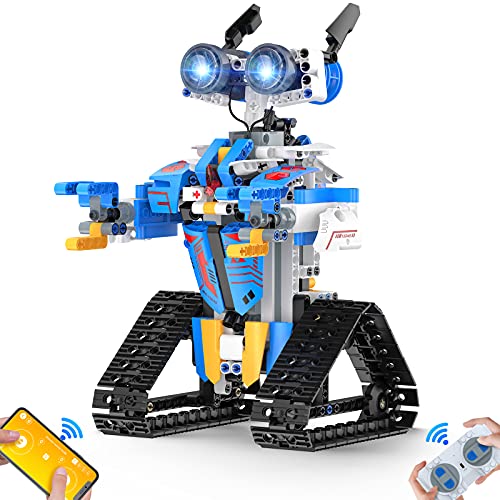
Henoda’s robot building set combines a large piece count with multiple control modes to support diverse play styles. The kit includes 468+ pieces and stickers to customize the model, promoting hand-eye coordination and practical building skills. It’s described as suitable for ages 8 and up, but many 7-year-olds can enjoy guided play and simple assembly with adult supervision. The robot moves in multiple directions, features glowing eyes and rotating joints, and offers four remote-control modes: phone APP Bluetooth, remote control, path mode, and voice or STEM programming mode. The remote range extends beyond 20 meters for expansive play spaces.
Sillbird 5-in-1 Robotic Kit: 488 Pieces With App Or Remote
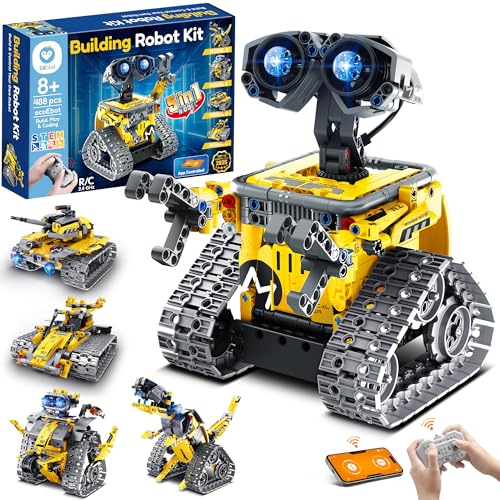
This Sillbird set emphasizes versatility with five buildable models and a combined learning approach. At about 488 pieces, kids can construct, disassemble, and rebuild to explore different mechanisms. The kit supports dual control: an intuitive Bluetooth app and a traditional remote, enabling basic programming, path creation, and precise movement. It’s designed to inspire early engineering and coding concepts, while keeping play accessible through straightforward assembly steps and kid-friendly instructions.
Bottleboom 13-in-1 Solar Robot Kit: Water Or Land Movement

The Bottleboom kit centers on solar power and modular building, offering 13 distinct robot configurations. Built to teach energy principles, the kit demonstrates solar energy use and basic renewable power concepts. All pieces are designed for safe handling with non-toxic ABS materials, focusing on durable parts and long-term play. Parents may appreciate the emphasis on learning through experimentation, problem solving, and collaboration during family build sessions.
Hodurgyi 5-in-1 STEM Kit: APP Or Remote Control For 4+ Models

Hodurgyi’s 5-in-1 kit blends in-app smart control with traditional remote operation, enabling 360-degree rotation, four-direction movement, and guided STEM programming. The 554-piece set supports constructing multiple models, reinforcing engineering concepts and spatial reasoning. The app interface introduces basic coding concepts and navigation paths, offering a bridge between hands-on building and computational thinking.
Makeblock mBot: Coding Robot For Scratch & Arduino

The Makeblock mBot introduces kids to coding through Scratch and Arduino ecosystems, making it a gentle entry into computer programming. The kit is designed for straightforward assembly, letting children explore line-following, obstacle avoidance, and remote-control functions. It’s well-suited for beginners who want a tangible link between hardware and software, with ample tutorials and community projects to extend learning as kids grow. The setup supports ongoing exploration of electronics, sensors, and robotics concepts.
Buying Guide
Key purchase considerations for choosing the best robot building kit for a 7-year-old include age appropriateness, safety, and ease of use. Look for large, sturdy pieces with rounded edges and non-toxic materials. Durable instructions with clear, step-by-step visuals help kids build independently or with minimal supervision. Consider control methods: apps provide modern interaction, while remotes can be simpler for younger kids; some kits offer dual modes to grow with the child.
Learning goals matter. If the child is curious about energy and physics, solar-powered or mechanical kits provide tangible demonstrations of energy conversion and motion. For budding coders, kits with Scratch- or Arduino-compatible software introduce basic programming concepts in a friendly environment. A kit with multiple models encourages problem-solving and creativity, but ensure the complexity matches the child’s patience and fine-motor skills.
Expandability and compatibility are also important. Kits with modular parts or compatibility with other brand blocks increase future play value. Consider the learning curve: some kits include guided projects to build confidence quickly, while others favor open-ended exploration to foster experimentation and perseverance. Finally, check for safe storage solutions and included accessories, such as batteries, chargers, or extra components, to maximize playtime without interruption.