Finding the right push walker can help toddlers gain confidence, improve balance, and enjoy independent steps. The following selections focus on safety, age-appropriate features, and durable design to support early walking and encouraging play. Each option listed has been vetted for quality and educational value, with a variety of materials and activities to suit different temperaments and spaces.
Summary at a glance: the table below highlights key details for the five featured push walkers, including brand, primary benefit, and target age range to help parents compare quickly.
| Product | Brand | Primary Benefit | Target Age |
|---|---|---|---|
| Fisher-Price Panda Push Walker | Fisher-Price | Multi-stage learning with 100+ songs and phrases | 6+ months to walking |
| Tiny Land Wooden Push Walker | Tiny Land | Montessori-inspired activity center and mirror | First steps to 3 years |
| Radio Flyer Classic Walker Wagon | Radio Flyer | Furniture bumpers and toy storage | 12 months to 4 years |
| Baby Einstein Musical Mix ‘N Roll | Baby Einstein | 4 modes of play with 100+ melodies | Infant to toddler |
| Pithfor Wooden Baby Walker | Pithfor | Eight activity toys for comprehensive development | 10–12 months to 3 years |
Fisher-Price Panda Push Walker

The Panda-themed push walker serves as an interactive activity center that grows with the child. It supports babies from sitting to pulling up and walking, with a two-sided design for exploration. Steady Speed wheels help maintain a beginner-friendly pace, reducing the risk of trips or falls. Its 100+ songs, sounds, and phrases across three learning levels introduce concepts like the alphabet, counting, and opposites, enhancing early language and cognitive development.
Fisher-Price 4-in-1 Snack Cart Walker
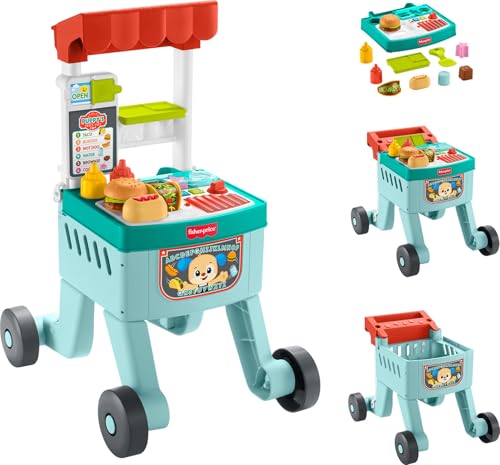
This 4-in-1 push walker blends a snack-cart theme with learning activities. It evolves as the child grows from sitting to walking to pretend play. Three Smart Stages cover opposites, counting, shapes, and the alphabet, with 135+ songs and sounds. A globe button enables language selection among English, Spanish, French, and Brazilian Portuguese, broadening early multilingual exposure. Lights and interactive buttons further engage curiosity and fine motor skills during play and push sessions.
Tiny Land Wooden Push Walker

Wooden construction paired with a mirror, gears, and learning toys gives this walker a Montessori-inspired feel. The rear rack offers space for little treasures, encouraging independent exploration. An adjustable speed control helps set the pace for first steps, promoting balance and confidence. The wood build uses non-toxic finishes and smooth edges to reduce risk, and silent rubber wheels protect floors while reducing noise during indoor use.
Radio Flyer Classic Walker Wagon

The Classic Walker Wagon emphasizes safety with resistance clickers that regulate motion, helping beginners build initial balance without rushing ahead. A furniture-friendly bumper protects walls and furniture, reducing the risk of scuffs during early walking. The wagon doubles as a toy storage unit, encouraging tidy play and a sense of responsibility as toddlers carry and haul small items during outings or inside the home.
Baby Einstein Musical Mix ‘N Roll

This versatile walker grows with the child through four modes: floor toy station, push-behind walker, music table, and creative table. It offers 100+ melodies and phrases across languages including English, Spanish, French, and German. A parent volume control ensures safe listening levels, while the music and tempo-focused play support auditory development and rhythm awareness as toddlers push, sit, and explore.
Pithfor Wooden Baby Walker

Designed as an all-in-one learning aid, this wooden walker blends mobility with eight activity toys, including a mirror, rolling drum, bead maze, xylophone, spinning gears, shape sorter, drum, and zig-zag track. It supports toddler development across perception, coordination, and cognition through varied play experiences. The natural wood finish and non-toxic materials align with safety-conscious parents seeking durability and a calm, engaging aesthetic in playtime and first steps.
Buying Guide: Key Purchase Considerations
- Age and developmental stage — Choose a walker that supports sitting to standing transitions and early walking, with adjustable pace or resistance for safety.
- Materials and durability — Wood options often provide a sturdy feel and longer lifespan, while plastic models may offer brighter colors and lighter weight; verify non-toxic finishes and smooth edges for toddler safety.
- Safety features — Look for slow-start or resistance mechanisms, corner bumpers, wide bases for balance, and floor-friendly wheels that won’t scratch surfaces.
- Multisensory learning — Walkers with songs, languages, lights, and gears promote cognitive development, language exposure, and fine motor skills.
- Portability and storage — Consider size, weight, and foldability if space is limited, plus the presence of compartments or toy storage for playtime convenience.
- Language options — Some walkers offer multilingual modes; this can be beneficial for bilingual households or early exposure to new languages.
- Ease of cleaning — Removable fabrics or easy-wipe surfaces help maintain hygiene with snacks and curious fingerprints common in toddler play.
- Room to grow — Products with multiple modes or extendable features can accompany a child through several developmental stages.
When selecting a push walker, balance your child’s temperament with the activity level of your household. If a child prefers calm exploration, a wooden walker with simple activities and a gentle pace may be ideal. For toddlers who respond to auditory cues and languages, options with songs and multilingual phrases can keep them engaged longer. Consider the space available at home or in childcare settings, and choose a model that provides stability, safety, and a bit of educational enrichment without overwhelming a young learner.