Programmable toys blend hands-on play with critical thinking, helping kids learn basics of coding, robotics, and problem-solving. The following selections cover remote control, app control, gesture sensing, and building-kit styles to suit different ages and interests. Each option encourages experimentation, creativity, and logical thinking while staying engaging and age-appropriate.
Summary of Selected Products
| Product | Brand | Key Feature | Age Range |
|---|---|---|---|
| Ruko 1088 Smart Robots | Ruko | Voice, APP, and programmable actions with 10 expressions and 9 joints | 4–9 |
| KingsDragon RC Robot | KingsDragon | Gesture sensing, 50 programmable actions, infrared remote | 3–8 |
| Henoda Robot Building Toys | Henoda | 443+ parts, remote & app control, STEM-focused creativity | 8–14 |
| ELEGOO UNO R3 Smart Robot Car Kit V4 | ELEGOO | Arduino-based, 24 modules, easy assembly, app/remote control | 8–16 |
| Ruko 6088 Programmable Robot | Ruko | APP, remote, gravity sensing, 200+ program icons | 3–6 |
The following sections highlight five of the most relevant options for kids who want hands-on learning with programmable features. Each entry explains how the toy supports skills such as sequencing, problem solving, and creative design, while outlining what makes it suitable for its target age range.
Ruko 1088 Smart Robots For Kids

The Ruko 1088 stands out with a tall, interactive design and multiple control modes. It offers voice control, APP access, and programmable sequences that help kids practice planning and logic. With 10 expressions and 9 joints, the robot moves with more lifelike variety than typical beginner toys, supporting creative storytelling and basic programming concepts in ongoing play sessions.
Key features include a robust height for presence, diverse activities like storytelling, music, and recording, and a focus on early STEM exploration. The robot’s size and expressive range make it a compelling gift for older preschoolers and early elementary learners who crave interactive experiences that feel like “real” robotics.
KingsDragon RC Robot Toys

KingsDragon emphasizes gesture control and programmable actions, offering infrared remote operation plus hand-gesture commands. Its capability to demonstrate up to 50 user-input actions and playback those movements makes it a strong option for kids learning sequence building and basic robotics programming. The design includes offset features like LED eyes for engaging feedback as the robot executes routines.
Designed for active play, this toy blends physical toy interaction with programmable play patterns. The combination of gesture sensing, obstacle avoidance, and multi-function modes supports iterative experimentation—children can refine their routines as they explore different actions and paths.
Henoda Robot Building Toys
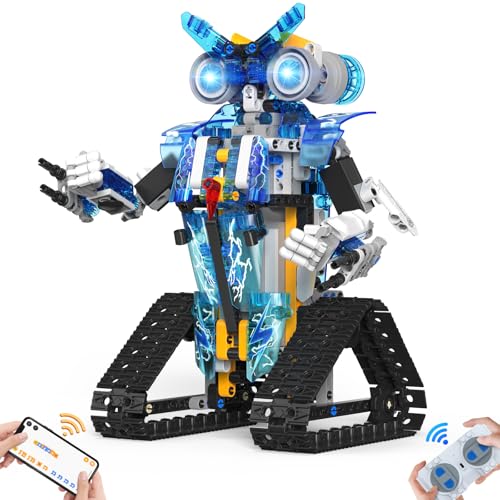
Henoda provides a large, hands-on building experience with 443+ pieces and a remote plus app control. This kit emphasizes STEM fundamentals as kids assemble and reassemble parts to create programmable robotics projects. The clear visual design, glow accents, and movable joints support exploratory learning, encouraging patience, creativity, and logical thinking through repeated cycles of build-program-test.
The remote offers 2.4 GHz control alongside Bluetooth app access, enabling remote operation, voice control, gravity-sensor modes, stem programming, and path modes. It’s well-suited for older children who enjoy intricate projects and want to explore sequencing and cause-effect in depth.
ELEGOO UNO R3 Smart Robot Car Kit V4

ELEGOO’s UNO R3 kit provides a hands-on Arduino-based learning path. It includes 24 module parts like obstacle avoidance and line tracing, and it supports control via Android and iOS devices. The assembly process emphasizes electronics basics, programming logic, and system integration, making it an excellent choice for kids who want to understand how sensors, motors, and microcontrollers work together in a robotics project.
As a complete educational package, this kit reduces friction for beginners while offering room to grow into more advanced topics, such as autonomy, sensor fusion, and simple AI concepts through project-based learning. The emphasis on modular components helps learners see the direct connection between hardware and software.
Ruko 6088 Programmable Robot

The Ruko 6088 combines APP control with remote and gravity-sensing input for a versatile command scheme. It includes a 200-icon program library and 50-function programming via its remote, giving kids a broad canvas to create sequences and customize behaviors. The app-based learning layer can broaden a child’s understanding of feedback loops, timing, and event-driven actions, which supports growing computational thinking skills.
With 9 expressions and 9 music options, the robot offers a visually engaging way to practice planning and execution. The inclusion of edge-aware controls and collaborative play can help siblings or friends work together to design and test complex routines.
Buying Guide: Key Purchase Considerations
- Age appropriateness: Match the robot’s complexity to the child’s age and learning goals. Some models prioritize simple gestures and remote commands, while others emphasize building and programming from scratch.
- Control method and learning curve: Consider whether a device uses remote controls, gesture sensing, or app-based programming. App-based systems often unlock more advanced features but may require a compatible smartphone or tablet.
- Programming depth: Look for toys with scalable programming options—from basic sequencing to multi-step actions and custom algorithms. A larger action library or the ability to create and save routines supports longer-term learning.
- Build quality and safety: Non-toxic materials, rounded edges, and sturdy joints are important for younger children. Heavier, larger robots suit imaginative play and physical interaction but may require supervision.
- Educational value: Practical STEM benefits include problem solving, logic, spatial reasoning, and basic electronics concepts. Kits that expose sensors, motors, and microcontroller basics are particularly advantageous for hands-on learners.
- Expansion potential: Some toys offer additional modules or compatible accessories. If a child outgrows a product quickly, a system with expandability provides continued engagement without replacing the core toy.
- Maintenance and durability: Rechargeable batteries, replaceable parts, and clear instructions reduce frustration and support longer play sessions.
- Budget alignment: Compare initial purchase cost against long-term value. Kits with more parts and broader programming options may offer greater educational payoff but at a higher upfront price.
Across these options, the best choice depends on a child’s interests—storytelling and expression, building and engineering, or software-driven programming. Whether a beginner-friendly remote-controlled figure or a modular Arduino-based kit, each toy presents a structured pathway to developing critical STEM skills while maintaining engaging play experiences.