Powerheads and wavemakers drive essential water movement in reef and marine tanks. The right model balances dead zones, enhances gas exchange, and supports coral and fish by simulating natural currents. Below you’ll find five carefully chosen options that vary in flow, size, and control features to fit most 20–135 gallon setups. Each product emphasizes adjustable flow, quiet operation, and reliable suction or magnet bases for flexible placement.
| Product | Brand | Tank Size Range | Flow (GPH) | Control |
|---|---|---|---|---|
| Hygger Lite Wave Maker | hygger | 10–50 gal | 792 | Digital controller with 4 wave modes |
| Hygger Mini Wave Maker | hygger | 20–80 gal | 850 | Digital controller with 5 modes, night & linkage |
| AQUANEAT Circulation Pump | AQUANEAT | 75–120 gal | 800 | Articulating suction cups; 360° flow |
| Hygger Wave Maker With Controller | hygger | 3–20 gal | 792 | Feeding switch; night mode; multiple modes |
| AquaIllumination Nero 7 | AquaIllumination | Reef tanks | Up to 4000 | Smart control via app |
Hygger Lite Wave Maker For 10-50 Gallons

The Hygger Lite Wave Maker is designed for small to mid-sized tanks, delivering up to 792 GPH with a magnetic base for easy placement on glass up to 6 mm thick. It supports 10–50 gallon tanks, freshwater or saltwater, making it suitable for those setting up compact reef or coral setups. The device features four wave modes and 10 speed levels, allowing precise control of current intensity. A 10-level frequency adjustment and a 9-minute feeding mode help tailor flow during feeding and maintenance. The intuitive digital controller simplifies customization of wave patterns, speeds, and frequencies to match your aquarium’s needs.
Hygger Mini Wave Maker For Aquarium
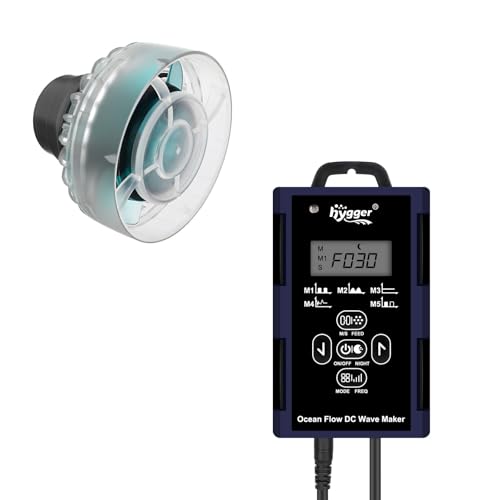
The Hygger Mini Wave Maker is a compact, ultra-quiet powerhead designed for 20–80 gallon tanks. With a max flow of 850 GPH and a transparent exterior, it blends into the reef environment while delivering robust circulation. The controller offers five wave modes (pulse, sine, constant, random, cross-flow) and extensive flow (70 levels) and frequency (95 levels) controls. Notable features include feeding mode, a linkage option to synchronize multiple pumps, and a night mode that reduces flow after dark—useful for delicate corals and nocturnal feeders.
AQUANEAT Circulation Pump, 800GPH

The AQUANEAT 800 GPH circulation pump is built for mid-large reef and fish tanks, recommended for 75–120 gallon setups. It offers strong yet controllable flow with 360° rotation using articulating suction cups for full flexibility in directing currents. The design promotes efficient circulation and enhances filtration by moving detritus toward the filter. This submersible unit helps mimic natural currents, improving oxygenation and providing a dynamic environment for fish, corals, and in-tank plants.
Hygger Wave Maker With Controller

This Hygger model combines a compact 4W motor with a high-flow 792 GPH output, suited for small to medium reef or mixed tanks (3–20 gallons recommended). It features a four-mode wave system, a switch to pause for feeding, and a quiet operation profile aided by a robust magnet suction base. The unit’s 360° reach ensures flexible placement and the ability to tailor current lines around rockwork, corals, and plant growth for more natural movement and higher oxygenation.
Hygger Aquarium Wave Maker With LED Controller
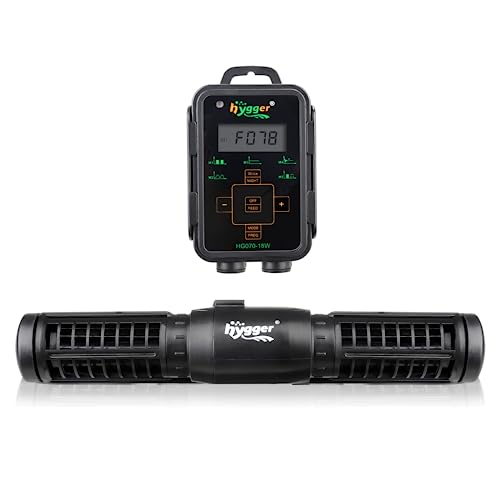
The Hygger Aquarium Wave Maker with LED controller emphasizes cross-flow technology to distribute waves 360 degrees, fostering a natural ocean-like current. It offers five wave modes, adjustable flow (30–100 levels), and frequency controls (30–100 levels). Feeding mode and night mode improve feeding sessions and nocturnal comfort. With placement versatility—above, mid-tank, or bottom—the unit helps prevent dead zones and aligns with reef-building needs for both freshwater and marine setups up to around 60 gallons.
AquaIllumination Nero 7 Submersible Wavemaker

The AquaIllumination Nero 7 is a high-capacity submersible wavemaker designed for reef tanks requiring substantial flow. It provides up to 4000 GPH and can be integrated with AI’s control ecosystem via the myAI or Mobius apps. The Nero Guard adds safety for slow swimmers and curious invertebrates, while the adjustable flow supports SPS and LPS coral growth. This powerhead suits larger or heavily stocked reefs where precise automation and remote management are desired.
Buying Guide
Key considerations when choosing a reef tank powerhead or wavemaker:
- Tank size and coral needs: Larger tanks and fast-growing corals benefit from higher flow options (500–4000+ GPH). For nano or low-flow setups, compact units with adjustable modes are better.
- Flow control and modes: Look for multiple wave modes (pulse, sine, constant, random, cross-flow) and adjustable flow and frequency. Feeding and night modes help with feeding behavior and nocturnal comfort.
- Placement options: Magnetic bases are convenient for glass up to a few millimeters thick; suction cups provide flexible placement but may loosen in larger tanks. Consider 360° rotation for optimal coverage around rocks and coral colonies.
- Noise and energy use: Quiet operation is important in living spaces. External rotor designs and ceramic shafts reduce noise and wear, especially in larger systems.
- Smart control and integration: Some models offer LED or app-based controllers, enabling automation, scheduling, and linking multiple units. See if it fits your reef automation setup.
- Maintenance and compatibility: Check ease of cleaning, availability of replacement impellers, and compatibility with saltwater and reef tanks to prevent corrosion and algae buildup.
- Redundancy versus diversity: In experienced setups, using more than one smaller unit distributes flow more evenly than a single high-flow device, while some reefers prefer a single powerful pump for large volumes.
Across these options, select a model with adjustable flow, a proven magnetic or suction-based mounting system, and a control interface that matches your tank’s routine. For reef environments, 360° coverage and cross-flow capabilities help minimize dead zones and promote uniform circulation, which benefits both water quality and coral health.