Finding engaging number toys for 4-year-olds helps build counting, number recognition, and early math confidence. The options below focus on hands-on play that makes math concepts tangible, supports fine motor development, and keeps kids excited about learning. Each pick is designed for preschoolers and early kindergarteners, with safe materials and age-appropriate activities.
| Product | Brand | Key Focus | Amazon Link |
|---|---|---|---|
| MOTREE Preschool Learning Toys | MOTREE | Counting, basic addition/subtraction, Montessori-style manipulatives | Link |
| TOP BRIGHT Preschool Learning Toys | TOP BRIGHT | Foundational math concepts, counting, Montessori-inspired learning | Link |
| Magnetic Wooden Fishing Game | NASHRIO | Letters, numbers, color recognition through fishing themed play | Link |
| Kaodezhu Dinosaur Balance Toys | Kaodezhu | Balancing numbers with weights, early math concepts | Link |
| Dinhon Locks With Keys | Dinhon | Numbers 1-10, matching and fine motor skills | Link |
MOTREE Preschool Learning Toys for Toddlers

What’s Included: A wooden finger board, 13 colorful number blocks, 8 flash cards, and a holder. This Montessori-style math toy supports counting, addition, and subtraction within 10, helping children visualize numbers and develop early math skills. Suitable for preschoolers and kindergarten readiness activities.
Designed for hands-on learning, this set encourages cause-and-effect understanding and fine motor development. It’s a compact, durable option for home, daycare, or classroom settings, aligning with early numeracy goals and curiosity-driven play.
Momo & Nashi Preschool Learning Activities

Complete preschool learning activities focusing on tracing letters and practicing handwriting. While centered on letters, it reinforces fine motor skills and number-oriented tasks through structured practice. Includes markers, eraser, and on-the-go box for learning anywhere.
Skills covered include lines, shapes, numbers 1-10 tracing, and A-Z letter tracing. The dry-erase format allows repeated practice, supporting memory and pen control—useful alongside number-focused games for a well-rounded early math and literacy routine.
Magnetic Wooden Fishing Game
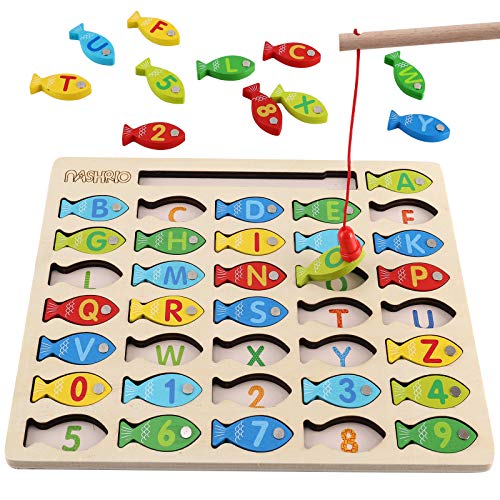
This wooden fishing game blends number and letter recognition with color sorting in a playful fishing setup. Children use a magnetic pole to catch fish pieces labeled with letters or numbers, promoting early literacy and numeracy in a tactile, durable format.
Made from polished wood with eco-friendly, non-toxic finishes, it emphasizes safety while offering engaging, repeated play that reinforces basic math and language skills through a repetitive, goal-oriented activity.
TOP BRIGHT Preschool Learning Toys

Designed for ages 3+, this Montessori-inspired set combines counting with early math concepts. Colorful blocks and manipulatives help make abstract ideas concrete, supporting number recognition and basic addition/subtraction in a hands-on, independent-play format.
The kit is structured to grow with a child, encouraging problem-solving, concentration, and logical thinking. It aligns with typical preschool curricula and can complement classroom activities or at-home practice.
Kaodezhu Dinosaur Balance Toys

Balance-based math play uses colorful blocks and dinosaur weights to teach left-right balance concepts. Children place numbers on one side and corresponding weights on the other to achieve equilibrium, reinforcing counting, comparison, and spatial reasoning.
Designed as an engaging STEM activity, it supports hands-on learning and fosters cooperative play when used in small group settings. The visual weight comparisons help kids grasp equations and balance concepts in early math.
Dinhon Locks With Keys Numbers Matching

Numbers 1-10 are learned through lock-and-key play that matches keys to corresponding locks. This Montessori-inspired toy enhances number recognition, counting, and fine motor development while encouraging independent problem-solving and patience.
Safe, non-toxic materials and smooth edges support use by ages 3-5. The toy is suitable for home use or classroom centers as a tactile math manipulative that reinforces sequencing and matching skills.
Buying Guide: Key Purchase Considerations
- Age appropriateness: Look for toys labeled for 3-5 years to ensure the activity aligns with fine motor skills and early numeracy milestones.
- Hands-on learning: Manipulatives, balance games, and lock-and-key puzzles support active exploration, which aids memory and concept retention.
- Safety and materials: Choose toys with smooth edges, non-toxic finishes, and sturdy construction suitable for daily use by toddlers and preschoolers.
- Montessori alignment: Toys designed around concrete manipulation help children develop number sense, logical thinking, and independence.
- Skill coverage: A well-rounded set should mix counting, number recognition, basic addition/subtraction, and fine motor practice to build a solid math foundation.
- Durability and cleaning: Prefer washable or easy-to-clean surfaces for toys that involve fingers, markers, or paint to sustain long-term use.
- Storage and portability: Compact sets with holders or organizers support quick setup and tidy cleanup between activities.
- Learning progression: Look for items that scale in complexity, so a child can continue to grow with the toy as their math skills advance.