Parents seeking developmentally appropriate, Montessori-inspired toys for a 15-month-old can prioritize items that nurture fine motor skills, color and shape recognition, problem solving, and independent play. The following five toys combine natural materials, simple mechanisms, and open-ended play to support a child’s growing curiosity. This guide highlights key features, learning benefits, and safe design considerations to help families choose reliable options for early development.
| Product | Brand | Key Benefit |
|---|---|---|
| Toddlers Montessori Wooden Educational Toys for Baby Boys Girls Age 1 2 3 Year Old | KMTJT | Shape sorting and color recognition with safe, non-toxic finishes |
| SOCBTNSO Busy Cube Toy | SOCBTNSO | Six activities in one for cognitive and motor development |
| Tiny Land Montessori Toy Set for Baby 13-15 Months | Tiny Land | 7-in-1 sensory play encourages exploration and problem solving |
| kecristv Montessori Toys for 1 2 Year Old | kecristv | Shape sorting and stacking with chunky, easy-to-handle pieces |
| JUXUE Baby Spinning Stacking Toys for Toddlers 1-3 | JUXUE | Stacking, spinning, and cause-and-effect play |
KMTJT Montessori Wood Toy Set

The KMTJT set provides a substantial wooden learning environment with 12 fruit blocks, 8 carrots, 10 worm pieces, and a five-sided cart. Large, smooth pieces and non-toxic water-based paint align with safety expectations for toddlers aged 1-3. The design promotes a range of activities, including fruit recognition, shape matching, sorting, and basic color differentiation. This multi-piece collection supports fine motor skills as little hands manipulate blocks and fit them into corresponding shapes, while adults can guide early cognitive tasks in a low-risk, durable format.
Overview of learning opportunities includes practical life-like sorting, color matching, and simple counting impulses, offering ample chances for guided exploration. As a Montessori-inspired tool, it encourages independent play and self-directed discovery. The toy’s structure allows for varied play sequences—children can sort by shape, thread pieces into the cart, or stack blocks to form simple towers—helping to develop hand-eye coordination and spatial awareness.
From a safety standpoint, the parts are designed with rounded edges and high-contrast patterns to attract attention without overwhelming the senses. The combination of different textures—wood grain, smooth blocks, and the sturdy cart—also supports tactile exploration, a core element of Montessori-style learning at this age.
SOCBTNSO Busy Cube Toy

The SOCBTNSO Busy Cube is a compact, six-in-one learning cube designed for on-the-go play and development. Each face offers a distinct activity to sharpen hand-eye coordination, problem-solving, and focus, aligning with Montessori principles that encourage self-guided exploration. Its travel-friendly dimensions make it ideal for car rides, plane trips, or visits to a caregiver’s house, allowing a child to practice grab-and-release motions, color matching, and cause-and-effect reasoning across multiple micro-tuzzles in one centered device.
Developmentally, the cube emphasizes sensory engagement and cognitive growth. The tactile details and varied tasks help sustain attention while building dexterity. The cube’s build is described as robust and impact-resistant, which supports safe handling by very young children who frequently drop or toss toys during exploration. This fosters persistence and curiosity as children experiment with different approaches to each task.
Parents can observe progress as the child discovers how actions produce outcomes—opening a door, lining up shapes, or guiding beads along a track. The structured yet open-ended format is well-suited for short, frequent play sessions that fit the routines of busy families.
Tiny Land 7-in-1 Montessori Play Set

The Tiny Land 7-in-1 set blends an assortment of sensory and cognitive building blocks designed for 13- to 15-month-olds. It features components such as a baby drum, a carrot harvesting activity, a color-matching plate, a size-matching puzzle, and a color board book. This variety supports evolving developmental needs, encouraging sensory exploration while refining fine motor control through grasping, stacking, and sorting tasks. The set’s design emphasizes independent play while providing parent-guided prompts to extend learning.
Educational value centers on color and shape recognition, auditory sequencing from the drum, and early problem-solving as children try to match pieces to their correct places. The Montessori orientation fosters self-driven play, with activities chosen to grow with a toddler’s capabilities and curiosity, ensuring each play session remains engaging without overwhelming the child.
kecristv Montessori Shape Sorter

The kecristv shape sorter focuses on stacking and sorting with 20 pieces across five colors and five geometric shapes. High-quality wood, smooth edges, and non-toxic, food-safe paint are emphasized to ensure safety for toddlers. The chunky pieces are designed to be easy to grasp, supporting fine motor development and hand-eye coordination as children fit shapes into corresponding holes. Beyond sorting, the set encourages color and shape recognition, language development through color-name and shape-name labeling, and early counting concepts.
As a gift choice, the product is positioned as a versatile tool for boys and girls aged 1-2. The large, thick pieces reduce the risk of choking while offering a satisfying tactile experience. Parents can use the sorter to introduce turn-taking and cooperative play with siblings or caregivers during guided sessions, aligning with Montessori aims of learning through exploration and repetition.
JUXUE Spinning Stacking Toy
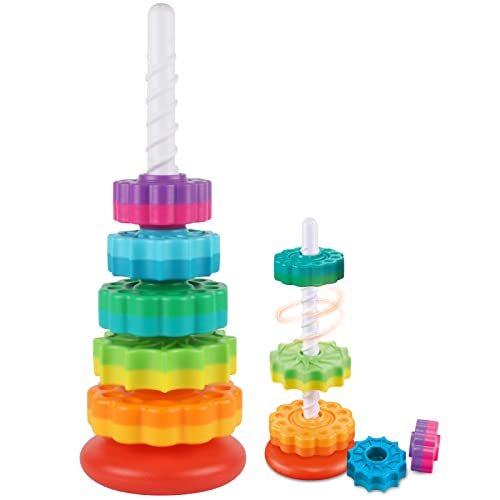
The JUXUE toy centers on stacking and spinning, featuring a screw rod and rainbow-colored discs that can be rotated or stacked by size, color, or shape. This toy provides tactile and visual stimuli while encouraging fine motor control and dexterity. At playtime, a child can watch discs spin freely or be guided to recreate patterns, supporting cause-and-effect understanding and problem-solving through experimentation. The rotating mechanism also introduces dynamic feedback as discs slow, stop, or spin again, captivating a toddler’s attention for extended sessions.
Educational benefits include color recognition, spatial reasoning, and early math concepts like sequencing. The toy’s simplicity—focusing on core actions such as stacking and turning—makes it accessible for a 15-month-old but also scalable as the child grows, maintaining relevance across months of development. This aligns with Montessori principles by prioritizing hands-on discovery and self-initiated exploration.
Buying Guide: Key Considerations For Selecting Montessori Toys
When choosing Montessori-inspired toys for a 15-month-old, consider materials, safety, developmental fit, and play value. Favor natural wood or sturdy, BPA-free plastics with rounded edges and non-toxic paints. Pieces should be large enough to prevent choking and designed for easy grasping by small hands. Look for open-ended toys that encourage problem solving, shape and color recognition, and fine motor skills without over-stimulation.
Developmental fit matters: at 15 months, children are refining pincer grasp, hand-eye coordination, and exploratory behaviors. Toys that support sorting, stacking, basic puzzle-making, and cause-and-effect play align with typical milestones. Multi-activity toys can offer variety within a single product, reducing decision fatigue while keeping a child engaged for short, frequent play sessions.
Versatility and durability are important for value. Toys should withstand frequent dropping and rough handling. Easy cleanup and minimal maintenance are practical benefits for busy households. Finally, consider how a toy can be integrated into daily routines—mealtimes, quiet time, or traveling—so play becomes a natural, recurring part of a child’s day.
Other perspectives to weigh include parental involvement, cultural relevance, and the amount of setup required. Some families prefer highly guided activities with specific prompts, while others favor more open-ended options that empower children to lead their play. Balance these preferences with safety ratings and the toy’s long-term developmental potential to choose options that remain engaging as a child grows.