Choosing Montessori-inspired toys for an 11-month-old focuses on fine motor skills, cause-and-effect understanding, sensory exploration, and safe, non-toxic materials. The following selections emphasize simple, age-appropriate activities that support cognitive and physical development without screens. Each option encourages exploration, repetition, and hands-on problem solving during this pivotal stage.
| Product | Brand | Key Benefit | Age Range |
|---|---|---|---|
| JUXUE Baby Spinning Stacking Toys | JUXUE | Stacking, spinning, color and shape recognition | 1-3 years |
| Adena Montessori Object Permanence Box | Adena Montessori | Object permanence, fine motor control | 6-12 months |
| WOODMAM 9-in-1 Montessori Toys Set | WOODMAM | Multi-toy exploration: stacking, mirror, cup stacking | 7-12 months |
| MINGKIDS 6-Piece Multisensory Shapes | MINGKIDS | Color and texture recognition, sensory exploration | 12 months+ |
| GOPO TOYS Montessori Shape Sorter | GOPO TOYS | Problem solving, fine motor skills | 1+ year |
JUXUE Spinning Stacking Toy for Toddlers
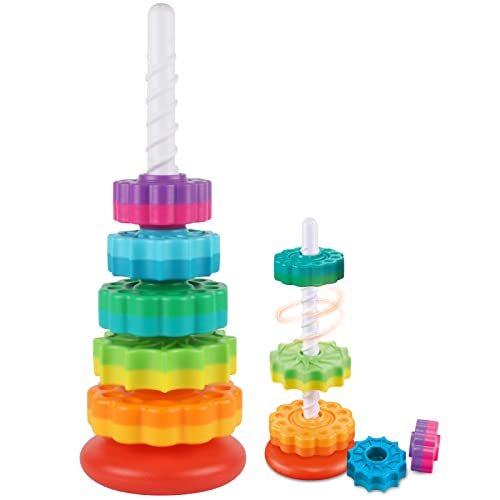
The JUXUE spinning stacking toy combines a screw rod with a rainbow wheel, inviting infants to stack and rotate discs. Each disc features two colors and can be rotated freely, making it suitable for 11-month-olds beginning to experiment with cause-and-effect. The toy supports hand-eye coordination, dexterity, and early color recognition as children manipulate the pieces during play. The adjustable base offers options to shake or fix the pole, allowing varied play styles and extended engagement.
Adena Montessori Object Permanence Box with Tray

This object permanence kit helps infants grasp that objects continue to exist even when out of sight. With three balls of varying textures and materials—wood, plastic, and EVA soft—this toy provides tactile variety that supports sensory exploration. By inserting balls into the tray holes, babies practice hand-eye coordination and refine fine motor skills. The combination of materials and tasks aligns with Montessori principles of independent, sensory-rich learning in early infancy.
WOODMAM 9-in-1 Montessori Toys Set

WOODMAM’s 9-in-1 set is designed for babies around 7-12 months. It bundles a mix of Montessori-inspired activities, including an object permanence box, stacking cups, a mirror puzzle, and a ring stacker. Crafted from natural wood and finished with non-toxic water-based paint, the set emphasizes safe exploration. Soft, durable silicone textures on stacking cups add sensory variety, while the mirror and puzzle components promote visual tracking and problem-solving skills as baby experiments with different ways to play.
KMTJT Toddler Montessori Shape Sorting Toys

Designed for 1- to 3-year-olds, KMTJT’s wooden set includes a variety of shapes, fruits, carrots, worms, and a five-sided cart. The materials are large, with polished edges and non-toxic water-based paint, prioritizing safety and durability. The shape sorting and color recognition activities encourage problem-solving, hand-eye coordination, and early math concepts in a tactile, kid-friendly way that aligns with Montessori-oriented play.
GOPO TOYS Montessori Shape Sorter
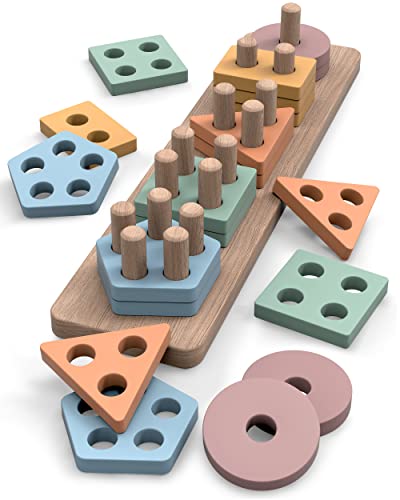
GOPO TOYS offers a Montessori-inspired shape sorter that emphasizes independent discovery. The set includes stacking and sorting challenges designed to build problem-solving abilities, hand strength, and fine motor skills. The wooden construction uses non-toxic finishes and rounded edges to keep play safe for curious 11-month-olds who are just beginning to explore how pieces fit together and relate to each other in space.
Buying Guide — Key Purchase Considerations
- Age appropriateness: Look for toys explicitly designed for 6-12 months or 12 months+ to ensure the level of challenge matches development.
- Material safety: Prefer natural wood, non-toxic paints, and BPA-free plastics. Check for rounded edges and smooth finishes to minimize choking hazards.
- Motor skills focus: For this age, toys that promote grasping, releasing, and transferring objects help refine pincer grip and hand-eye coordination.
- Sensory variety: Combos that include color, texture, and sound (without loud noises) support sensory processing and curiosity.
- Hypoallergenic and cleanability: Materials should be easy to clean and resistant to frequent handling and drooling common at this stage.
- Durability and safety standards: Look for products that pass ASTM and CPSIA standards or similar safety certifications appropriate for baby toys.
- Play variety: A mix of single-doll or single-task toys and multi-activity sets can keep a child engaged while exposing them to different concepts.
- Portability and storage: Compact designs or those with simple storage options help maintain an organized play environment.
When selecting toys for an 11-month-old, prioritize items that encourage exploration and safe, repetitive play. Rotating a few top picks helps maintain interest and supports steady skill development over several months.