Discover approachable mechanical kits that teach core physics and engineering concepts through fun, hands-on building. The following selections offer clear instruction, durable components, and engaging experiments for newcomers. Use these models to explore gears, levers, pulleys, and simple machines while developing problem-solving skills. Below is a quick reference to the five standout options chosen for beginners.
| Product | Brand | Key Benefit |
|---|---|---|
| Thames & Kosmos Mechanical Engineering: Machines & Vehicles | Thames & Kosmos | 20 projects, real-world vehicle applications |
| Thames & Kosmos Simple Machines Science Kit | Thames & Kosmos | 6 classic machines, fundamental physics |
| Discovery Model Engine Building Kit | Discovery | 4-cylinder engine with moving parts |
| COWVTUJ ARMPAL Mechanical Claw Model Kit | COWVTUJ | 3-jaw robotic arm, wooden puzzle build |
| OSOYOO Model 3 Robot Car Kit for Arduino | OSOYOO | Intro to robotics, programmable control |
Note: Each kit offers a blend of hands-on assembly and foundational science concepts, making them suitable for beginners and curious learners alike. Images and product details come from public listings to provide a snapshot of what to expect when exploring mechanical kits for a learning-focused beginner audience.
Thames & Kosmos Mechanical Engineering: Machines & Vehicles

The Thames & Kosmos Mechanical Engineering kit introduces kids aged 8 and up to the science of machines through 20 hands-on building projects plus 22 supplemental experiments. The kit uses a durable, reusable building system that allows reconfiguration into models such as a tightrope walker, elevator, crane, windmill, and an all-wheel drive ATV. Learners explore forces, gravity, weight, simple machines, energy storage and conversion, momentum, gears, and even basic solar system physics. The modular design supports extended exploration as students grow more comfortable with mechanical concepts.
Educational value is a standout feature: projects guide users through understanding how machines convert energy and how different mechanisms interact. This kit is well-suited for homeschoolers, classroom demonstrations, or curious families seeking structured, repeatable experiments. While designed for younger builders, older beginners can still benefit from the clear instructions and progressive challenges provided by the included components.
Thames & Kosmos Simple Machines Science Kit

This kit focuses on the six classic simple machines: wheels and axles, levers, pulleys, inclined planes, screws, and wedges. Through 26 model-building exercises, learners gain practical experience with gears and basic mechanical principles. The durable modular construction system is designed to be compatible with other Thames & Kosmos building pieces, enabling extended projects beyond the included models. The kit helps users connect everyday objects to fundamental physics, such as understanding how a wheelbarrow or flagpole demonstrates simple machinery in action.
As a beginner-friendly option, it emphasizes conceptual clarity and repeatable experiments, ideal for steady progression from basic to more complex mechanisms. Parents and teachers will appreciate the emphasis on real-world applications and the ability to reuse components in future projects to reinforce memory and understanding.
Discovery Model Engine Building Kit
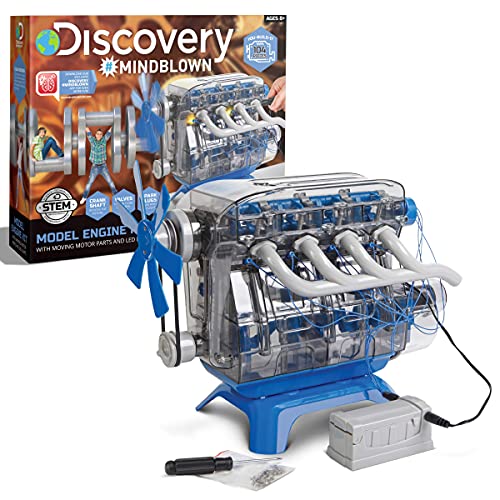
The Discovery Model Engine Building Kit provides a four-cylinder combustion engine model with moving pistons, fans, belts, LED lights, and belts for a realistic display of mechanical relationships. The kit encourages critical thinking as builders assemble components and observe how crankshafts, pulleys, and valves interact. It is designed to engage both kids and adults by delivering tangible results and a sense of accomplishment from watching the engine “come to life.” The activity reinforces essential skills such as planning, sequencing, troubleshooting, and understanding basic engine mechanics.
Included features support a hands-on learning approach: clear assembly instructions, functional parts, and a setup that demonstrates core engineering principles. This kit can serve as a stepping-stone toward more advanced mechanical projects or robotics, offering a strong foundation in how motion and energy transfer operate within a system.
COWVTUJ ARMPAL Mechanical Claw Model Kit

The COWVTUJ ARMPAL kit offers a 3-jaw mechanical claw model built as a 190-piece laser-cut wooden puzzle. This project presents a hands-on challenge for puzzle enthusiasts and hobbyists, with a guided assembly process that highlights precision and logical sequencing. The model is designed to help learners appreciate robotics fundamentals, including mechanical linkages, grip mechanics, and spatial reasoning. The included professional-style guide manual provides step-by-step diagrams to support accurate construction, and the kit offers lifetime technical support and a 90-day warranty for added confidence.
Despite its wood-based construction, the kit delivers a satisfying tactile experience and a tangible introduction to robotic arm concepts. It is well suited for learners who enjoy detailed assembly tasks and want to visualize how a three-jaw gripper functions within a larger mechanism. This model balances complexity with accessibility, making it a meaningful project for motivated beginners.
OSOYOO Model 3 Robot Car Kit for Arduino

The OSOYOO Model 3 Robot Car Kit is an Arduino-compatible platform designed for beginners and educators. It supports Android and iOS app control and includes features such as line tracking, object motion following, obstacle avoidance, and gravity-sensing control. The kit is fully compatible with UNO boards and provides a practical path into circuits, programming sensors, and actuators. It serves as a versatile starter project for learners who want to explore robotics without prior experience, while offering room for expansion with additional sensors and modules.
The value proposition centers on hands-on programming and hardware integration, enabling users to practice logic design, sensor interpretation, and motor control. While approachable for beginners, the kit also scales for more experienced hobbyists who want to experiment with more complex robotic behaviors and code-based customization.
Buying Guide: Key Considerations For Choosing Beginner Mechanical Kits
When selecting a mechanical kit for beginners, consider the following factors to ensure an educational, engaging, and age-appropriate experience.
- Educational focus: Look for kits that clearly explain the core concepts (gears, levers, pulleys, simple machines) and provide guided experiments or model-building sequences.
- Difficulty level: Choose projects with progressive challenges, from simple assemblies to more complex mechanisms, to sustain interest without overwhelming new learners.
- Durability and components: Durable pieces and modular construction help learners reuse parts across multiple projects and reduce frustration from breakage.
- instructional quality: Clear manuals, diagrams, and step-by-step instructions support independent learning and reduce reliance on external help.
- Safety and materials: Non-toxic materials, rounded edges, and age-appropriate parts are important for younger builders and classroom settings.
- Expandability: Kits that integrate with additional modules or other brands allow longer-term engagement and deeper exploration of mechanics.
- Programming and electronics: If the kit includes electronics or coding, ensure the complexity aligns with the learner’s current skill and learning goals.
- Support and warranty: Access to customer support, replacement parts, and warranties can be crucial for keeping a positive learning experience.
- Cost and value: Consider the number of projects, the depth of concepts covered, and the reusability of parts to assess overall value.
Comparison snapshot: For pure mechanical instruction, Thames & Kosmos Simple Machines and the Mechanical Engineering kit offer foundational concepts with clear progression. The Discovery Model Engine provides a tangible engine model to connect theory with motion. The COWVTUJ ARMPAL emphasizes robotic arm concepts through a wooden puzzle approach, while the OSOYOO kit blends robotics with programming for early exposure to code-driven mechanics. Depending on whether learners prefer hands-on assembly, puzzle-style challenges, or programming-based projects, readers can select the kit that best aligns with their goals and experience level.