Finding engaging, educational toys for 3 to 5-year-olds can boost early literacy, numeracy, and fine motor skills while keeping play fun. The following selections emphasize alphabet learning, word-building, counting, and interactive problem solving. Each product is designed for preschoolers and early makers, with durable materials and kid-safe designs. Use this guide to compare options that support independent exploration and parent-child interaction alike.
Summary of chosen products:
| Product | Brand | Key Focus | Age Range |
|---|---|---|---|
| Alphabet ABC Learning Educational Toys | Beestech | Letter matching, word learning | 2-5 |
| See & Spell CVC Word Builders | KMUYSL | Sight words, phonics, spelling | 3-5 |
| Magnetic Wooden Fishing Game | NASHRIO | Letter recognition, counting | 3-5 |
| Montessori Number Counting Blocks | HONGID | Number sense, counting | 3-5 |
| LIWIN LET’S GO! Matching Letter Game | LIWIN LET’S GO! | Memory, spelling, vocabulary | 3-8 |
Beestech Alphabet ABC Learning Educational Toys
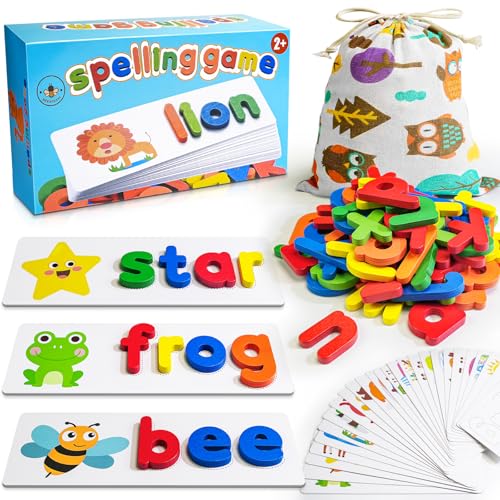
Beestech’s wooden letters pair with flash cards to form an intuitive learning activity for toddlers and preschoolers. Children place the correct wooden letter on top of a flash card to build vocabulary and letter recognition. The set uses polished wood with no sharp corners, promoting safe play. A storage bag helps with tidy organization and easy transport for learning on the go.
KMUYSL See & Spell Word Builders

KMUYSL offers a comprehensive 80-piece set for sight-reading, spelling, and letter recognition. Includes 28 double-sided flash cards and 52 wooden blocks. The design emphasizes rich scenes and frequently used CVC sight words to help children build memory and cognitive connections. A compact storage bag makes it convenient for travel and classroom use, supporting collaborative play and social interaction among peers.
NASHRIO Magnetic Wooden Fishing Game
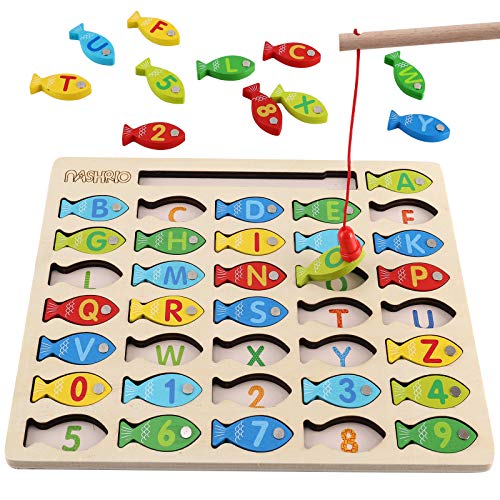
This wooden fishing game combines alphabet letters and numbers in a lively, interactive puzzle format. Children use a magnetic pole to catch fish, reinforcing color, letter, and number recognition while developing fine motor skills. Made with smooth-edged, eco-friendly finishes, it provides a safe, hands-on learning experience suitable for shared play or independent exploration.
HONGID Montessori Number Counting Blocks

HONGID’s counting blocks support early math concepts through tactile, Montessori-inspired play. The set includes a counting board, number blocks, cards, and a holder to organize activities. Young learners visualize basic addition and subtraction within 10, building a solid mathematical foundation while promoting concentration and fine motor development.
LIWIN LET’S GO! Matching Letter Game
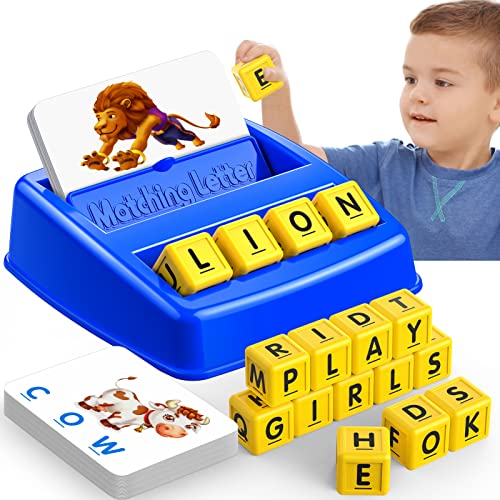
LIWIN LET’S GO! offers a memory-based letter matching game that reinforces spelling, word recognition, and vocabulary development. Designed for children aged 3-8, this game supports parent-child interaction and collaborative learning while sharpening strategic thinking and social skills during playtime.
Buying Guide: Key Purchase Considerations
- Age appropriateness: Choose toys clearly labeled for ages 3-5 to ensure appropriate cognitive and motor challenge without frustration.
- Educational focus: Prioritize activities that build early literacy (letters, phonics, sight words) and numeracy (counting, basic arithmetic) as well as fine motor skills.
- Durability and safety: Look for smooth finishes, rounded edges, and non-toxic paints or materials suitable for active toddlers and preschoolers.
- Play style compatibility: Select options that support independent play, parent-child interaction, or group use to fit family routines and classroom settings.
- Storage and portability: Toys with integrated storage or compact packaging help keep play areas organized and portable for travel.
- Social and language development: Tools that encourage turn-taking, collaboration, and discussion help develop communication and social skills alongside cognitive growth.
- Reusability and adaptability: Items that provide multiple learning modes or extendable challenges can grow with a child’s developing abilities.