Exploring robotics through hands-on kits helps young minds grasp core concepts in electronics, coding, and engineering. The following selection highlights beginner-friendly to advanced projects that inspire creativity while building practical skills. Each kit offers different strengths—from programmable microcontrollers and remote control interfaces to mechanical hands and 3D puzzle elements—so you can match the right kit to a child’s age, interests, and learning pace.
Summary of selected products:
| Product | Brand | Focus | Typical Use |
|---|---|---|---|
| ELEGOO UNO R3 Smart Robot Car Kit V4 | ELEGOO | Arduino-based car with obstacle sensing and line tracing | Coding, electronics, robotics basics |
| Makeblock mBot Robot Kit | Makeblock | Scratch/Arduino-based learning robot | Intro to programming and robotics |
| Smartivity DIY Robotic Mechanical Hand | Smartivity | Mechanical hand and hydraulic-free design | Mechanical engineering concepts |
| Sillbird Robot Building Kit | Sillbird | 5-in-1 programmable robot set with dual control | Programming and robotics fundamentals |
| Butterfly EduFields 40-in-1 STEM Robotics | Butterfly EduFields | Large parts kit for diverse projects | Creative engineering and experimentation |
ELEGOO UNO R3 Smart Robot Car Kit V4

The ELEGOO Smart Robot Car Kit V4 is designed to introduce kids to programming, electronics assembly, and robotics using a beginner-friendly Arduino-style platform. The kit includes 24 module parts such as obstacle avoidance and a line tracing module, enabling learning through practical experiments. Its core advantage is an integrated learning environment that supports coding projects for young builders, including control via Android and iOS devices. Assembly is simplified with standardized XH2.54 ports to minimize errors during build, helping kids gain confidence as they wire, code, and test their first autonomous vehicle.
Key features align with early STEM education goals: hands-on practice with sensors, microcontrollers, and motion control; a modular approach that accommodates expanding complexity; and compatibility with familiar smartphones for accessible experimentation. The kit supports a progression from basic circuit concepts to more sophisticated robot behaviors, making it suitable for classroom demos or at-home projects. It emphasizes safe, parent-guided exploration while encouraging independent problem solving as kids debug and refine their robot car.
Makeblock mBot Robot Kit

The Makeblock mBot Robot Kit is positioned as an entry-level coding robot that blends Scratch-style programming with Arduino capabilities. It is designed to teach electronics, robotics, and computer programming in a straightforward way. Builders can follow clear assembly instructions and then explore line-following and obstacle-avoidance modes. The kit promotes hands-on learning through interactive software and multiple free apps, facilitating progression from block-based coding to more advanced programming. A note about batteries ensures readiness for hands-on builds and remote operation, keeping kids engaged and motivated as they explore STEM concepts.
With intuitive tutorials, the mBot supports project-based learning. Children can create projects that integrate sensors, motors, and logic to solve real-world tasks. The kit’s flexibility makes it suitable for classroom demonstrations or a creative weekend project. The combination of hardware and software demonstrates a strong bridge between hardware assembly and software development, encouraging iterative testing and refinement as kids learn to optimize performance.
Smartivity DIY Robotic Mechanical Hand

The Smartivity DIY Robotic Mechanical Hand offers a hands-on mechanical engineering experience without batteries. Built around a step-by-step instruction manual, it provides a deeply engaging DIY project that can entertain kids for hours while reinforcing mechanical principles. This kit is ideal for ages 8–14 and emphasizes screen-free, experiential learning. It stresses the development of fine motor skills and an understanding of simple machines through a tangible build. The mechanical hand design showcases how gears, levers, and linkages translate user input into movement, making it a strong choice for curious learners who enjoy visual feedback from their handiwork.
Educational value centers on constructing a working machine, observing cause-and-effect relationships, and cultivating problem-solving patience. The kit’s lifetime replacement part policy supports uninterrupted play and ongoing curiosity, ensuring that kids can revisit and repair or modify their build as they grow more confident in their abilities. While focused on mechanical construction, it also opens doors to broader engineering discussions about force, motion, and control systems.
Sillbird Robot Building Kit
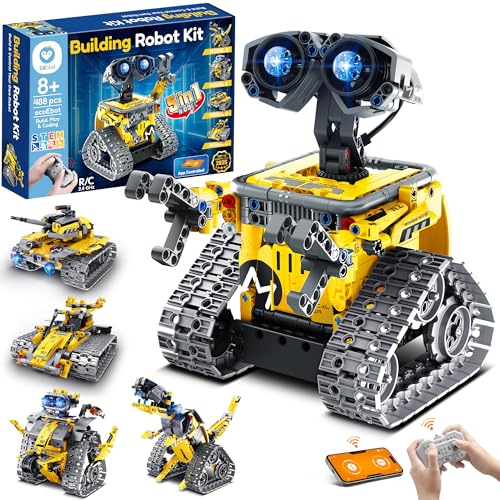
The Sillbird 5-in-1 programmable robot set provides dual control options via Bluetooth app or a traditional remote, offering a versatile learning experience for ages 8 and up. Its five build modes encourage kids to explore different mechanical configurations while practicing basic programming concepts through interactive software. The kit’s flexibility supports ongoing interest as children advance from basic movement to more complex actions like programmed paths and precise movements. The combination of intuitive controls and modular parts fosters experimentation, creativity, and problem solving in a structured learning path.
Educational impact includes understanding programming fundamentals, electronics, and robotics components in a family-friendly format. The dual-control design enhances engagement, letting kids compare how different control methods influence behavior. As with many modular kits, the emphasis is on iterative learning—build, test, measure, and refine—to reinforce STEM confidence and curiosity over time.
ANNISOKA Robot Arm Kits

The ANNISOKA Robot Arm Kit focuses on the fundamentals of robotics and circuits by providing motors, PCB microcontroller boards, and wiring. Designed as a first-time robotics experience, it combines wooden puzzle elements with electronics to deliver a hands-on understanding of how circuits control mechanical movement. It’s pitched for ages 8–14 and up, offering a learning path from basic physics concepts to practical engineering skills. The kit emphasizes the interplay between design and function, encouraging kids to experiment with different configurations to optimize motor control and response.
For educators and parents, this kit offers a clear, structured approach to early engineering. The inclusive scope covers power management, signal processing, and mechanical design, promoting curiosity about how real-world robots operate. As a learning tool, it supports reasoning about cause-and-effect, teamwork in building projects, and the satisfaction of turning a concept into a working machine.
TEACH TECH Hydrobot Arm Kit

The Teach Tech Hydrobot Arm Kit introduces hydraulic principles through a functional robotic arm. Suitable for ages 12 and up, the kit guides learners through building working robots with hydraulic actuation, offering a more advanced hands-on experience. It demonstrates stationary force transmission, multi-axis rotation, and the mechanics of gripping objects using lever-based control. The absence of batteries in favor of hydraulic power showcases a different engineering paradigm and fosters understanding of fluid dynamics and mechanical design in a practical context.
Its instructional approach emphasizes real-world engineering concepts and how fluid power can simplify complex movements. The Hydrobot Arm Kit is well-suited for older kids or families looking for a deeper dive into robotics, where experimentation with hydraulic systems complements electronic control for a richer understanding of automated mechanisms.
Buying Guide: Key Purchase Considerations
Age range and learning curve
Choose kits aligned with the child’s age and prior experience. Younger builders benefit from simple assemblies and visual programming, while older kids may enjoy multi-robot setups, remote control capabilities, and programming with Scratch or Arduino.
Programming options
Evaluate whether a kit supports block-based coding, text-based languages, or hybrid approaches. Scratch-based interfaces are beginner-friendly, whereas Arduino-compatible kits offer exposure to real coding syntax and electronics concepts.
Hardware and sensors
Look for kits with essential sensors (ultrasonic, infrared, line tracking), clear documentation, and modular parts. A broad sensor suite often translates into richer projects and longer engagement.
Assembly complexity and reliability
Consider the build time, required tools, and the likelihood of completing the project without frustration. Kits using standardized connectors and clear instructions reduce errors and boost confidence.
Expandability and lifespan
Some kits are designed to scale up with additional modules, software updates, or compatible accessories. This can extend the learning experience beyond a single project and support ongoing curiosity.
Safety and supervision
Ensure that parts are age-appropriate, with any small components supervised for younger children. Parental involvement in initial builds is common and beneficial for learning outcomes.
Power sources and maintenance
Check whether batteries are included or required, and assess the maintenance needs of mechanical components. Some kits offer rechargeable options or require disposable batteries, which influences ongoing use.
Educational value and goals
Identify whether the kit emphasizes programming, electronic circuits, mechanical design, or a combination. A balanced kit can foster broader problem-solving skills and curiosity across STEM fields.
Summary recommendation
For beginners: kits with clear instructions, easy assembly, and Scratch/Arduino compatibility can build confidence quickly. For intermediate learners: explore multi-mode kits with sensors and remote control features to deepen programming and robotics understanding. For advanced young engineers: select projects with hydraulic or complex mechanical systems to challenge problem-solving and critical thinking.