For new enthusiasts, choosing an FPV platform that combines gentle handling with engaging flight is essential. The following selections are tailored to beginners, offering durable builds, beginner modes, and accessible setup. This article highlights five beginner-friendly FPV options, with practical notes on stability, safety, and entry-level capabilities to help you start flying confidently.
| Product | Brand | Key Benefit |
|---|---|---|
| SoloGood HEE Wing T-01 | SoloGood | Durable EPP foam airframe with strong power and easy control |
| APEX FPV Drone Kit | APEX | Low-latency FPV, beginner-friendly Altitude Mode |
| CADDXFPV Protos FPV Drone | CADDXFPV | Compact, HD video, multiple flight modes |
| LMRC LM19-A Drone | LMRC | HD camera, simple remote control, brushless for stability |
| Tinyhawk Lite FPV Drone | Tiny Hawk | Real FPV, Betaflight ready, long flight times |
SoloGood HEE Wing T-01 Fixed Wing RC Plane

The SoloGood HEE Wing T-01 is a 730mm fixed-wing RC plane designed for beginners. It uses EPP foam, ABS, and carbon fiber for impact resistance and durability, helping learners avoid frequent repairs after minor bumps. The model features an upgraded flight control system and dual motors for a thrust-to-weight ratio up to 1.71, improving stability in moderate winds. It also supports external cameras, enabling multi-camera capture options for aerial photography during practice flights. The design emphasizes a broad center-of-gravity range and good aerodynamics, letting pilots fly slowly while maintaining control over the sky.
APEX FPV Drone Kit

The APEX FPV Drone Kit targets beginners with a VR headset and dual-mode flight options. It delivers a wide 120-degree FPV view for immersive learning sessions, and a Beginner Mode designed to keep the drone stable and easy to control. Manual Mode is available for advancing pilots, making it a scalable option as skills improve. The kit emphasizes low-latency transmission and a user-friendly setup, helping new pilots gain confidence in visual orientation and basic maneuvering before tackling more complex FPV flights.
CADDXFPV Protos FPV Drone Kit

The CADDXFPV Protos FPV Drone Kit emphasizes a compact, palm-sized form factor with HD video transmission. It features a lightweight 1/3-inch Starvis II sensor and a wide-angle lens for detailed footage, as well as an ultra-light Ascent HD VTX for low-latency video. With three 840mAh batteries included, pilots can extend flight time and practice more routes. Built-in safety protections reduce downtime, and the kit supports multiple flight modes to accommodate varying skill levels from beginner to freestyle enthusiasts.
LMRC LM19-A Drone With HD Camera

The LM19-A from LMRC pairs a 720p HD camera with a stable 2.4 GHz FPV link. It is designed for beginners with a ready-to-fly approach and a focus on ease of use. The included display stand and ground mode offer options for desktop showcase and simple ground-based flying. Multiple flight speeds and brushless motor configuration improve wind stability, enabling calmer flights for novice pilots exploring aerial photography and basic FPV experiences from a safe, beginner-friendly platform.
Tinyhawk Lite FPV Drone With Camera
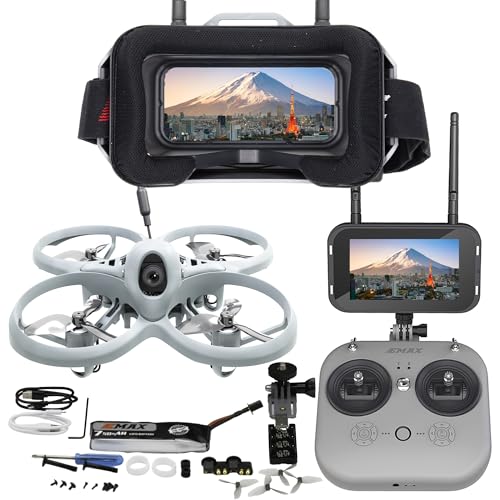
The Tinyhawk Lite FPV Drone is a compact, beginner-friendly kit featuring real FPV with minimal latency. It includes Betaflight configurations, allowing pilots to tune flight characteristics as skills grow. A 1S HV 750mAh battery delivers longer flight times, and the kit is designed for easy transport and quick setup. Beginners can start with simple maneuvers and advance toward more complex maneuvers as proficiency improves, benefiting from a pathway toward pro-level flight with a scalable platform.
Buying Guide
- Skill level and goals: Choose a platform with beginner modes or stability features if you’re starting out, then progress to manual or advanced modes as confidence grows.
- Durability and materials: Foam and composite frames reduce repair costs after inevitable bumps in the learning curve.
- Flight time and charging: Look for kits with multiple batteries or longer-lasting packs to maximize practice time per session.
- Transmission latency: Low-latency FPV is crucial for responsive control and safer learning, especially in outdoors settings with wind.
- Safety features: Self-protection or emergency landing functions, prop guards, and range limits help minimize risk during training.
- Expandability: A system that supports additional cameras, goggles, or simulators will grow with you as you improve.
- Regulatory considerations: Some compact FPV kits do not require FAA registration, but always verify local rules before flying.
In practice, beginners benefit from starting with a durable, easy-to-control platform and then gradually incorporating features like HD video, wider field of view, and additional flight modes as skill and confidence build. The listed options provide a spectrum—from fixed-wing beginner planes to entry-level FPV quads—to help new pilots find a suitable path into the world of FPV aviation.