Whether you’re teaching beginners or brushing up your own piano sight-reading, the right flash cards can speed up learning. This guide highlights five top-rated music note flash card sets available on Amazon, covering note names, staff notation, rhythm, key signatures, and more. Each option offers durability, clear visuals, and kid-friendly design to support practice at home, in lessons, or in classrooms.
| Product | Brand | Key Strengths |
|---|---|---|
| Flashcardables Premium Music Flash Cards | flashcardables | Double-sided, color-coded categories; durable laminated cards |
| Lark & Wolf Learn to Read Music Flash Cards | Lark & Wolf | 56 large, wipe-clean cards; easy storage box |
| 104 Piano Music Flash Cards – Basic Symbols | HETOETF | Comprehensive basics; multi-octave organization |
| 54 Piano Note Theory Flash Cards | JYCSTE | Color-coded, clear packaging box; easy keyboard reference |
| MUSO Music Flash Cards for Beginners | MUSO | 74 cards; splash-proof; American solfège |
Flashcardables Premium Music Flash Cards

Flashcardables’ set uses high-quality double-sided laminated cards designed for long-term use. The cards come in a boxed kit and feature bright colors with large print to support readability. Color-coded categories help learners isolate skills such as Notes, Clefs, Tempo, Dynamics, Melodic & Harmonic Intervals, Note Values, Rests, Time, Key Signatures, and Music Symbols, enabling targeted practice sessions and quick drills. The durable construction makes them suitable for classroom and home practice, reducing wear and tear over time.
Lark & Wolf Learn to Read Music Flash Cards

These flash cards are sized for easy handling and feature a glossy wipe-clean finish with rounded corners. They cover European and American terminology, aiding both beginners and young learners. The set includes 56 larger cards (5″ x 3″) and uses a consistent design where each card presents the note or symbol on one side and the corresponding name on the other. An upgraded storage box and lid improves organization for classroom and home use, supporting repeated review and self-testing.
104 Piano Music Flash Cards – Basic Symbols
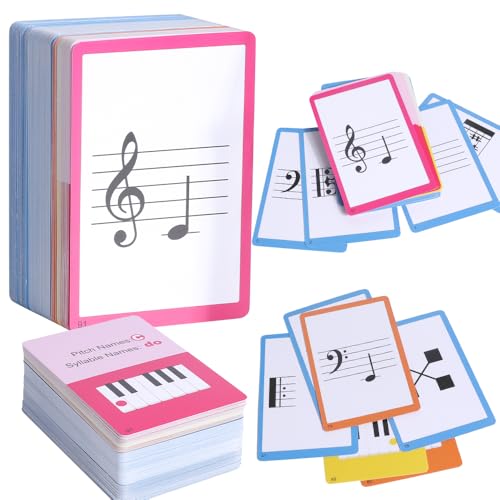
The 104-card set from HETOETF covers a broad range of piano notation fundamentals. It includes basic symbols, staff notation, pitch and syllable names, keyboard positions, and both octave organization and symbol names on the reverse. The cards are designed with easy-to-read fonts and bright colors, plus a simple keyboard illustration at the bottom to reinforce note placement. A double-sided layout allows quick self-testing and progressive review for learners at various levels.
54 Piano Note Theory Flash Cards

This JYCSTE set offers 54 color-coded cards that support comprehensive note theory from staff notation to pitch names and keyboard positioning. It includes octave divisions (great to small octaves) and flats/sharps, with clear, readable typography. The included packaging box enhances portability and storage. The design emphasizes intuitive learning, with a consistent layout that helps students review note positions and symbol names efficiently.
MUSO Music Flash Cards For Beginners

MUSO’s flash cards focus on beginner-friendly material with 74 cards, coated for splash resistance and durability. The set uses American solfège and includes four octaves of notes along with essential terminology, including rhythm, dynamics, and articulation. Laminated, color-coded panels help learners identify notes and symbols quickly, while the two-ring binding and included instruction cards support structured lessons and at-home practice. The design emphasizes safe materials and recyclability along with child-friendly aesthetics.
104 Piano Flash Cards – Basic Music Symbols

Another comprehensive set, this 104-card option mirrors several core features of the HETOETF collection with a robust two-sided design. The emphasis remains on building a broad foundation in music notation, including staff notation, symbol names, and keyboard positioning. The durable cards are designed for daily classroom use, with clear diagrams and consistent color-coding to aid memorization and quick recall during practice sessions.
Buying Guide: Key Purchase Considerations
- Learning goals: Choose sets that align with your focus, such as note naming, rhythm, or staff notation. Some kits emphasize early literacy, while others cover broader music theory.
- Durability and format: Laminated or waterproof cards with a boxed or ring-bound system are best for repeated handling and classroom environments.
- Card design: Look for large print, high-contrast colors, and clear font choices. Color coding by skill area can accelerate drill sessions and reduce cognitive load.
- Size and portability: Larger cards are easier for group work; smaller cards fit in binders or bags for on-the-go practice.
- Storage and organization: A sturdy storage box or ring binder helps maintain order between practice sessions and lessons.
- Safety and materials: For younger students, ensure cards are sturdy, non-toxic, and free from sharp edges or choking hazards if applicable.
- Teacher and student resources: Some sets include additional instructions or answer sides to support self-testing and guided practice.
- Expansion potential: Consider whether you might need to add other related materials (rhythm flash cards, key signatures, or chords) later on.
- Price-to-value balance: Durable, well-designed sets may offer better long-term value even if the upfront cost is higher.
- Compatibility with learning style: Visual learners benefit from color-coded visuals; hands-on learners may prefer wipe-clean or laminated formats for repeated use.
These considerations help compare how each product supports consistent practice, classroom use, and progress tracking. When selecting, balance durability, content breadth, and ease of use to match your teaching style and the learner’s needs.