Exploring early language and cognitive development? Flash cards for babies offer a screen-free way to boost vocabulary, recognition, and memory from infancy through toddlerhood. This guide highlights five top options designed to engage little learners with colorful illustrations, textures, and interactive activities. Each choice prioritizes durability, age-appropriateness, and developmental benefits, so caregivers can pick the best fit for their child’s pace and interests.
| Product | Brand | Amazon Link |
|---|---|---|
| First Words Flash Cards | Scholastic | Link |
| LearnWorx 101 Baby Flash Cards for Toddlers | learnworx | Link |
| Jollybaby Reusable Soft Flash Cards | Jollybaby | Link |
| Alphabet Flash Cards for Toddlers | learnworx | Link |
| Torlam Toddler Flash Cards | Torlam | Link |
First Words Flash Cards

Scholastic’s First Words Flash Cards offer a compact, age-appropriate way to introduce basic vocabulary and everyday objects. The set is designed to support early language development through simple images and word cues, helping babies and toddlers begin to associate objects with their spoken labels. Caregivers can use the cards during short, interactive sessions to encourage naming, memory recall, and turn-taking in conversation. The durable card stock is suitable for little hands and frequent use, with a focus on foundational words that set the stage for early literacy.
Key points include clear visual stimuli, consistent word-image pairings, and easy-to-grasp formats that align with typical baby and toddler milestones. While intended primarily for early word recognition, the cards also support language-rich play and routine-based learning, such as labeling items during daily activities. This makes the set a practical option for families seeking a straightforward, low-distraction learning tool that grows with a child’s expanding vocabulary.
LearnWorx 101 Baby Flash Cards

LearnWorx presents a 101-card set designed to cover a broad range of everyday objects, animals, foods, and places. The cards feature bright, engaging illustrations and a large format intended for easy handling by young children. On the reverse side, simple prompts and questions invite interaction, turning flash cards into a dynamic learning game that can aid speech development and word recognition. The bundle’s design emphasizes durability and caregiver-friendly activities that can be scaled from infant interactions to preschool readiness games.
What makes this set versatile is its inclusion of both listing content and interactive prompts. Children are encouraged to answer questions or describe items, which supports vocabulary expansion and sentence formation. The large card size helps with visibility and finger-grip control, making it practical for little hands to explore. As a learning tool, it suits families who want a comprehensive, mixed-content resource without needing multiple separate decks.
Jollybaby Reusable Soft Flash Cards

Jollybaby offers soft, reusable flash cards designed to withstand baby exploration. The set emphasizes durability with tear-resistant materials suitable for mouthing and rough handling. Themed around fruits, vegetables, and numbers, these cards promote sensory-rich learning, color and shape recognition, and early math concepts. The double-sided design adds versatility, allowing one side to present numbers or words and the reverse side to depict corresponding items, which fosters memory reinforcement and word-object association over repeated use.
Durability and washability are central advantages here, making the product well-suited for busy caregivers seeking long-lasting tools that resist damage from drooling or spills. The tactile experience, combined with the visual cues, also supports multisensory learning, which can be especially beneficial for infants who learn best through touch and sight.
Alphabet Flash Cards for Toddlers

These 52 large ABC flash cards cover uppercase and lowercase letters with engaging visuals on the reverse side for context. Each card presents a single letter, enabling focused letter recognition and early phonics work. The design supports simple matching activities and letter-name practice, suitable for infants, toddlers, and preschoolers who are beginning to connect letters with sounds and familiar objects. With 5 x 3.75 inch sizing, the cards are comfortably sized for young children to handle and explore without overwhelming them.
The set’s strength lies in its straightforward structure: one letter per card, paired with colorful imagery that reinforces memory through association. This makes it practical for families who want to emphasize alphabet awareness in a non-intimidating way. The large format and consistent layout support confidence-building experiences for early readers and can be integrated into daily routines or quick lessons.
Torlam Toddler Flash Cards
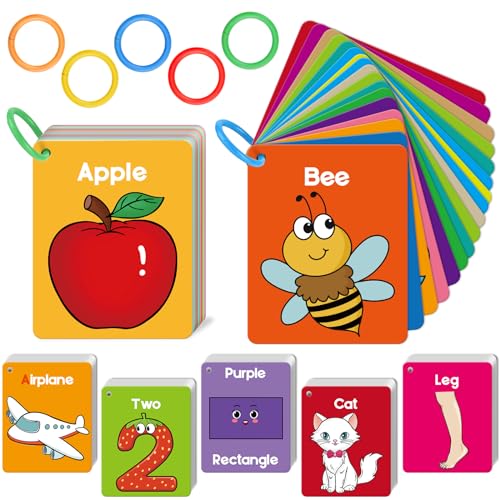
Torlam’s toddler flash cards bundle aims to build foundational skills across multiple domains: alphabet, numbers, shapes and colors, animals, first words, body parts, and foods. The set includes 60 double-sided cards and five colored rings for organization and easy carry. The diverse content is designed to support kindergarten readiness by introducing essential vocabulary and early cognitive concepts in a structured, age-appropriate sequence. Icons and illustrations are crafted to engage toddlers while keeping text concise for early readers.
From a developmental perspective, this kit emphasizes breadth over depth, offering exposure to a wide range of topics. It is well-suited for caregivers who want a single, consolidated resource that touches on multiple early-learning targets, including memory, attention, and basic categorization. The included rings facilitate rotation and shelf-friendly storage, helping families keep learning materials accessible and organized.
Buying Guide: Key Purchase Considerations
- Durability and material: Soft, reusable, and tear-resistant cards tend to last longer with babies who explore with mouths and hands. Consider washable surfaces for easy cleaning.
- Content scope: For broader early learning, choose cards that cover letters, numbers, colors, animals, and words. A mix can support multiple milestones simultaneously.
- Size and readability: Larger cards with bold images help with recognition and allow caregivers to point and name easily. One letter per card is ideal for targeted learning.
- Age appropriateness: Look for sets designed specifically for babies and toddlers, with simple word-object cues and minimal text beyond the key label.
- Engagement features: Double-sided designs, interactive prompts, and prompts on the back encourage conversation and active participation between caregiver and child.
- Multi-sensory options: Some sets incorporate textures or tactile elements to support sensory development, which can be beneficial for early learners.
- Portability and organization: Cards that come with rings or compact storage help keep materials accessible and neat for on-the-go learning.
- Caregiver support: Look for cards that include simple activity ideas or question prompts to guide conversations and maximize learning.