Crystal radio kits offer a practical window into early electronics, letting students and enthusiasts observe how radio waves become audible sound. This guide highlights five crystal radio kits that emphasize authentic components, clear assembly, and educational value. Each section presents a concise overview, key features, and practical tips for setting up and experimenting. Whether you’re exploring AM reception, tuning mechanisms, or impedance matching, these kits support hands-on learning without requiring soldering for all models.
| Product | Brand | Notes |
|---|---|---|
| Crystal Radio AM Receiver (New-Inductor-Tuned) | MINISCIENCE.COM | Inductor-tuned with ambient AM wave power |
| Crystal Radio AM Receiver (Parts+Base) | MINISCIENCE.COM | Parts kit with base for customization |
| ISolderStore DIY Mini Tesla Coil Kit | ISolderStore | Educational DIY electronics project |
| Science Kits for Kids – FM/AM Radio | CYOEST | Wooden kit with FM reception features |
| Dotexion Crystal Radio | Dotexion | Impedance matching transformer included |
| MARALANG Crystal Radio | MARALANG | Impedance matching transformer included |
Note: All items listed focus on educational value, real electronic components where applicable, and the potential for hands-on exploration. Some kits include wood bases, screws, and non-soldered assembly steps to encourage careful workmanship and experimentation.
Crystal Radio AM Receiver With Tuning Circuit

This MINISCIENCE.COM kit centers on authentic components that form a functioning circuit, including a diode, resistor, capacitor, and earphone. It uses a tunable inductor to explore AM reception and wave behavior. The wooden base and components are fragile until assembled, so careful handling and wood glue can improve durability. Intended for educational use rather than as a toy, it supports exploratory learning and troubleshooting beyond the guide. For best results, perform experiments in areas with strong radio signal reception to observe clearer audio output.
Key features include: authentic electronic parts, a flexible coil tuning system, and emphasis on hands-on exploration. It’s designed to illuminate how radios convert electromagnetic waves into audible sound, encouraging learners to think critically about circuit design and reception quality.
Assembly tip: take time aligning the diode, resistor, and capacitor; ensure clean connections and secure the wooden base after curing glue. The kit rewards meticulous workmanship with more stable operation and clearer sound.
Crystal Radio AM Receiver (Parts+Base)

The MINISCIENCE.COM parts-based kit provides a flexible option for learners who want to customize their build. It features an inductor-tuned design (new model) and contrasts with a capacitor-tuned approach in older variants, offering a chance to compare tuning methods. Like the other kit, it uses authentic components and cautions that the wood pieces are delicate until properly assembled. The educational focus remains on observing how changes in the tuning mechanism affect reception, with an emphasis on experimentation rather than just following directions.
Highlights include: a clearly defined tuning system, authentic components for real circuit behavior, and guidance toward hands-on discovery of radio wave interaction with different coils and capacitors. This version supports customization and design experimentation while maintaining a practical, safe learning environment.
Practical tip: plan your layout before gluing the base and consider labeling pins to track connections during testing. This approach helps diagnose reception issues and demonstrates the cause-effect relationship between circuit configuration and sound quality.
DIY Mini Tesla Coil Kit – Educational Soldering Project
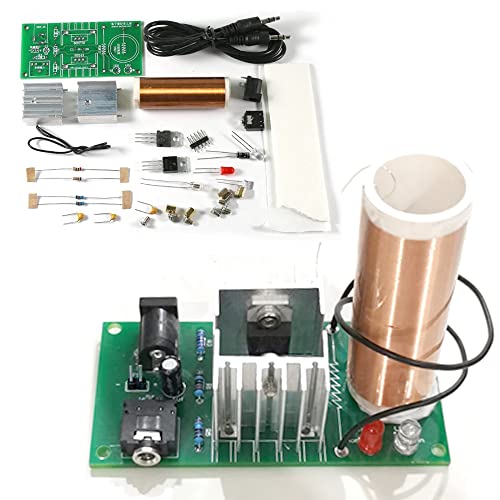
This kit centers on a different, yet related, educational electronics project: a 15W Tesla coil that demonstrates high-voltage phenomena. It is designed as a soldering project with English installation instructions accessed via QR code. The kit supports learning about circuitry, soldering techniques, and safety considerations. While not a traditional crystal radio, it offers a broader context for understanding electronics principles, including electromagnetic phenomena and circuit assembly practices, making it a compelling supplementary project for STEM learning.
Core considerations include: practical soldering practice, exposure to high-voltage demonstrations, and guidance through a detailed instruction set. It complements radio-focused kits by expanding hands-on electronics skills while maintaining a strong emphasis on safety and learning outcomes.
FM Radio Kit with Classic Wood Design

This CYOEST kit offers discovery into how radio works, focusing on FM reception with a frequency range of 88-108MHz. The retractable antenna helps users capture signals and observe reception dynamics. While primarily marketed as a kids’ science kit, it also serves older learners seeking a hands-on understanding of radio principles and electronics. The wooden design adds a tactile, tactile element that can inspire curiosity and creative project ideas.
Educational value centers on: practical assembly, real-world reception, and the simplicity of a wooden construction that reinforces the concept of a portable, compact radio system. The kit is positioned as a versatile gift that supports STEM learning for a broad age range, from beginners to more advanced hobbyists.
Dotexion Crystal Radio With Impedance Matching Transformer

The Dotexion kit emphasizes an impedance matching transformer in a crystal radio design, a feature that helps optimize headphone load and signal transfer. It highlights the traditional need for a long antenna and a good ground to improve reception. The kit notes that low-impedance headphones are compatible but not included, underscoring realism in the build. This approach supports learners who want to explore how impedance affects audio output and how to achieve clearer signals with practical real-world constraints.
Practical guidance includes considering antenna length, ground quality, and headphones selection to maximize listening quality. The included transformer provides a tangible element for understanding how impedance matching improves power transfer in simple radio circuits, reinforcing core electronics concepts.
Buying Guide: Key Purchase Considerations for Crystal Radio Kits
- Educational objective: Choose kits that emphasize real components, signal behavior, and hands-on experiments rather than purely decorative or toy-like experiences.
- Assembly and tools: Some kits require careful assembly with wood bases or soldering; others offer solder-free experiences. Consider your or the learner’s comfort with tools and risk tolerance.
- Tuning mechanism: Inductor-tuned versus capacitor-tuned designs affect how users interact with the radio. Inductor tuning tends to provide smooth resonance adjustments, while capacitor tuning can illustrate different electrical properties.
- Reception realism: Look for kits that address AM or FM bands realistically, including antenna and ground guidelines to demonstrate practical reception challenges.
- Component quality: Authentic components (diodes, resistors, capacitors, earphones) improve learning outcomes by illustrating real-world circuitry.
- Base and durability: Wooden bases or sturdy enclosures help protect delicate parts; consider whether glue or additional assembly steps are appropriate for the learner.
- Age and safety: Some kits are not intended for young children and require adult supervision or guidance to ensure safe handling and proper understanding of electronics concepts.
- Future customization: Kits with modular components or additional parts enable experimentation, upgrades, and the expansion of projects beyond a single build.
- Documentation and support: Clear manuals, QR codes, or instructions in English enhance comprehension and troubleshooting, especially for self-guided learners.
- Budget and value: Compare included components, base quality, and potential for expansion when evaluating kits to ensure long-term learning value.
In choosing the right crystal radio kit, consider the learner’s goals, whether it’s understanding wave reception, practicing circuitry assembly, or exploring historical radio technology. A kit that balances authentic components, clear instructional guidance, and room for hands-on experimentation tends to deliver the strongest educational impact while fostering curiosity about electronics.