Finding effective counting tools for kindergarten helps young learners build number sense, counting accuracy, and early arithmetic skills through engaging, hands-on activities. The following five products offer tactile experiences—from wooden counting pegs to ten-frame systems and color-sorting challenges—that align with standards for early math. Each item emphasizes visual representations of numbers, one-to-one correspondence, and fine motor development. Use this guide to compare options and choose tools that fit your classroom or homeschool environment.
| Product | Brand | Key Benefit |
|---|---|---|
| Montessori Toys for 3-5 Year Old | BSADIY | Number recognition, counting with simple addition/subtraction |
| Coogam Magnetic Ten-Frame Set | Coogam | Visual ten-frames for addition/subtraction and place value concepts |
| Aizweb Counting and Color Sorting Toys | Aizweb | Counting, color sorting, fine motor skills with tweezers and cards |
| Suwimut Wooden Counting Peg Board | Suwimut | One-to-one correspondence, number-quantity relationships |
| School Zone Numbers 0-25 Flash Cards | School Zone | Fast number recognition and quick counting practice |
Montessori Toys For Early Math

BSADIY’s Montessori set focuses on building math foundations for ages 3-5. The kit promotes number recognition and counting, then advances to simple addition and subtraction with finger boards and
wooden blocks. This interactive approach strengthens curiosity, logical thinking, and problem-solving as children explore early math concepts. The natural wood construction supports durability and a smooth, splinter-free surface for daily use.
Safety and durability are emphasized through premium materials that stand up to frequent handling. The combination of tactile blocks and counting boards provides a concrete way to visualize numbers, making it easier for young learners to grasp how numbers relate to quantities. The set’s design aims to cultivate confidence in math from an early age, aligning with preschool and kindergarten curricula.
Coogam Magnetic Ten-Frame Set
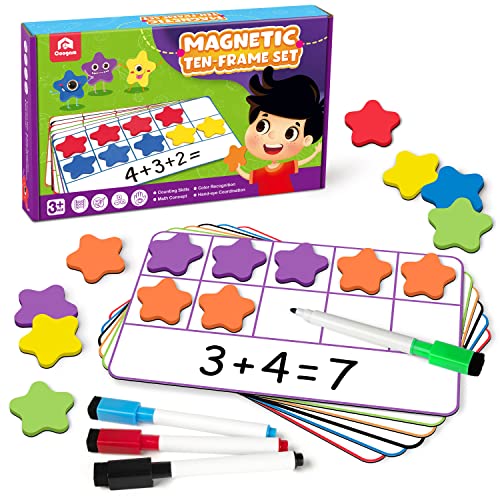
The Coogam Ten-Frame Set presents a robust visual framework for early arithmetic. The kit includes six colored ten-frame boards with ten counters per color, plus dry-erase markers and a portable storage bag. An extra writing area beneath the boards supports composing equations and recording results. This hands-on tool helps children visualize ones and tens, aiding mental calculation and addition/subtraction practice in a concrete, kid-friendly format.
As a versatile manipulation, the ten-frames can support a range of activities beyond basic counting—patterns, skip counting, multiplication, and early algebraic reasoning. The multi-color counters foster color discrimination and engagement, while the durable boards encourage repeated use in classroom centers or homeschool sessions. The set’s portability makes it suitable for guided instruction or on-the-go practice.
Aizweb Counting And Color Sorting Toys

Aizweb’s counting and color sorting set blends tactile counting with color recognition and fine motor practice. Children grip tweezers, transfer beads into tubes by color, and use double-sided activity cards to reinforce counting sequences, matching, and ordering. The activity cards add variety and sustained engagement while building pencil-grip strength and precision in a playful context.
With its emphasis on early math readiness, the toy helps kids internalize counting principles through tactile manipulation and visual cues. The included color-coding supports rapid assessment of color matching and sequencing, while the hold-and-sort format aligns with Montessori-inspired learning. This makes it suitable for both home use and classroom centers that emphasize concrete representations of numbers.
School Zone Numbers 0-25 Flash Cards

School Zone’s flash cards cover numbers 0 through 25 and provide quick, portable practice for counting, numerical order, and basic arithmetic readiness. The package supports timed drills, matching games, and simple problem-solving activities, helping children recognize numbers rapidly and build foundational counting fluency. The compact format makes it easy to integrate into centers, tutoring sessions, or homeschool routines.
While primarily a card set, these materials complement hands-on manipulatives by reinforcing mental math through visual exposure. Teachers can pair the flash cards with counting blocks, ten-frames, or peg boards to create balanced lessons that address both visual and kinesthetic learning styles. Consistent practice with these cards can support early numeracy development in kindergarten cohorts.
Suwimut Wooden Counting Peg Board

The Suwimut counting peg board is a compact, wooden, double-sided toy designed for early counting and number-quantity relationships. It includes 10 counting toys, 55 pegs, and a canvas drawstring bag for portability. The board visually links numbers with quantities, helping children understand one-to-one correspondence. Its durable construction supports repeated use at home, in classrooms, or during travel.
Children develop counting skills by placing pegs into corresponding holes, reinforcing patterns and shapes while building fine motor control. The portability of the set makes it ideal for centers or small-group sessions. As a Montessori-inspired tool, it supports progressive learning—from recognizing numbers to counting with accuracy and establishing solid mathematical foundations.
Toddler Learning Toys With Time And Math Cards

This twivah set combines basic math with time-telling activities. The kit includes 23 double-sided math cards featuring addition and subtraction problems, alongside 18 daily routine time cards to help children connect times with everyday activities. The wooden components support hands-on engagement and provide a tangible way to visualize equations and time concepts.
Educators and parents can use the cards to guide step-by-step problem solving, encouraging verbal reasoning and structured thinking. The time-related cards extend the activity into practical life skills, promoting an integrated approach to early numeracy and daily routines. The wooden construction ensures durability for repeated classroom or home use, with versatile applications across centers, tutoring, and enrichment activities.
Buying Guide: Key Purchase Considerations And Comparisons
- Learning objective alignment: Choose tools that clearly support counting, number sense, and early arithmetic, not just entertainment.
- Concrete to abstract progression: Start with manipulatives that show quantities visually, then gradually introduce symbolic representations (numbers, equations).
- Durability and safety: Prioritize wooden or high-quality materials with smooth edges and splinter-free surfaces for daily use by young children.
- Adaptability: Look for sets that accommodate different skill levels, from counting basics to simple addition and subtraction, to grow with the child.
- Portability: For homeschool or small-group settings, choose compact kits with carry cases or bags for on-the-go learning.
- Complementary resources: Pair counting tools with flash cards, time-telling materials, and color-sorting activities to reinforce multiple math strands.
- Care and maintenance: Consider materials that are easy to clean and maintain, especially for shared classroom materials or high-usage households.
- Budget and space: Weigh per-item value against storage space and the number of students who will use the tools regularly.
Across these options, the most effective counting tools typically combine tangible manipulatives, visual representations of numbers, and opportunities for guided practice. When selecting for a kindergarten setting, consider a balanced mix of ten-frames, peg boards, sorting activities, and quick-recognition flash cards to create comprehensive, multi-sensory math routines.