Counting sticks and wooden number blocks are proven tools for building early math intuition. This guide highlights five engaging counting stick sets and abacus-style kits that blend tactile learning with visual math concepts. Designed for home, classroom, or homeschool use, these products help kids recognize numbers, understand quantity, and practice basic operations through play. Below you’ll find product highlights, how they support math development, and buying tips to help you choose the best fit for your child’s learning style.
| Product | Brand |
|---|---|
| Alytimes Counting Stick Calculation Math Educational Toy | Alytimes |
| Counting Stick, 100Pcs | VBESTLIFE |
| KUTOI Counting Number Blocks and Sticks | KUTOI |
| Umbresen Montessori Toys Math Educational Toy | umbresen |
| Cltoyvers Wooden Abacus | Cltoyvers |
Alytimes Counting Stick Calculation Math Educational Toy
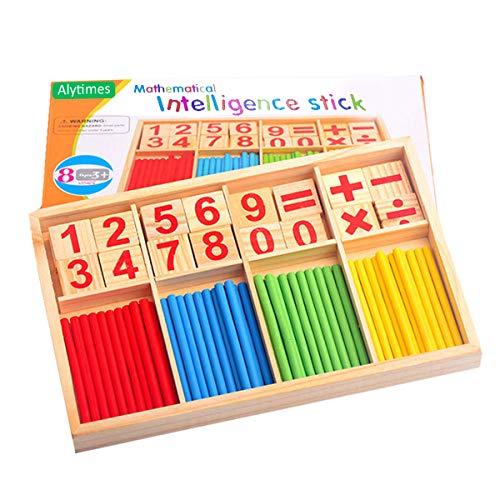
The Alytimes set features a wooden counting block with numbers and counting rods designed to help children connect quantity with numerals. The box measures about 23 x 15 x 2.2 cm, and the wood is finished with environment-friendly paint for safe, repeated handling. This homeschool-friendly toy supports number recognition and relational math concepts by combining tactile blocks with visual number cards. The kit is ideal for guided play that reinforces counting, number sequencing, and early arithmetic skills.
Key benefits include hands-on practice with counting rods, opportunities to demonstrate one-to-one correspondence, and the chance to explore simple addition and subtraction through creative play. It fits well with early learners who benefit from physical manipulatives to anchor abstract concepts. Teachers and parents can use the pieces to build math confidence through guided activities and games.
Counting Stick, 100Pcs

These plastic counting sticks come in a 100-piece set, designed to support counting operations and pattern creation. The sticks are glossy and smooth on the exterior, making them comfortable for little hands to handle repeatedly. Kids can arrange sticks into simple and complex patterns, which strengthens pattern recognition and imaginative thinking while reinforcing basic arithmetic concepts such as counting, grouping, and sequencing.
Usage ideas include building number lines, practicing addition and subtraction with sticks, and creating color-based or pattern-based math challenges. The material is durable for classroom or home settings, and the bright sticks help maintain engagement during math activities. Suitable for early elementary learners, these sticks support visual-spatial reasoning as students explore quantities and operations.
KUTOI Counting Number Blocks And Sticks

KUTOI’s counting set combines number blocks with counting rods and a storage tray, making it a compact, all-in-one math manipulative. The kit supports early learning goals by helping children recognize numbers from 0 to 9 and understand quantities through counting rods. It’s well-suited for preschool and kindergarten activities, classroom centers, and homeschool sessions where structured counting and number sense are taught in a hands-on manner.
The collection highlights 5 math signs, 19 numbers, and 52 counting rods, enabling simple arithmetic explorations, pattern creation, and number-building exercises. The visual layout and storage tray make organization easy for young learners and caregivers, promoting independent practice and tidy classroom habits. This set is a practical option for reinforcing foundational math concepts in a tactile format.
Umbresen Montessori Toys Math Educational Toy

Umbresen’s wooden intelligence sticks and number cards come with a wooden storage box, providing a neat, durable setup for math play. The set emphasizes safety and durability with a natural wood build and non-toxic finishes. Included are 5 math signs, 19 numbers (0–9), and 48 counting rods, enabling activities that cover number recognition, counting, and early arithmetic in a color-coordinated, hands-on format.
The product encourages color recognition as students differentiate colors on rods and cards, while the wooden components support fine motor development through manipulation. The box allows for easy organization, making it suitable for classrooms or home use where routine practice and independent learning are valued.
Cltoyvers Wooden Abacus

Cltoyvers offers a classic wooden abacus with 100 counting sticks and 110 math cards. The design merges traditional abacus learning with visual problem-solving through a card slot that displays equations below the beads. This setup supports addition and subtraction practice via manipulating beads on ten wires, making it an effective tool for developing counting fluency and mental math strategies.
Durable construction features a sturdy wood frame and smooth operation of the beads along metal rods. The combination of sticks and cards fosters a multisensory math experience, helping children connect abstract numbers to concrete quantities. It’s suitable for both individual learning and guided small-group activities in classrooms or homes.
Buying Guide: Key Purchase Considerations
- Age and developmental stage: Choose sets designed for early learners (preschool to first grade) to align with counting, number recognition, and basic arithmetic goals.
- Material and safety: Look for solid wood or durable plastics with non-toxic finishes. Smooth edges and rounded corners reduce the risk of injuries during play.
- Manipulative type: Decide between counting sticks, number blocks, abacus-style setups, and card-and-rod combinations. Each supports different math skills—counting fluency, visual number sense, or operability with base-10 concepts.
- Storage and organization: Sets with a storage tray or box help maintain order, encourage independent clean-up, and support classroom routines.
- Educational scope: Some kits emphasize color recognition and patterning, while others focus on addition/subtraction or number construction. Consider your learning objectives and the child’s interest to maximize engagement.
- Durability and maintenance: For frequent use, opt for tougher materials and easy-to-clean finishes. Wooden sets typically offer longevity when cared for properly.
- Expansion potential: If you anticipate needing more complex activities later, select modular kits that allow additional rods, cards, or signs to be added without replacing the entire set.
In practice, combining several manipulatives can support a broad spectrum of math readiness. Parents and educators may rotate through sets to introduce new concepts while reinforcing previously learned skills. The right mix helps youngsters build confidence in counting, recognize patterns, and perform simple calculations with increasing independence.