Finding the right beginner-friendly coding robot for a five-year-old can set the stage for a lifetime of curiosity. The following selections emphasize hands-on learning, simple interfaces, and age-appropriate activities that build foundational STEM skills. Each option blends play with education, helping young kids explore cause-and-effect, sequencing, and basic logic through engaging activities. This guide highlights five standout choices to help you compare features, ease of use, and learning goals for your child.
| Product | Age Range | Main Benefit | Interface |
|---|---|---|---|
| Makeblock mBot | 8-12 (also suitable for younger with guidance) | Block-based coding with four learning projects | Scratch/Arduino compatible |
| Learning Resources Cooper | 4-8 | Screen-free coding with physical cards | Buttons & cards |
| ELEGOO Conqueror Robot Tank Kit | 8-12 | Arduino-based construction with visual programming | Graphical programming |
| aukfa STEM Robot Toys | 8-12 | Remote/app control with multiple modes | App and remote control |
| Learning Resources Code & Go Mouse | 4+ | Intro to coding with a programmable mouse | Push-button, guided play |
Makeblock mBot Robot Kit With Scratch Coding Box

The Makeblock mBot introduces kids to coding through game-based tutorials and hands-on projects. Its design supports a smooth transition from physical construction to block-based coding, making it suitable for guided learning with younger children and progressively challenging for older kids. The kit emphasizes four core projects such as line-following and obstacle avoidance, giving young learners clear goals and visual feedback. Building is fast, typically around 15 minutes, which helps maintain engagement during playtime and study sessions.
Key features include an approachable learning path, crystal-clear project explanations, and tips to troubleshoot common issues. The kit encourages creativity and problem-solving while reinforcing spatial reasoning as kids navigate how sensors and motors respond to their code. While intended for ages a bit older, with adult support this kit can be an early entry point for five-year-olds to experience the joy of programming.
Learning Resources Cooper The STEM Robot

Cooper is a screen-free coding robot that introduces fundamental programming concepts using physical control buttons and 40 coding cards. This design supports early cognitive development without screens, helping children practice sequencing, cause and effect, and planning. It offers four interactive play modes, including line tracking and obstacle avoidance, to sustain curiosity with varied challenges. USB-C charging adds convenience by reducing battery replacements, enabling longer, uninterrupted learning sessions.
Parents gain a clear structure for guided exploration, while kids enjoy tangible feedback from pressing buttons and seeing Cooper respond. This hands-on approach aligns well with early childhood learning standards that emphasize fine motor skills, attention, and collaborative play during family coding sessions. Cooper’s modular play also makes it easy to extend learning as a child grows.
ELEGOO Conqueror Robot Tank Kit With UNO R3
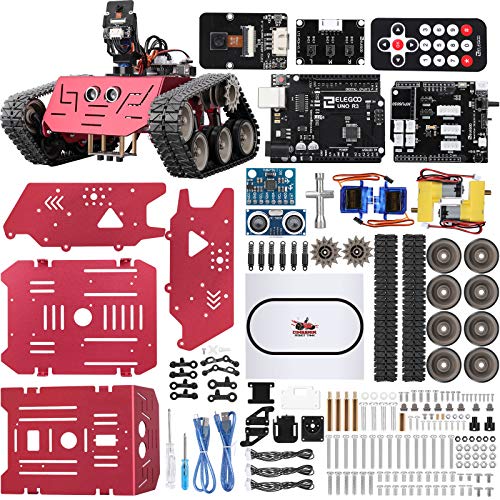
Based on Arduino, this kit blends hands-on assembly with accessible graphical programming to nurture creativity and problem-solving. Designed to engage kids in STEM, Conqueror supports a construction-focused approach that builds motor control, circuit understanding, and simple programming logic. The project encourages experimentation with different textures, terrains, and sensor readings, helping young learners grasp the fundamentals of robotics in a structured yet flexible environment.
For families seeking a slightly more involved project, this kit provides a robust platform that can scale with a child’s growing interests. Visual programming simplifies the initial learning curve, while open resources enable parents to expand activities and keep lessons fresh. The result is an educational kit that blends craft, engineering, and coding into a cohesive play-and-learn experience.
aukfa STEM Robot Toys Building Kits

Aukfa’s kit emphasizes multiple control methods, including remote and app-based commands, making it versatile for varied learning environments. The product supports four app-based play modes such as gyro, path mode, voice command, and stem programming, providing a rich set of pathways for building programming and problem-solving skills. The battery solution includes USB charging, reducing downtime between sessions and encouraging longer trial intervals for new concepts.
The kit’s modular design supports hands-on construction and imaginative play, allowing kids to explore cause and effect as they program the robot to move, turn, or respond to commands. This flexibility helps maintain engagement while systematically introducing logic, sequencing, and spatial reasoning in a kid-friendly format. It’s a strong choice for families who want a scalable toy that grows with a child’s curiosity.
Learning Resources Rechargeable Code & Go Robot Mouse

The Code & Go Mouse delivers approachable coding through a programmable mouse that lights up and speaks as it travels. This toy focuses on essential coding concepts such as sequencing and pattern recognition using simple push-button controls and pictorial cards. It’s ideal for introducing little learners to screen-free, tactile programming in a clear, age-appropriate way. The mouse is designed for tabletop play, making it convenient for quick, focused practice during family activities or classroom rotations.
As a gateway to computational thinking, the Mouse helps children understand loops, conditions, and debugging in a low-pressure context. Parents can supervise while gradually increasing challenge by introducing longer routes or more complex card sequences. Its portability and straightforward setup make it one of the most accessible options for five-year-olds beginning their coding journey.
Buying Guide: Key Purchase Considerations
- Age-appropriateness: Look for products labeled for early elementary years or specifically designed for ages 4-8. Some kits can scale with a child’s growing confidence with more advanced activities.
- Interface and learning style: Screen-free options emphasize tactile and physical play, while block-based or app-driven kits can add complexity as kids advance. Choose a mix that suits your child’s preferences and attention span.
- Expansion and longevity: Favor kits with multiple projects or modes that unlock new challenges. A product that can be revisited with different goals provides ongoing value.
- Durability and safety: Check build quality, safe materials, and age-appropriate parts. Lightweight, robust components help sustain interest through repeated use.
- Maintenance and accessories: Consider charging methods, availability of replacement parts, and the ease of updating software or firmware when relevant.
- Learning outcomes: Align options with early STEM skills such as sequencing, problem solving, hand-eye coordination, and basic digital literacy.
In selecting a starter coding robot for a five-year-old, prioritize products with clear guidance, simple setup, and opportunities to grow with the child. Screen-free or light-touch programming tools are excellent for foundational understanding, while modular, expandable kits can sustain curiosity as skills develop. The five highlighted products provide a balance of approachable play and educational depth, enabling parents to tailor a learning path that fits their child’s pace and interests.