Finding the right clock can make learning to tell time engaging and effective. This guide highlights top learning clocks that help kids grasp hours, minutes, and time concepts with interactive features, durable design, and classroom-friendly usability. Read on to compare options and pick the clock that best fits your child’s pace and setting.
| Product | Brand | Key Benefit |
|---|---|---|
| BEST LEARNING Learning Clock | BEST LEARNING | Interactive talking time, sleep mode for bedtime, award-winning design |
| Melissa & Doug Turn & Tell Wooden Clock | Melissa & Doug | Hands-on time cards with reversible activities |
| Learning Resources Time Activity Set | Learning Resources | Multi-sensory, comprehensive teaching system |
| Carson Dellosa Judy Clock | Judy Instructo | Color-coded clock hands and large display for classroom use |
| Oyster&Pop Learning Clock | Oyster&Pop | Silent, kid-friendly design with labeled minute hands |
Introduction to selection: The clocks below are chosen for accessibility, durability, and how well they align with typical learning progressions—from recognizing numbers to reading analog time and linking it to digital formats.
BEST LEARNING Learning Clock

The BEST LEARNING clock is a multi-award-winning teaching toy designed to engage children in learning to tell time. It features an interactive talking mode and a quiz mode to reinforce concepts. The clock uses a yellow hour hand and a red minute hand to guide children through setting times, with audio feedback to reinforce correct answers. A Sleep Mode offers ten classical melodies and a night-light option with a timer, supporting bedtime routines while fostering familiarity with the clock face.
Melissa & Doug Turn & Tell Wooden Clock

The Turn & Tell Wooden Clock provides hands-on learning with time cards that can be flipped and placed into a slot on top. It supports time-matching activities and includes a digital “clock” feature that automatically adjusts to show the corresponding analog time. This setup encourages active manipulation of clock elements to build a solid understanding of time-telling through play and structured tasks.
Learning Resources Time Activity Set
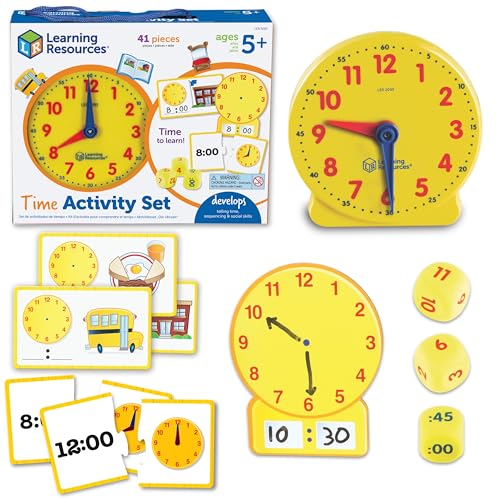
This time activity set emphasizes a hands-on, multisensory approach. It includes a realistic teaching clock with synchronized hour and minute hands, color-coded components, and a range of activity cards, puzzles, dice, and a dry-erase board. The integrated system supports diverse learning styles and provides multiple pathways to mastery of telling time, including analog-to-digital matching tasks.
Carson Dellosa Judy Clock
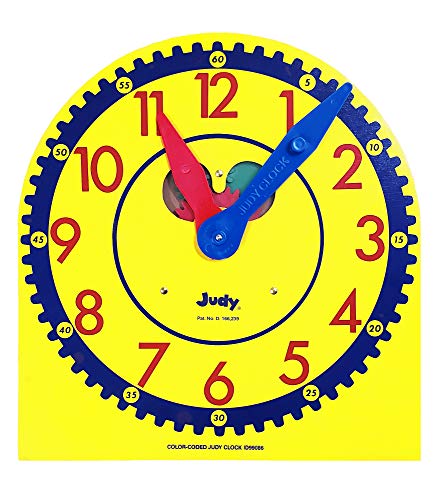
The Judy Clock from Carson Dellosa offers a larger, kid-friendly 13″ x 12″ face with color-coded hands and clear tick marks. It is ideal for classroom demonstrations or homeschool practice, focusing on telling time to the hour and minute with accessible numerals and structured visuals. The larger size makes it easier for groups to view and discuss time concepts during lessons.
Oyster&Pop Learning Clock

The Oyster&Pop clock combines a silent, non-ticking design with a vivid, kid-friendly face. It labels minute hand positions and quarters, helping children translate visual cues into a practical sense of time. This clock is suitable for bedrooms, classrooms, or study spaces where quiet operation supports focus and independent practice.
OWLCONIC Kids Clock

OWLCONIC’s analog wall clock emphasizes understanding the passage of time with a colorful, teacher-designed face. It introduces time-related language like o’clock and half past, making it suitable for learners aged five and up. The design supports classroom or homeschool learning with a focus on practical time-telling skills and daily routines.
Buying Guide: Key Considerations For Choosing A Learning Clock
- Age and skill alignment: Pick a clock that matches the child’s current level—simpler, highly visual models for beginners, or multi-component sets for progressive learning.
- Hands-on vs. interactive features: Consider whether your child benefits from physical manipulation (moving hands) or audio/quiz-based reinforcement to stay engaged.
- Clock design: Color-coded hands, large numerals, and a clear face help with quick recognition. Larger classroom clocks support group instruction, while compact clocks suit individual practice.
- Analog vs. digital integration: Some clocks emphasize analog time with hints for digital reading later. If digital time is also a goal, look for set components that bridge both formats.
- Durability and safety: For younger kids, choose sturdy plastic or wood with smooth edges and non-toxic finishes. Consider a silent operation option for focused study.
- Storage and portability: For homeschoolers or classrooms, modular sets and included storage solutions simplify rotation and lesson planning.
- Supplemental resources: A model that includes teaching guides, activity cards, or ebooks can extend learning beyond the clock face.
In short, the best clock for your child depends on learning style, setting, and the pace of skill development. The selections above offer a range of features—from interactive talking modes and classroom-ready demonstrations to silent, distraction-free designs—that support consistent practice and gradual mastery of telling time.