Introducing an affordable path to clear skies and crisp lunar details. This guide spotlights user-friendly Dobsonian scopes that balance cost with performance, helping beginners explore planets, nebulae, and star clusters without breaking the bank. Each pick emphasizes simple setup, solid optics, and practical features you can rely on for learning the night sky.
The following summary table lists five beginner-friendly, budget-conscious Dobsonian telescopes. Each entry highlights the brand, model, key strengths, and what to expect in practice. Use this table to compare at a glance and pick the best fit for your first deep-sky nights.
| Product | Brand | Key Strengths | Highlights |
|---|---|---|---|
| Celestron StarSense Explorer 130AZ | Celestron | Smartphone-powered navigation, ease-of-use | App-guided sky tour, StarSense technology |
| Celestron Moon 76mm Tabletop | Celestron | Compact, artistic lunar viewing | Tabletop design, beginner-friendly |
| Celestron StarSense Explorer 114AZ | Celestron | Small footprint, smart features | Smartphone-assisted star finding |
| Sky-Watcher Classic 200 Dobsonian | Sky-Watcher | Large aperture, simple controls | Classic build, strong optics |
| Celestron StarSense Explorer 10-inch | Celestron | Large aperture on a budget | Portable, app-assisted navigation |
Celestron StarSense Explorer 130AZ App-Enabled Telescope

The 130AZ combines a 130mm aperture with a compact tabletop Dobsonian mount, offering quick setup and portable use. Its standout feature is the StarSense Explorer system, which uses sky recognition technology to analyze star patterns and guide the telescope to celestial targets. With smartphone docking and the StarSense app, users receive a curated list of tonight’s best targets based on time and location. This makes it a practical choice for beginners seeking guided exploration of planets, nebulae, and star clusters from both urban and dark-sky sites.
Key benefits include a straightforward alignment process and intuitive target recommendations, reducing the learning curve for new astronomers. The physical controls remain simple, and the lightweight design supports easy transport between viewing sessions. For entry-level stargazing in a compact form, this model provides a compelling mix of accessibility and capability.
Potential considerations: while the 130mm aperture offers solid light-gathering, dimmer deep-sky objects may require dark-sky locations for the most rewarding views. The app-driven approach relies on a compatible smartphone and stable software updates for optimal performance. Overall, it suits beginners who want guided, entry-level astronomy without sacrificing the joy of real celestial observations.
Celestron Signature Series Moon by Robert Reeves

This premium tabletop Dobsonian is designed for lunar study with a 76mm reflector optical tube and a striking, artistically inspired Moon artwork. While marketed as a beginner-friendly option, it brings a refined aesthetic and straightforward operation that can engage first-time observers. The compact, portable design makes it easy to set up on a table or desk, offering comfortable viewing of lunar features such as craters and maria. It’s a capable entry point for beginners who value both style and functional optics in a compact package.
Highlights include user-friendly handling, good portability, and reliable performance for moon-focused astronomy. The combination of a modest aperture and simple operation supports quick, satisfying sessions. This model is well-suited for hobbyists who appreciate a design-forward instrument that still remains approachable for newcomers exploring basic deep-sky targets alongside the Moon.
Practical considerations: the telescope excels in lunar viewing and bright planetary objects but may require patience or larger apertures for fainter deep-sky objects. If your primary interest is a stylish, easy-to-use starter with solid optics, this Moon-focused scope offers an attractive balance between form and function for beginners.
Celestron StarSense Explorer 114AZ App-Enabled Telescope

The 114AZ is a compact, beginner-friendly option that leverages StarSense Explorer technology and smartphone docking to guide sky navigation. The combination of a 114mm aperture and smart targeting makes it a versatile choice for city observers who want accessible celestial targets without complicated alignment. The app’s real-time guidance helps users locate planets, nebulae, galaxies, and star clusters, while the instrument remains lightweight enough for quick setup and transport.
Considerations include the balance between portability and light-gathering power. For beginners, the 114mm aperture offers a meaningful step up from smaller tabletop scopes, enabling more rewarding views of brighter deep-sky objects. Access to a broad catalog of targets via the app can accelerate learning and foster consistent observing sessions. As with other StarSense models, a compatible smartphone is essential to maximize the experience.
Sky-Watcher Classic 200 Dobsonian

The Sky-Watcher Classic 200 Dobsonian offers a generous 200mm aperture in a solid-tube, traditional design. This model emphasizes simplicity and stability, with tension control handles that allow for smooth movement without requiring perfect balance. Its fully multi-coated 94% reflective mirrors maximize light transmission for brighter, crisper views of the Moon and brighter deep-sky objects. The Classic 200 strikes a balance between beginner-friendly operation and the ability to grow with user experience, making it a popular choice for new astronomers who want a bigger, more capable scope without a complex setup.
Strengths include a straightforward, reliable layout, comfortable manual tracking, and a robust optical path that yields satisfying views. The trade-off is a heavier, larger instrument than tabletop options, which may require a stable viewing location and a bit more space for storage. If you want a larger aperture to enhance detail and observe fainter targets as skills improve, this model is a strong candidate in the budget-friendly Dobsonian space.
Celestron StarSense Explorer 12-inch App-Enabled Telescope
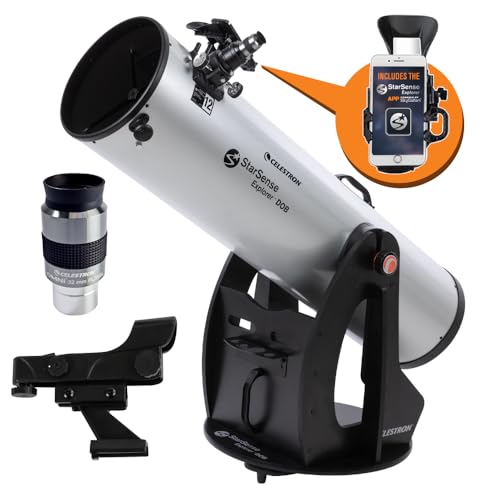
Aimed at serious hobbyists seeking a substantial payoff, the 12-inch StarSense Explorer pushes the aperture to 305mm for impressive light-gathering. The app-assisted navigation remains a core feature, helping users locate target objects quickly and efficiently. While larger and heavier than the smaller models, this scope retains the same user-friendly ethos, enabling beginners to gradually take on more challenging targets as experience grows. It’s well-suited for observatories or dedicated observing spaces where space and setup time are manageable.
Considerations include transport and balance challenges associated with larger optics. Users should invest in a sturdy mount and ensure adequate space for setup. For students and hobbyists who want extended deep-sky observing sessions and the ability to resolve fainter galaxies and nebulae, the 12-inch StarSense Explorer offers significant enhancements over entry-level options while maintaining guided navigation to ease the learning process.
Sky-Watcher Classic 250 Dobsonian

The Sky-Watcher Classic 250 Dobsonian is a robust 10-inch reflector instrument that builds on the same traditional Dobsonian philosophy with improved aperture. It emphasizes affordability, a straightforward setup, and an accessible learning curve for beginners who want a higher light-gathering capacity without complex electronics. The 10-inch aperture offers a meaningful boost for deep-sky objects and a wider range of planetary detail compared with smaller tabletop scopes, while still remaining within a reasonable budget for new stargazers.
Highlights include a solid optical design, durable construction, and a user-friendly experience that supports growth as observing skills develop. For families or individuals who plan regular stargazing sessions, this model provides a dependable, high-value option that prioritizes direct viewing pleasure and simplicity over electronic accessories. It’s a practical step up for those ready to explore more ambitious targets while staying within a reasonable budget.
Buying Guide: Key Purchase Considerations
- Aperture vs. portability: Larger apertures collect more light, revealing fainter objects, but are heavier and less portable. Choose an aperture that aligns with your observing goals and transport constraints.
- Dobsonian basics: A sturdy, easy-to-operate mount is crucial for beginners. Simple height adjustments, smooth motion, and secure balance help maintain enjoyable sessions.
- Optics quality: Multi-coated mirrors and robust optical tubes improve image brightness and contrast. Look for fully multi-coated primary and secondary mirrors when possible.
- Guided vs. unguided: App-assisted models can accelerate learning and target selection, especially for beginners in light-polluted areas. If you prefer a traditional approach, a simple manual Dobsonian will still deliver excellent views.
- Portability and storage: Consider space for storage, setup time, and how frequently you’ll transport the telescope to observing sites or parks.
- Compatibility and upgrades: Some models support accessories such as larger eyepieces, focusers, or star-mapping apps. Ensure compatibility with your existing gear and future plans.
- Maintenance: Regular collimation checks keep optics aligned. Simpler designs are easier for beginners to maintain, but all Dobsonians benefit from routine care.
In sum, budget-friendly Dobsonians offer a practical entry into astronomy, blending straightforward operation with meaningful viewing opportunities. Whether you value guided navigation, larger light-gathering power, or a compact tabletop design for quick sessions, the options above provide reliable paths to enjoyable, educational stargazing experiences.