Catapult kits offer a tangible way for kids to explore physics, engineering, and history through play. The following hand-picked selections emphasize safe assembly, clear instructions, and measurable experiments that help budding engineers grasp concepts like force, trajectory, and energy transfer. Each option below provides engaging building projects, realistic launching action, and opportunities for extended learning. The list covers wooden, mechanical, and historical designs to suit different ages and interests while keeping safety and educational value in focus.
| Product | Brand | Focus | Approx. Build Time |
|---|---|---|---|
| National Geographic Da Vinci Catapult Kit | Blue Marble | Three machines: ballista, bombard, catapult | 1–3 hours |
| Thames & Kosmos Catapult Engineering STEM Maker Kit | Thames & Kosmos | Six models: catapults, trebuchets, ballistas | 1–2 hours per model |
| Pathfinders Leonardo da Vinci Catapult Kit | Pathfinders | Da Vinci-inspired catapult with real launching action | ~1 hour |
| Pathfinders Medieval Catapult STEM Building Kit | Pathfinders | Historical siege engine with functional catapult | ~1 hour |
| Pathfinders Roman Catapult | Pathfinders | Ancient siege engine with launching capability | ~1 hour |
Best National Geographic Da Vinci Catapult Kit

The National Geographic Da Vinci Catapult Kit merges historical engineering with modern hands-on construction. The kit assembles into three distinct devices—a ballista, a bombard (early cannon), and a catapult—allowing kids to compare mechanisms and test different launch dynamics. With 15 projectiles and six targets included, learners can run controlled experiments to observe how changing angles, lever lengths, and tension affect range and accuracy. Clear, user-friendly instructions help complete each model in a few hours, making this a versatile choice for a weekend project or a school-friendly STEM activity.
Top-Tick Thames & Kosmos Catapult Engineering Kit

The Thames & Kosmos Catapult Engineering Kit invites young engineers to build six functional models, including crossbows, onagers, and a ballista. The included 32-page illustrated manual connects playful construction with real physics concepts such as force, energy, motion, and trajectory. This kit supports a progression of learning—from simple launches to analyzing performance, making it suitable for classroom use or family STEM nights. The pieces are designed for safe handling, and the experiments emphasize measurement and hypothesis testing as kids compare outcomes across models.
Pathfinders Leonardo Da Vinci Catapult Kit

This Pathfinders Leonardo Da Vinci Catapult Kit recreates a famous siege engine with authentic design principles. The build time is typically under an hour, and the model offers real launching action using a functional tension arm. The kit emphasizes STEM learning tied to historical context—perfect for school projects or curious minds exploring physics, geometry, and engineering from a Renaissance perspective. It’s designed for hands-on discovery, encouraging learners to experiment with force, trajectory, and aim in a safe, controlled way.
Pathfinders Medieval Catapult STEM Building Kit

Pathfinders’ Medieval Catapult STEM kit emphasizes historical engineering with a fully functional tension-powered catapult. The component set includes precision-cut wooden parts and clear instructions to assemble a reliable siege engine. The project’s simplicity and quick build time make it accessible for a wide age range, from advanced elementary to teen learners. The kit offers a way to explore distance, force, and mechanical efficiency while connecting classroom physics to historical siege technologies, which can enrich history and science discussions.
Pathfinders Roman Catapult – Ancient Siege Engine
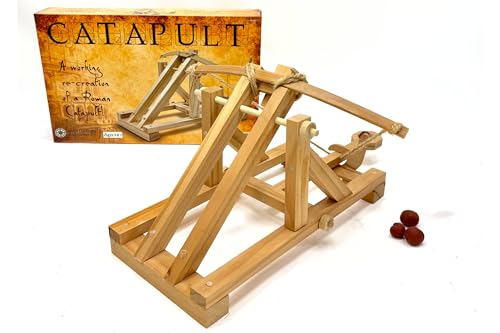
The Pathfinders Roman Catapult kit focuses on ancient engineering, offering a realistic model that launches projectiles over impressive distances. With pre-cut wood pieces and elastic bands, the kit is designed for easy assembly and operation, making it appropriate for curious learners ages eight and up. The construction storyline helps children relate archaeological history to practical physics concepts such as energy transfer and parabolic motion. The included guidelines emphasize safe experimentation and measurement, enabling students to compare launch configurations and improvements over time.
Buying Guide: Key Purchase Considerations
When choosing the best catapult kit for kids, consider the following factors to match learning goals and safety needs:
- Age appropriateness and complexity: Look for kits that align with the child’s age and building skill level. Some sets offer simpler one-hour builds, while others span several sessions with advanced mechanical concepts.
- Educational value: Prioritize kits that explicitly connect building to physics concepts—force, motion, trajectory, energy transfer—and provide accompanying guides or experiments.
- Number of models and reuse: Some kits include multiple devices, enabling extended investigations and comparisons across mechanisms.
- Materials and safety: Wooden components with non-toxic finishes and well-documented safety instructions are preferable for younger builders.
- Parts and tools: Check whether tools are included or whether the assembly relies on common household items. Kits with glue and elastic bands are common; ensure there are no sharp edges.
- Instructions and ease of follow-through: Clear, illustrated manuals help reduce frustration and support independent learning or guided collaboration for parents.
- Expansion potential: Some kits offer additional experiments or compatible accessories that extend learning beyond the initial build.
- Historical context: If curiosity about history drives interest, choose kits that tie into Renaissance or ancient engineering narratives to enrich storytelling and cross-curricular learning.
In practice, a well-rounded kit will combine engaging construction with measurable outcomes, such as projectile range, accuracy, and repeatable results. For classrooms or clubs, bulk or multi-pack options can streamline lesson planning, while home use benefits from clear visuals and step-by-step guidance that keeps kids motivated and safe during experimentation.