Parents and caregivers seek safe, engaging, and educational toys that support fine motor skills, focus, and sensory exploration. Busy boards, especially those designed with autism in mind, offer hands-on learning through tactile switches, lights, zippers, and buttons. This guide highlights five top options, comparing their features, portability, and developmental benefits to help you choose the best fit for your child’s needs.
Quick Overview of Featured Busy Boards
| Product | Brand | Key Benefit |
|---|---|---|
| Grarain Busy Board for Toddlers | Grarain | Montessori-inspired, clock design, travel-friendly |
| Sumsoltic Busy Board (v5) | Sumsoltic | 12 switches, LED variety, master switch, portable |
| iHarPro Busy Board with 19 LED Lights | iHarPro | 30% larger, many switches, back-of-board learning aids |
| Soupost Toddler Busy Board | Soupost | 8-in-1 Montessori hub, travel-friendly, sensory-friendly |
| EPIMA Toddler Busy Board | EPIMA | 25 activities, detailed fine motor practice, travel-ready |
Grarain Busy Board for Toddlers

Grarain’s busy board presents a Montessori-inspired learning platform designed for children aged 1-3. The front features a clock design and a LED circuit diagram, while the back shows an alpha-numeric chart. With 23 LED lights and multiple interactive switches, this board promotes fine motor skills, color and number recognition, and curiosity. It is travel-friendly, measuring 6.7 x 5.3 x 1.1 inches, and runs on two AAA batteries (not included). The compact design makes it suitable for car rides, restaurants, and church activities, while supporting early cognitive development.
Sumsoltic Busy Board (v5)
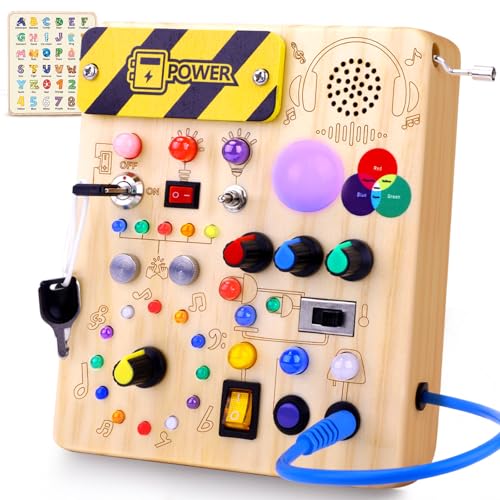
Sumsoltic offers a sensory-rich busy board with 12 switches and vibrant LED lights. It includes a master switch to conserve battery life, a music box, body conductivity features, and color mixing recognition for engaging play. The board supports color recognition, auditory processing, and fine motor development in toddlers, with two AA batteries required. Its travel-friendly dimensions (5.71 x 6.69 x 1.1 inches) make it a practical choice for car trips and flights without adding bulk.
Busy Board With 19 LED Light Switches

iHarPro’s Busy Board features a larger footprint with 19 switches and 40 LED lights, designed to minimize glare while maximizing interactive learning. A master power switch helps conserve battery life, and the back of the board includes printed letters, numbers, and color references. Sized at 7.8 x 6.5 x 1.1 inches, this board strikes a balance between portability and robust activity, supporting early literacy and numeracy concepts alongside fine motor skills.
Soupost Toddler Busy Board

Soupost’s 8-in-1 Montessori hub emphasizes practical activities like zipping, matching shapes, telling time, and spelling with hook-and-loop letters. The soft felt construction offers a calm, mess-free play experience, ideal for travel and quiet times in restaurants or airplanes. This board supports fine motor development, early math and literacy, and emotional recognition through expression cards, making it suitable for varied developmental needs including autism-friendly play.
EPIMA Toddler Busy Board

EPIMA’s Busy Board showcases 25 Montessori-style activities designed to enhance fine motor skills, dressing skills, and cognitive development. The board includes zippers, lacing, buttons, calendars, and other hands-on tasks to foster hand-eye coordination and independent play. Its travel-friendly size and inclusive design make it a solid option for toddlers on the autism spectrum who benefit from structured sensory exploration.
Buying Guide: Key Purchase Considerations And Comparisons
When selecting a busy board for autism, consider the following factors to match a child’s needs and environment:
- Age and developmental level: Choose boards with age-appropriate activities that progress in difficulty to avoid frustration.
- Sensory needs: Some boards emphasize tactile feedback (zippers, buttons, switches), while others highlight visual cues (LEDs, color coding). Tailor to your child’s preferred sensory input.
- Durability and safety: Look for smooth edges, non-toxic materials, and securing mechanisms to prevent choking hazards. Wood-backed boards are sturdy but heavier; plastic variants can be lighter and portable.
- Portability: For travel, prioritize compact designs with handles or carry bags. Consider weight, dimensions, and battery requirements (AA/AAA batteries vs. rechargeable).
- Educational value: Seek boards that support fine motor skills, hand-eye coordination, cause-and-effect learning, and early math or literacy concepts without overwhelming the child.
- Maintenance: Removable or wipe-clean surfaces help manage messes. Check for easily replaceable batteries or rechargeable options.
- Multisensory balance: Some boards combine visuals (LEDs) with tactile tasks; others focus on practical life skills (buttons, zippers). A mix can engage a broader range of interests.
Comparative highlights:
- Grarain vs. Sumsoltic: Grarain emphasizes a Montessori clock-and-alphanumeric setup with compact travel size; Sumsoltic offers a larger variety of switches and a master switch for efficient power use, plus a music box for auditory engagement.
- iHarPro vs. Soupost: iHarPro provides a larger surface with more switches and back-side learning aids, suitable for longer play sessions; Soupost emphasizes 8-in-1 Montessori activities with a soft felt design ideal for quiet travel time.
- EPIMA follows a broader activity suite focused on dressing skills and calendar learning, appealing to children who benefit from structured routines and daily-life tasks.
Practical tips:
- Test the toy before long usage periods to ensure it aligns with your child’s attention span and sensory comfort.
- Observe how your child interacts with both light-based and tactile tasks to determine which formats sustain engagement.
- Pair busy-board play with short, guided sessions to model task sequences and reduce potential frustration.
All featured products are designed to support independent exploration, motor development, and sensory processing in young children. When choosing, consider the child’s preferences, safety needs, and the contexts in which the board will be used most often (home, car, or plane).