Discover engaging building sets that spark creativity, critical thinking, and hands-on STEM learning for children. The following selections emphasize safe materials, expandable play, and age-appropriate challenges, helping kids explore architecture, engineering, and design through play.
| Product | Brand | Key Benefit | Age Range |
|---|---|---|---|
| KEVA Structures 200 Wood Building Planks | MindWare | Precision-cut planks for gravity-driven construction | 5 and up |
| Architectural Engineering Kit | Thames & Kosmos | Over 20 models of trusses, arches, and domes | 8 and up |
| KEVA Contraptions Reactions | MindWare | Build ball runs and chain reactions | 7 and up |
| Bridges & Buildings STEM Kit | V Generations | 250 pieces to build 15 models | 8 and up |
| Indoor Fort Building Kit | Blue Marble (National Geographic) | Flex-Tech hubs for versatile fort configurations | 6 and up |
KEVA Structures 200 Wood Building Planks Set

MindWare’s KEVA building planks offer precision-cut pine pieces designed to stack with surprising stability. No glue or connectors are needed; gravity and imagination do the work. This set supports quiet, focused construction that teaches balance, leverage, and basic physics as kids build towers, cantilevers, and geometric structures. The planks promote constructive play and early engineering intuition while remaining simple enough for independent use or guided challenges.
Thames & Kosmos Architectural Engineering Kit

In this kit, kids step into the role of architect and engineer to build more than 20 models of structural elements and real-world buildings. Begin with basic structures like trusses, arches, and domes, then progress to scaled models of famous formations. The kit uses flexible pieces that mimic steel frames, expanding the range of constructions while remaining compatible with other Thames & Kosmos engineering kits for expanded play and learning.
KEVA Contraptions Reactions Planks

This MindWare set extends KEVA play with 178 planks plus additional pieces to create marble runs and chain reactions. It blends design with physics as kids explore balance and timing while building tunnels, ramps, and devices that trigger interactive outcomes. The collection encourages inventive thinking and fosters an appreciation for cause-and-effect mechanisms within a safe, wooden-building framework.
V Generations Bridges & Buildings STEM Kit

This 250-piece kit invites kids to tackle more than 15 building models, blending creative construction with engineering concepts. The set supports exploration of force, load, compression, and tension through hands-on model building. Suitable for curious minds aged 8 and above, it fosters problem-solving, spatial reasoning, and iterative design as children test and refine their structures.
Kids Fort Building Kit 120 Pieces
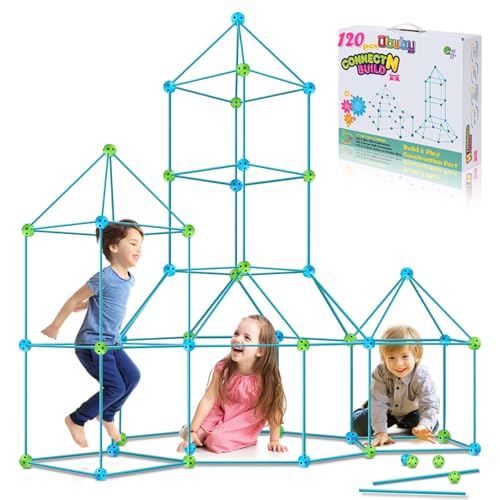
OBUBY’s fort kit provides 120 plastic pieces to craft forts of various shapes, from caves to castles. The construction process emphasizes quick assembly and disassembly, enabling flexible indoor and outdoor play. The kit includes a storage bag for easy transport, supporting collaborative building with friends or solo exploration of architectural ideas like space, shelter, and enclosure.
National Geographic Indoor Fort Building Kit

This 225-piece kit focuses on flexible construction for indoor play. The Flex-Tech hubs secure poles while allowing slight bending, enabling tents, castles, or dome-like forts. Durable components and included clips make it easy to cover structures with blankets or sheets. The design supports imaginative storytelling and spatial planning as kids explore various fort configurations.
Buying Guide: How to Choose the Right Building Set
- Age and skill level: Match kit complexity to the child’s developmental stage. Younger kids benefit from simple, tactile components, while older children enjoy more challenging assemblies and engineering concepts.
- Material and safety: Prioritize non-toxic, durable materials. Wood-based sets offer tactile feedback and a classic building experience, while high-quality plastics can support larger, modular builds.
- Open-ended vs. structured play: Open-ended sets encourage creativity and experimentation, whereas structured kits guide learners through specific models to introduce new concepts.
- Expandability: Consider whether the kit integrates with other sets or can be augmented with additional pieces to extend play value over time.
- Educational focus: Look for sets that emphasize geometry, physics, structural engineering, and problem-solving, aligning with school curricula or personal interests.
- Storage and portability: Kits with organized containers or bags help keep parts together and support on-the-go learning.
- Durability and upkeep: Reusable pieces reduce waste and encourage repeated experimentation, though some sets may need occasional maintenance due to wear or losses.
- Community and inspiration: Some brands provide idea books, online galleries, or challenge cards to stimulate creativity and collaborative play.
When selecting, balance play value with educational goals. For a beginner, a wooden plank system offers intuitive building and quick gratification. For advanced learners, kits with multiple models and realistic engineering concepts encourage iterative testing and problem solving. Pairing two or more sets can expand possibilities and sustain long-term interest in building structures.