Discover engaging building sets that blend play with learning. This guide highlights five standout options that appeal to curious minds and help develop engineering thinking, problem-solving, and coordination. Each selection offers varied play styles—from robot building and coding to classic brick building—ensuring there’s something for different interests and skill levels.
| Product | Brand | Key Feature |
|---|---|---|
| Karei Robot Building Kit | Karei | 3-in-1 robot with remote/app control |
| HISTOYE 51-in-1 Robot Kit | HISTOYE | 700 pcs; build 51 models |
| LEGO Speed Champions Ferrari SF-24 F1 | LEGO | Authentic Ferrari F1 replica |
| Parhlen 244-Piece Building Set | Parhlen | Electric screwdriver, 244 pieces |
| LEGO Classic Medium Creative Brick Box | LEGO | Extensive color palette and storage |
Karei Robot Building Kit: 3-in-1 RC Robot

Designed for ages 8 and up, this 700-piece kit lets builders assemble three distinct machines: a remote-controlled robot, an excavator, and a garbage truck. Each model uses synchronized gears, a flexible manipulator, and LED features to simulate real operation. The packaging emphasizes gifts for kids who enjoy tech and engineering projects, with a dual-control system that combines a 2.4GHz remote and a smart app. It supports path planning and beginner-friendly coding, helping kids learn tech skills hands-on while boosting hand-eye coordination and quick reaction times. Remote operation reaches about 15 meters from the user.
LEGO Classic Large Creative Brick Box 10698

This LEGO classic set centers on open-ended building with 33 colors of bricks, including windows, doors, baseplates, tires, and rims. It’s designed to foster imaginative play and storytelling as kids build houses, vehicles, animals, and more. The included storage box doubles as a play surface and keeps pieces organized for quiet time or classroom use. With the freedom to create anything, it supports collaborative play and long-term engagement, perfect for developing spatial reasoning and creative thinking in both boys and girls.
HISTOYE 51-in-1 Robot Kit
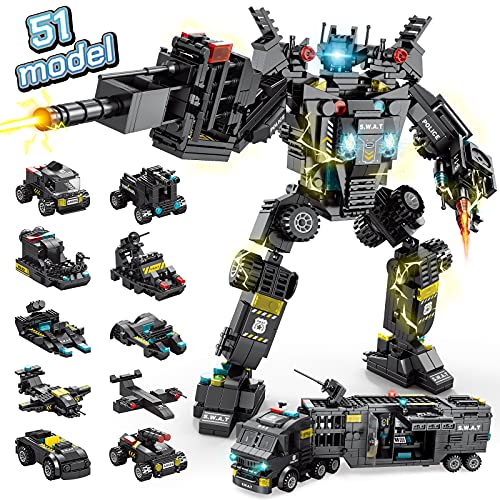
The HISTOYE set includes 700 pieces capable of building up to 51 different models, emphasizing STEM education through hands-on construction. Suitable for ages 8–12, the kit enhances spatial thinking, problem-solving, and logical reasoning as kids experiment with multiple configurations. The parts are designed to be compatible with expanding play—builders can add more blocks to create new models beyond the included set. This encourages persistence, planning, and iterative testing as kids explore engineering possibilities.
Fort Building Kit by SpringFlower

The SpringFlower fort kit offers 140 pieces designed to create indoor and outdoor fort structures. The set includes 30 magic balls, 64 rods, and 46 connectors to assemble caves, tunnels, teepees, and playhouses. The system emphasizes family collaboration and teamwork, with a simple build process that suits younger builders while remaining robust for larger creations. It also supports STEM-like play by encouraging planning, structural reasoning, and spatial imagination as kids design secure, expandable hideaways.
choopheme 10-in-1 STEM Toys

With 10 possible models, this kit focuses on engineering vehicles like excavators, bulldozers, cranes, wind turbines, and more. It targets kids aged 4–10, providing detailed assembly instructions to guide beginners while challenging advanced builders to diversify their designs. The kit emphasizes safety, non-toxicity, and easy storage, helping kids build confidence through hands-on projects, color and shape recognition, and mechanical problem-solving.
Buying Guide: Key Purchase Considerations
When selecting building sets for boys, consider age appropriateness, complexity, and learning outcomes. Look for kits that balance creativity with structured learning to sustain interest over time. Consider these perspectives:
- Age and skill level: Choose sets that align with the child’s current abilities and offer room to grow. Some kits scale up in complexity with additional models or coding features.
- Type of play: Do you want robotics and coding, classic bricks, or fort-building? A mix typically covers a wider range of interests and supports different play styles.
- Education value: Kits that include STEM concepts such as engineering, physics, or programming provide lasting educational benefits beyond entertainment.
- Durability and storage: Look for sturdy components and a convenient storage solution to encourage organization and reuse.
- Expansion potential: Some sets offer compatibility with other bricks or add-ons, enabling extended play and invention.
- Setup and maintenance: Consider whether the kit requires batteries or apps and how easy it is to assemble and disassemble for repeated play.
Product Comparisons
For a quick snapshot, consider these contrasts across the five picks. Karei emphasizes 3-in-1 robotics and remote/app control, ideal for tech-oriented builders. HISTOYE focuses on volume and model variety, challenging kids to test multiple configurations. LEGO Speed Champions delivers authentic model-building with display and play elements and benefits from LEGO’s durable bricks and familiar system. Parhlen offers an accessible power tool-assisted building experience with broad project themes and practical storage. LEGO Classic provides open-ended creativity with a broad color range and storage capability, encouraging long-term imaginative play.
Additional Considerations
Parents may weigh factors such as screen time, assembly time, and cost. Robotics kits like Karei can engage older kids in programming concepts, while classic brick sets foster collaborative play and storytelling. Fort-building sets prioritize imaginative spaces for group activities, and 51-in-1 kits push spatial reasoning by requiring kids to adapt to different models. Evaluating a child’s interests—whether they lean toward machines, races, or imaginative building—helps ensure sustained engagement and skill development.