Choosing the right bridge-building kit for a classroom helps students explore structural engineering, physics, and problem solving through hands-on exploration. The selected kits below cover a range of ages and complexity, offering realistic modeling of loads, forces, and construction techniques. Each option supports collaborative learning, critical thinking, and experimentation with bridges, towers, and other structures.
| Product | Brand | Key Focus | Pieces / Models |
|---|---|---|---|
| Thames & Kosmos Structural Engineering: Bridges & Skyscrapers | Thames & Kosmos | Force, load, compression, tension | 285+ pieces, 20 models |
| Learning Resources STEM Explorers Bridge Builders | Learning Resources | Real-world engineering concepts, fine motor skills | 9 challenges |
| Pathfinders STEM Kit – Bridge Building Kit | Pathfinders | Gears, pulleys, counterweights, working lift bridge | 1 functional lift bridge |
| V Generations Bridges & Buildings STEM Kit | V Generations | Structural engineering concepts, multiple models | 250+ pieces, 15+ models |
| K’NEX Architecture: Golden Gate Bridge | K’NEX | Large-scale architecture, long-span suspension design | 1,536 pieces |
Note: The table highlights core learning angles, from simple to complex, to help teachers align kits with curriculum goals and available class time.
Thames & Kosmos Structural Engineering: Bridges & Skyscrapers

This kit invites students to build 20 different models that demonstrate force, load, compression, and tension. With over 285 interchangeable building pieces and a comprehensive 36-page illustrated manual, it supports guided learning and independent exploration. The variety of models allows classrooms to rotate projects and compare structural strategies, promoting collaborative problem solving and application of real-world physics concepts.
Learning Resources STEM Explorers Bridge Builders

Designed to solve STEM challenges, this kit lets kids design, construct, and test bridges and towers through nine challenges. It draws from real-world engineering, introducing suspension and beam concepts while building critical thinking, planning, and testing cycles. The hands-on activities foster collaborative work in classroom groups and help students connect theory with tangible outcomes.
ROBOTIME 3D Puzzle Tower Bridge Construction

ROBOTIME’s Tower Bridge model blends 3D puzzle assembly with LED lighting to illustrate architectural detail and engineering aesthetics. For classrooms, it offers a visually engaging project that reinforces assembly sequencing, spatial reasoning, and patience. While educational notes emphasize design appreciation, the challenge remains accessible to teens with guidance and adult support, pairing creative craft with structural insight.
Pathfinders STEM Kit – Bridge Building Kit
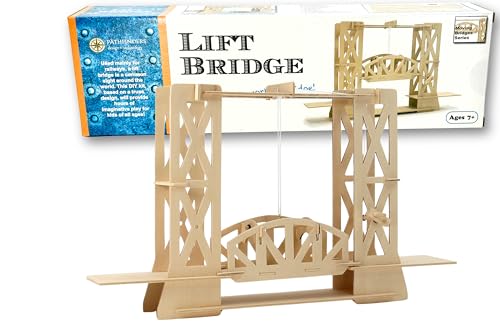
Children build a fully functional wooden lift bridge, bringing gears, pulleys, and counterweights to life. The kit is designed for a practical 60-minute build, offering clear illustrated instructions that keep students engaged and frustration-free. It supports classroom demonstrations of mechanical engineering principles and encourages teamwork, planning, and iterative testing to improve designs.
V Generations Bridges & Buildings STEM Kit

The V Generations kit includes 250 pieces to build more than 15 models of bridges and building structures. It emphasizes learning about science, structural engineering, and specific forces such as load, compression, and tension in an interactive way. The breadth of models supports diverse classroom activities, allowing students to compare construction strategies and explore scalability in design.
K’NEX Architecture: Golden Gate Bridge

This expansive build set recreates the Golden Gate Bridge at scale, with 1,536 pieces and a suspension design that introduces students to large-scale engineering concepts. The step-by-step instructions help learners master assembly while appreciating architectural details and forces at play in a complex span. It serves as an aspirational capstone project for more advanced classes or STEM clubs.
Buying Guide
- Curriculum alignment: Choose kits that map to core topics like load, tension, compression, and beam vs. truss concepts to support standards-based lessons.
- Age and complexity: Start with simpler models for younger students and progress to large-scale or mechanical kits for older students to match skill development.
- Hands-on vs. guided learning: Some kits emphasize independent exploration; others provide structured teachers guides and lesson plans. Mix approaches for diverse classrooms.
- Group learning potential: Look for kits that enable collaborative work, with roles for designers, builders, testers, and record-keepers to foster teamwork.
- Materials and safety: Ensure components are durable, non-toxic, and age-appropriate. Check for small parts in classrooms with younger students.
- Expansion and compatibility: Consider whether pieces integrate with other kits to extend learning and allow more model variety over time.
- Assessment opportunities: Prefer kits that include experiment logs, rubrics, or measurement activities to track progress and provide tangible feedback.
- Budget and availability: Plan for classroom sets or school-wide kits that fit a typical budget cycle and supply chain lead times.
- Accessibility and support: Choose products with robust documentation, teacher tips, and responsive customer support for classroom settings.
- Diversity of models: A mix of bridges, arches, towers, and other structures helps demonstrate different engineering principles and keeps lessons engaging.