Finding the right building blocks for a curious 5-year-old can boost early STEM skills while keeping playtime exciting. The following selections emphasize hands-on construction, color and shape recognition, fine motor development, and imaginative storytelling. Each option below offers sturdy pieces, age-appropriate challenges, and storage solutions to help tidy up after play. Use this guide to compare sets that encourage problem solving, collaboration, and creative thinking in classroom or family settings.
| Product | Pieces | Focus | Ideal For |
|---|---|---|---|
| Huaker Stem Building Toys | 180 pieces | STEM concepts, color/shape recognition | Kids 4-8, classroom or family play |
| Qirptey Kids STEM Building Toys | 125 pieces | Engineering basics, hands-on models | Kids 3-7, preschool to early elementary |
| Hiwawind Magnetic Blocks | 40 pieces | Magnetic construction, open-ended play | Young builders, STEM exploration |
| Soyee Diamond Magnetic Blocks | 58 tiles | Magnetic tiles, princess/city builds | Imaginative play, early STEM |
| BigShu Toddler Magnetic Blocks | Multiple parts | Magnetic rods and balls, 3D builds | Preschoolers to early elementary |
Huaker Stem Building Toys For Ages 4-8

The Huaker set provides a large 180-piece assortment in multiple colors and shapes, enabling kids to construct race cars, robots, trucks, and dinosaurs. A step-by-step instruction booklet helps guide early builders, while a large storage box facilitates quick cleanups after play. This kit is designed to support STEM learning through hands-on exploration, helping children recognize colors and shapes while developing logic and spatial thinking. It also encourages collaborative play as families or peers build together, aligning with classroom use for 4–8-year-olds. The broad variety of patterns supports open-ended design and imaginative storytelling, making it a versatile option for budding engineers.
Key features include:
- 180 pieces in assorted colors and shapes
- Instruction booklet for guided builds
- Large storage box for easy cleanup
- Supports color recognition, spatial reasoning, and critical thinking
Buying considerations: This set emphasizes group play and guided builds, but it also accommodates free-building sessions that nurture creativity. Suitable for homeschool or classroom centers, it’s a strong base for introducing basic engineering concepts through structured activities or free exploration.
Qirptey Kids STEM Building Toys 125 Pcs

The Qirptey kit includes 125 pieces in various colors and shapes, paired with an idea booklet that guides kids through models like race cars, robots, trucks, and dinosaurs. Designed for ages 3–7, this set emphasizes fine motor skills, problem solving, and imaginative play. It’s well-suited for classroom use or family projects, offering enough parts to create multiple models while maintaining manageable cleanups. The included instructions help younger builders stay engaged and learn to follow steps while also encouraging independent experimentation as confidence grows.
Key features include:
- 125 colorful pieces with an idea booklet
- Supports STEM learning and creative problem solving
- Encourages collaborative play and storytelling
- Adaptable from preschool to early elementary ages
Buying considerations: Choose this set for a moderate-sized collection that still supports cooperative play. It’s ideal for classrooms or family sessions where children can rotate through different assembly challenges and observe progress over time.
Hiwawind Magnetic Blocks 40-Piece Set

Hiwawind offers a compact 40-piece magnetic block system designed to ignite creativity with easy-click magnetic connections. Made from non-toxic ABS, the blocks are smooth and durable, offering a strong magnetic hold to support a range of shapes. This set emphasizes STEM basics—spatial awareness, problem solving, and basic geometry—through open-ended play. It’s especially suitable for younger children who benefit from the tactile feedback of magnetic connections and rapid build-and-test cycles that validate ideas quickly. The simple setup also makes it an appealing classroom tool for quick demonstrations or centers.
Key features include:
- 40-piece magnetic blocks with strong magnets
- Non-toxic ABS construction with smooth edges
- Encourages spatial thinking and early engineering concepts
- Ideal for collaborative play and quick STEM challenges
Buying considerations: The magnet-based design supports fast iteration and encourages trial-and-error learning. It’s best used as a supplement to larger block sets when focusing on magnetic-building activities or to introduce magnetism concepts before moving to more complex builds.
Soyee Diamond Magnetic Blocks For Kids
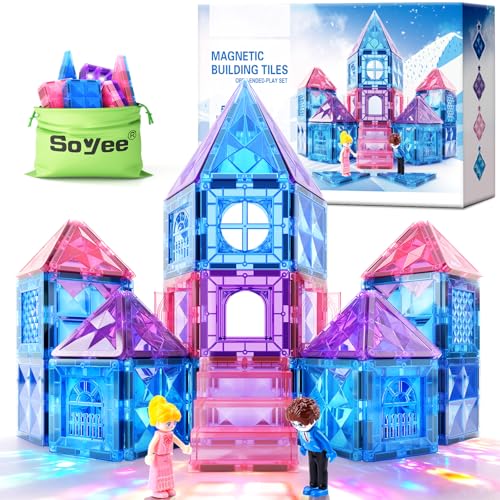
The Soyee set centers on diamond and square magnetic tiles to create princess castles and cityscapes. With 58 pieces, it supports imaginative role-playing and storytelling, while also enabling early engineering endeavors as children connect tiles to form walls, doors, windows, and stairways. The tiles are compatible with other magnetic blocks, allowing expanded play with existing kits. This option often appeals to children who enjoy pretend play alongside construction, offering a bridge between engineering concepts and fantasy narratives.
Key features include:
- 58 magnetic tiles with doors, windows, and stairs
- Safe ABS plastic with durable, child-friendly design
- Compatibility with other magnetic block sets
- Supports imaginative play and early spatial planning
Buying considerations: Ideal for the child who loves castles or magical worlds. Pair with additional magnetic kits to expand the play scenario and reinforce spatial reasoning through larger builds.
BigShu Toddler Magnetic Blocks

The BigShu set includes magnetic rods and balls designed for younger builders, with a focus on safe handling and large pieces that are easy to manipulate. The combination supports counting, sorting, color and shape recognition, and early geometry as kids assemble 2D and 3D structures. Its robust magnets help kids build sturdy models, which can bolster confidence during collaborative activities. The magnetic system also provides a natural introduction to engineering thinking as children experiment with balance and structural stability.
Key features include:
- Magnetic rods and balls for 3D construction
- Non-toxic, durable materials with strong magnets
- Supports counting, color and shape recognition
- Encourages imagination and hands-on problem solving
Buying considerations: A strong option for younger ages ready to explore with larger, simpler constructs. Use this set to build confidence in planning and executing multi-step designs before moving to more complex kits.
Buying Guide: Key Purchase Considerations And Comparisons
Selecting the right blocks for a 5-year-old involves balancing creativity with skill-building. Here are factors to consider when choosing a set:
- Age appropriateness: Ensure the pieces are sized safely for early elementary children and not overly small to minimize choking risks. Look for sets labeled for 3–6 or 4–8 to cover the typical 5-year-old range.
- Open-ended vs guided play: Magnetic tile sets and large-piece blocks support open-ended construction, while instruction booklets offer structured activities that help beginners follow steps and build confidence.
- STEM focus: Choose sets that cultivate spatial reasoning, counting, problem solving, and basic engineering concepts. A mix of color/shadow recognition and geometry helps develop math readiness.
- Storage and cleanup: A sturdy storage box or bag is valuable for teaching responsibility and keeping play areas organized. This is especially important for classroom settings.
- Compatibility and expansion: If possible, select systems that interoperate with other kits. This enables longer-term use as skills advance and play scenarios grow more complex.
- Social play: Kits that promote collaborative building help children practice communication and teamwork. Consider sets with enough variety to allow multiple kids to participate at once.
- Materials and safety: Look for non-toxic ABS plastic and smooth edges. Strong magnets should be sealed properly to prevent disassembly during play, while avoiding sharp corners.
In sum, the best choice depends on the child’s interests—whether they lean toward castle-building, car design, or abstract geometric structures—and the setting, whether at home, a classroom, or a daycare. A combination of larger, easy-to-handle pieces with occasional guided activities can sustain engagement while gradually introducing more complex building concepts.